Date: November 29th, 2010
I just realized that I’ve been skiing now for 40 years, a hell of a long time. I sorta even remember my first few sliding steps as a kid, it was fun, and even after 40 years I still just love going skiing. I’ve had some side trips into snowboarding (best sliding tool ever for crusty or weird conditions!), but overall it’s always been about skiing of some kind for me. I started out in little leather boots with cable bindings, then mountain touring on three-pin bindings, then a few years of resort skiing on alpine gear, then some XC racing, bunch of telemark skiing (a couple of pretty serious decades in there), then AT gear with ice climbing boots to get to ice routes in Canada. Skiing is a tool, recreation and just fun. But I’m done with modern “tele” skiing.
About six or seven years ago I did a long ski into an ice route in the Adirondacks with my friend Will Mayo. He was on AT gear, I was using some decent tele gear that I’d borrowed. Mayo is a good athlete who truly knows how to ski (he raced XC at one point also), but I got incredibly pissed off that I was having a hard time keeping up with him on my tele gear. We were on wax as it was cold, not skins, and I just couldn’t get a good kick because the damn “bill” on the tele gear prevented the boot from flexing properly. Will, on his AT gear with ice boots, could get a great kick and use far better technique as he could also ride the ski with his leg vertical over it instead of having his lower leg canted forward in the stance most tele boots induce . I about hucked a lung chasing him, and cursed the tele gear for what it had become: a great thing for riding chairlifts and skiing down, but useless for actually traveling in the mountains. This struck me as somewhat ridiculous; how did equipment that had, in my childhood, been a great way to travel in winter become so useless for anything but going down?
Then I had a day where I skied out from an ice climb in my ice boots. There was a nasty breakable crust, some heavy whipped snow, and other junk. With my heels locked down I could get through it reasonably well; it would have been a pain in the ass with any but the heaviest tele gear. The light went on, and I sold all my tele gear that year.
Modern light AT gear is now more efficient, lighter, and allows more confident and functional skiing in any situation I can think of when compared to tele gear. If a day involves more up and down than flat terrain I’ll use my Scarpa F1 boots, light Dynafit bindings and Black Diamond Guru skis. Somebody is going to argue that modern tele gear is better, but the bindings and boots are still heavier for an equivalent amount of function. The BD O3 and other bindings at least have hinges to allow for a more efficient stride on the flat, but locking your heel down just results in more skiing control and function for less weight than any tele combination going. End of story, tele is dead unless you have a goatee and ride a “Fixed” gear bike (which, by the way, always reminds me of neutering a dog–what’s up with that name?). Tele is now about style, not function. Snowboarding is a pain in the ass in the backcountry but at least has some useful function in junk snow, tele skis don’t even have that benefit.
So what to use?
I’ve done a few of these “ski mountaineering” races, and they are a lot of fun. These races are mainly up and down, so light AT gear makes sense. Some AT courses could probably be won by a good Nordic racer on nordic gear, but there are gear limitations in the rules, and most of the courses have serious enough terrain that AT gear is for sure faster. If your object is to “yo yo” up and down then I’d say light AT gear is the way to go. If you want to huck your meat in the back country then heavier AT gear rules. Some people are into the “it’s all about the down” idea, but I’m still enough of a geek to enjoy trying to ski on light AT gear.
At some point skiing becomes more about skill than supportive equipment. Little kids can’t stand on their skates well until they learn to balance, and I see many skiers who can’t ride a flat ski without a lot of support. Many of the best heli-ski guides I know don’t even buckle their AT boots; they just ride the board well, and ski smoothly. That seems logical to me. I am not a great technical skier by any stretch, but years of XC skiing and skiing around in the mountains on ice boots have given me some decent survival skiing skills. I still remember a Swiss guy named Michele absolutely shredding steep gullies on ancient, narrow Fischer XC skis and some 3-pin bindings 30 years ago. I don’t know many people who could ski terrain like that half as well today. At some point skill at actually skiing trumps the gear. My friend Pat Morrow is a die-hard tele monster, and although not a young pup anymore he can hang with pretty much anyone in any steepish terrain. The point is that anything will work, but what’s the most functional for the weight?
The logical setup for big glacier tours without really difficult terrain is, in my opinion as always, the NNN gear. Every couple of years a few friends and I go down the
full Wapta traverse in a day. We’ve tried several different setups, but the NNN gear is by far the best for this type of skiing. People often ask me, “But don’t you need big boots and AT gear in the mountains?” I first skied the Wapta when I was 12 on light leather boots with little cable bindings that allowed for a decent kick; the whole setup probably provided far less support than modern NNN gear. Heavy AT gear is overkill in almost any situation I can think of except lift-served or heli skiing terrain.
What made me think of all of this is that I just got home from London, where the trees still had leaves, and found a foot of snow on the ground here in Canmore. It’s time to SKI, and I’m still as stoked about that ideas as ever. Skiing is fun. Even if you’re a bark-eating, meadow skipping face-planting tele skier. See you out there, let’s get the turns ON! And it’s ice season too, options again!
PS–Roger Strong is an exception to all of this.
Posted in: Blog
Date: November 15th, 2010

 I’m really psyched to keep receiving photos of the Plywood Ice “Plice” that people are building around the world, really cool! I recently wrote an article for Climbing (out soon I think) about training for steep ice climbing; the gist of it the article is that climbing a lot of ice would be the best training, followed by some sort of wall (plice), followed by replicating the movements (which we can all do on the playground or with any brick wall out there) followed by weight room training. Periodization (focusing on when to peak, rest, refresh, build and so on), like any sport, is important to prevent burnout and injury, but most performance gains for ice climbing come from skill and muscle recruitment, not pure strength.
Anyhow, here are two more pictures, psyched for everyone getting it on!
The season has started here in Alberta; I haven’t been out ’cause I broke my finger, but I have been training on my own plice with a wrist loop, all good!
Photo Credits: Hagen and Taylor
Posted in: Blog

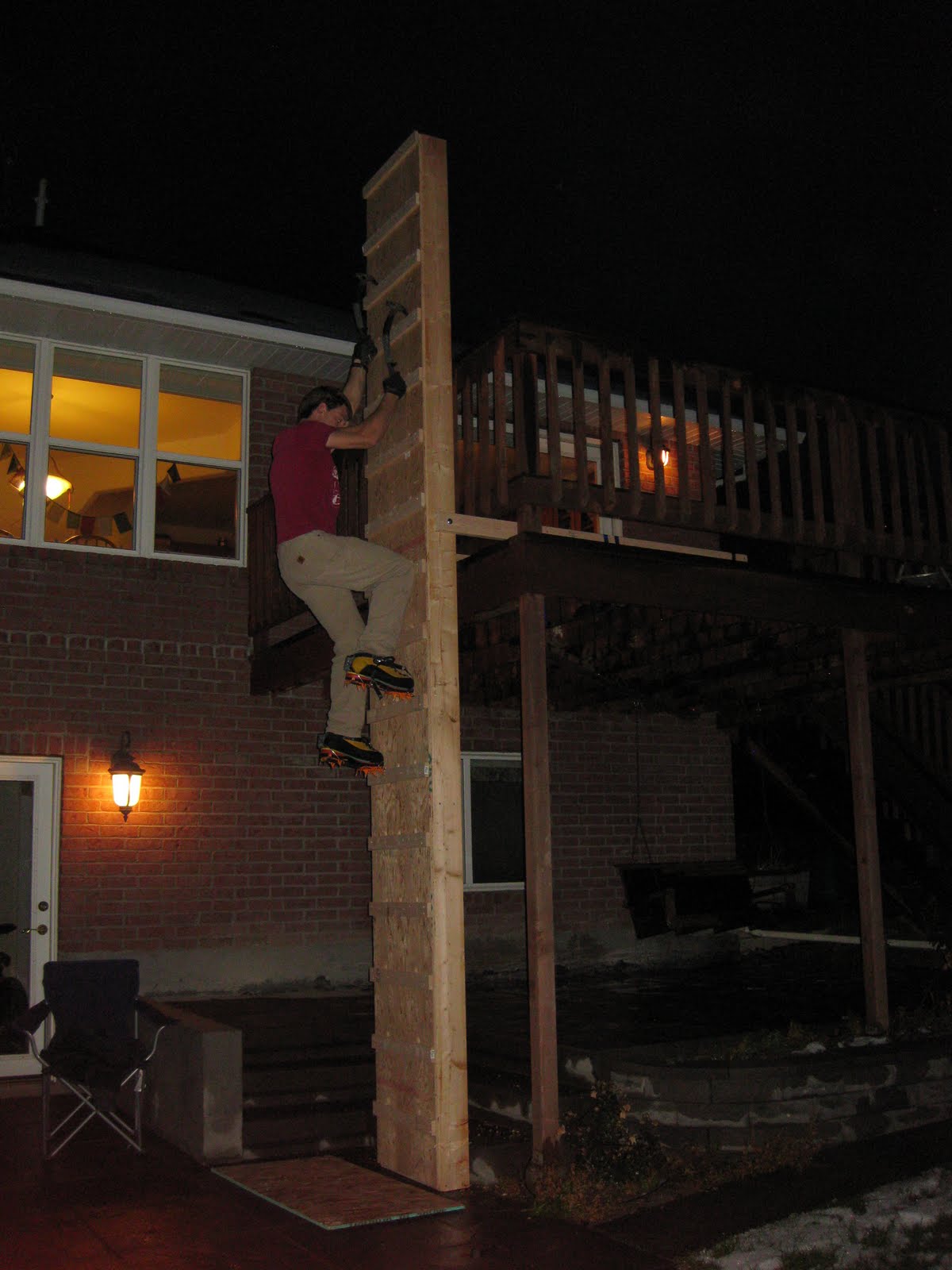 I’m really psyched to keep receiving photos of the Plywood Ice “Plice” that people are building around the world, really cool! I recently wrote an article for Climbing (out soon I think) about training for steep ice climbing; the gist of it the article is that climbing a lot of ice would be the best training, followed by some sort of wall (plice), followed by replicating the movements (which we can all do on the playground or with any brick wall out there) followed by weight room training. Periodization (focusing on when to peak, rest, refresh, build and so on), like any sport, is important to prevent burnout and injury, but most performance gains for ice climbing come from skill and muscle recruitment, not pure strength.