


Wall of Walls
Date: 10th June 2026
They say nothing good happens at 2 a.m., so why is my alarm blaring at me to get up, again, and go risk my life climbing savage ice in a valley guarded by some of the most serious avalanche terrain I’ve ever seen? It makes no sense, and that realization holds me down in my warm, safe bed as if I’ve dropped a heavy barbell onto my neck.
But I know Kirk is awake too, so I must lift the weight and get moving. The house where my wife and kids are still sleeping is cold, but much warmer than the frigid Rocky Mountain night I’m heading into. It’s -20°C and the December sun won’t be up for at least another five hours. Outside, my truck is carefully loaded with everything we could possibly need for the day ahead: winches, ice tools, a drill, a rock rack, snowshoes, skis and a snowmobile. No matter what happens, I’m certain we’re going to have an all-time adventure. I grind some coffee beans as quietly as I can, remembering stories of Alex Lowe (1958–1999) doing the same under a down jacket silencer. Coffee in hand, I grab the bag of pre-made burritos from the fridge, check the list and go before inertia sets in.
Kirk Mauthner lives in the Columbia Valley, on the west side of the Canadian Rockies, and my home is in Canmore, on the east side of the mountain range. Somehow, we’d never tied in together, but three years ago I called him up to ask about a potential new route I’d found, inadvertently launching a beautiful, shared obsession. Up here, Kirk is a legend.
He’s done more new ice routes than anyone else, developed a lot of rescue tactics and gear used globally and guided all over the world. Having spent more than forty years exploring the Canadian Rockies and Kootenay, he of course knew of the route I was asking about and said it wasn’t very good. But there was something else he’d come across while scouting in his “Super Super Cub” that he wanted me to see, something special—was I interested? Yes, when do you want to go?
I’ve spent most of my life as a professional athlete, traveling the world in search of the biggest and best ice climbs, from the radical spray-ice routes of British Columbia’s Helmcken Falls to China, Norway and South Africa. I’ve climbed the tallest frozen waterfalls in the world, chasing ice dreams like a Lab running after a tennis ball. But I also have a family, kids and a wife, and a list of more than two dozen friends who have died in the mountains. I’ve watched a life-time of mountain sunsets, and I’ve been to so many funerals that they blur together. I talk about risk with my kids, and even with the people running nuclear power plants as a guest speaker. I wrestle with the question of life and death every time I go out the door to climb, fly, paddle, ski or cave, which I’ve done two to five days a week for going on six decades. I’ve done CPR on fallen climbers, pilots and paddlers in some of the most beautiful places in the world. Is it worth it? And why am I still alive when so many others aren’t? I’m working on that answer every day, and some of it is taking shape in the form of a book, roughly titled Surviving and Thriving in High-Hazard Environments. Throughout the writing process, I’ve spent a lot of time digging into different ideas on risk management as I try to better understand how I handle dangerous situations.
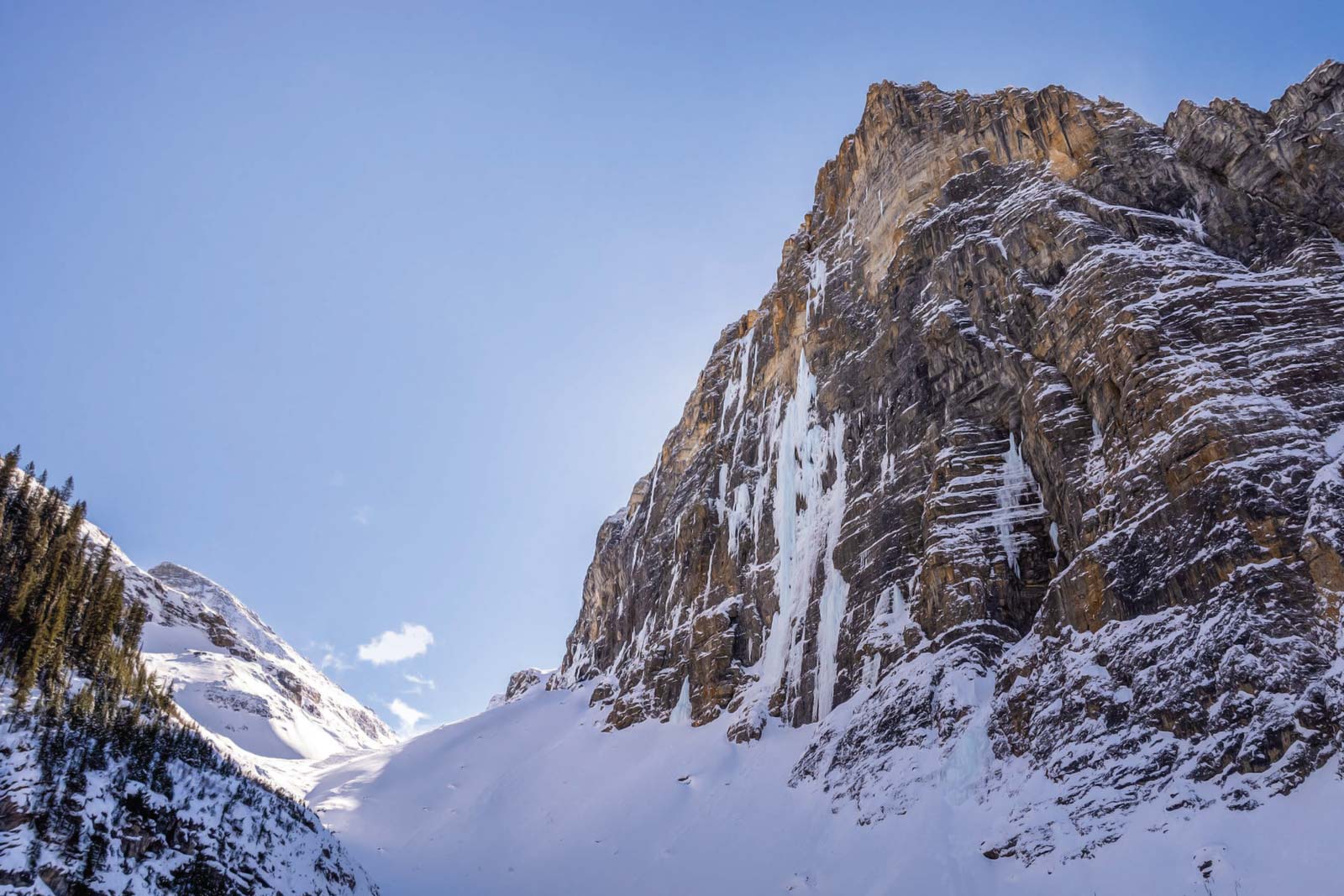
I’ve sort of sworn off huge new alpine lines many times. Too many dead friends, too much risk, too much work. But Kirk sent me a photo of what he’d seen from his plane, and I could see the wall was clearly special. These routes would be really hard to find without a plane. They aren’t visible from any viewpoints, and there are no winter roads leading to them; they are just a series of massive blue exclamation points on the back of a mountain with no paved roads anywhere nearby. If you’re an ice climber and aren’t excited by blue lines ripping into the sky, then it’s probably time to hang up your tools.
But just getting there is truly an epic: a two-plus-hour drive followed by snowmobiling up an inactive logging road, then skiing into absolutely huge terrain. After four to five hours, you finally see it: strips of blue punching up a wall far bigger and consistently steeper than anything else I’ve ever seen. I was lucky Kirk asked me to join him there; I could never have dreamed of something so wild so close to home, nor did I have the Kootenay skills to reach it. Kirk did. On our first trip in, I stood there with Kirk and didn’t even know what to say beyond “Wow.” As we picked a line up through the loaded terrain, the wall just grew above us. It seemed beautifully dreamlike, or maybe a nightmare waiting to happen. There’s a lot less distance between those experiences than most want to admit, until they’ve lived both.
The first hour and a half of my solo drive to meet Kirk is usually spent listening to risk-management audiobooks. Today, Dr. Todd Conklin’s voice comes through the speakers of my truck as he reviews how fatal accidents are unpredictable, except in hindsight. Conklin explains that the model of using prediction to prevent accidents simply does not work. Well shit, that was my primary strategy! Where I’m going today, there are literally tons of lethal hazards, from avalanches to collapsing ice pillars to loose rock, all of which we must successfully predict in order to survive. I turn off the depressing audiobook and switch to some random playlist, turning the volume up to an unhealthy level. “Guess I’m gonna die too young, too young …” sing the Stop Light Observations—not helpful. My mind wanders, reviewing a list of friends gone too young in the mountains. Am I different, better at what I do than they were? I must think so, because I sure don’t want to die, but here I am, and there’s no place I’d rather be. Hello, dissonance, my old friend…
I turn onto the road used by mining and logging trucks and Kirk is, of course, already there, smiling in my headlights. He’s always there, and I sure am glad to see him. Shared madness is easier to carry. Other partners might bail occasionally, but Kirk never does, not in twenty-some epic trips we’ve now taken here together. We exchange a quick hug, but each minute is precious and we need to keep moving. We both drive alone in case a logging or haul truck runs us off the road. Our two vehicles add capacity, or the ability to handle the unexpected—in this case to help each other out on the dangerous road. The radio crackles: “Fifteen down”—a trucker indicating their position on the road. Kirk’s calm voice replies, “I’ll pull over at 14.5 left.” Shit. We’d hoped to be off the road before these trucks were active, but we’re not, and this can honestly be the scariest part of the day for me. A many-ton truck filled with logs or rocks or whatever howls by in a loud roar, and we pull back out—but why is there a six-by-six rack of light bars coming down fast on us?! Kirk’s back on the radio, ditching into a small turn-out, and a huge truck flies by with no fucks given but a laconic “Thank you, gentlemen” over the radio. They have a schedule to keep too, and ice climbers aren’t on it. Nobody is up this early who doesn’t have a schedule to keep.
Forty minutes later we’re sniffing two-stroke mix in the dark. I manage to unload my new-to-me but well-used snowmobile out of my truck bed without bleeding or even breaking any plastic truck or sled bits, both a first. I don’t know what I’m doing, and I hate being incompetent, but this is Kirk’s Kootenay world, and I have to learn it if I want to climb the best new ice lines of my life. By the time I’ve strapped my skis and pack onto the sled, Kirk is, as usual, waiting for me. He does that a lot. Normally I’m decently fast at what I do in the mountains, but these mountains play by Kootenay rules, meaning there aren’t any. I acquired this sled and a loading ramp that doesn’t really work right just to access these climbs, and it’s worth it. Kirk hits the throttle with the classic braaap! and disappears up the snowy road at over 100 kilometers per hour. I want to match his speed, but I only go to thirty. I hear Conklin’s voice in my head explaining that to survive unknowns, you need capacity to handle what you didn’t plan for. I have no capacity to pilot an out-of-control snowmobile at even fifty kilometers per hour because I suck at sledding. I can’t predict when I might lose control. And if I do, I’ll crash into the trees or worse for sure. So, thirty it is. I hate sucking, and I suck at this, but I hate crashing more, so Kirk has to patiently wait. I only crash once, slowly, not bad.
The dark of a midwinter Canadian morning still rules as Kirk and I park our vehicles amid the kind of complete silence you only encounter in the remote mountains. We pull off epic layers, hoist our fifty-pound packs and start marching up a steep hillside. Kirk shows me how to carry my skis through the shoulder strap of my pack, and the bindings dig into my shoulders like a sadistic masseuse. I can’t seem to get it right, but keep moving, moving. Skis on, we slide through darkness so complete that when I turn my headlamp off the entire Milky Way looks like a light show over my head. It’s a privilege to see it, a sight no one in a warm bed will ever experience. This is worth it.
“Lot more snow since we were last in here,” says Kirk, verbalizing change, a practice that is critical in high-hazard environments. “Consistency change, new wind slabs here,” he says as we exit the trees an hour later. The first bits of morning light begin to illuminate mountain shapes beyond the glow of our headlamps, which we need to judge hazard. We’re on schedule. Kirk and I talk nearly nonstop—“It hasn’t slid again. What do you think?” “Shit. Maybe up toward the rock rib?”—as we read the terrain and question what we’re thinking and seeing.
Annie Duke, a decision-making expert and former professional poker player, writes about the importance of “truth seeking,” of checking your own assumptions with impartial peers. Kirk and I need honest reality or we get killed, so we’re a truth-seeking group of two, and we listen to each other carefully. Kirk understands the snow here maybe better than anyone on Earth, but even good guides and knowledge-able people will die in this year’s tricky snow-pack. There’s debris from a size 3+ avalanche (big enough to destroy houses like a freight train going through a Corolla) in the gully we’re skiing up, and we like that: it means less above us. Kirk reads snow like others read pizza menus. “Hmm, this blew down instead of up when the storm came in,” he says as he assesses the terrain. “Cross-loaded.” We head toward a spine that’s been blown free of snow and could offer safe passage to the raddest ice lines ever, glowing blue above us.
We’re nearly on the bare spine leading to our route—less than fifteen minutes away—when we see an immense wind slab running across the entire feature above us, a monstrous, spring-loaded trap waiting for an unwary ice climber to trigger it. The snow under it is like sugar, loose and weak. Slabs over facets are really bad (avalanche safety 101), and we’re poking at a kilometer of both. I have decades of experience in the mountains and professional-level avalanche training, but Kirk sees the hazard way before I do.
“If we toe-trigger this slope, it could go HUGE and run both above and to the sides of us and blow us right back into the gully—sure death,” he says. We look over at the short patch of snow leading to the safe rib, and up at the huge slope below the ice. When I was younger, I probably would have gone for it, gotten away with it and felt good about my decision. But I’ve seen the aftermath of slides enough now to want better margins, not to just get away with it until I don’t. The research from psychologist Paul Slovic and others is clear: we discount hazard when we find meaning in doing some-thing. These routes carry deep meaning for both of us, but we also know what happens when things go bad. Kirk and I talk a little, but we’re already pulling our skins off to start descending. It’s not worth it, and we know it. Our failure ratio here is around five fails for every new route we do.
On the way out, Kirk teaches me how to lean and counter-steer my sled, and we spend an hour going in circles, learning, learning, learning. I don’t distinguish myself, I’m not a power sports guy, but learning is an essential part of building capacity. Capacity is essential for better outcomes. If I had to point to one reason I’m still alive today, I would say it’s because I’ve had good teachers, and I’ve worked as hard as I can to learn from them. We drive the sleds slowly back to the trucks, as I practice recovering if I get off track. I feel better about it. I know that on the next trip I can recover from forty kilometers per hour. Every day you learn something is a good day. I’ve learned a lot, and although we failed to climb our route, we succeeded in surviving and learning. Those are the rules we play by.
Throughout my career I’ve been envious of those who enter the mountains like wolves. I remember a predatory look in the eyes of Ueli Steck, Alex Lowe, Tomaž Humar and Marc-André Leclerc. It was as if they saw the mountains like a wolf sees prey, and it was in their nature to hunt. They are all dead. Still, I envied their clarity. As for me, I worry, nerd out, read and practice the best risk management I know, but I also know how fallible we all are. Risk researcher Michael Mauboussin’s “Skill vs. Luck” equations haunt me with the truth that we’re seldom as good as we think we are. We ascribe good outcomes to our amazing skill, and bad outcomes to bad luck. I know this intellectually, but can I live it? Kirk and I spend a lot of the time skiing in and out talking about risk, mountains and life. It is time well spent even if we never swing a tool. Is it all worth it? I’ll get back to you on that after I die.
A few weeks later I’m a third of the way up a 1,000-foot wall with two short, poorly secured screws somewhere far below me and my tools stuck into only half an inch of sublimated ice. If I pull too hard on them they will rip out. But my mind is calm, clear, and I know what to do here because this is what I’ve spent forty years of my life learning how to do. I have the skill and capacity. A gentle test tug, weight shift, high step onto a natural ice edge, rock over and flick another tool. Sparks fly as my tool hits rock through a veneer of detached ice. Rebalance, breathe, is this worth it? It is. For a moment I’m a wolf, and wolves hunt. I’m hunting with full commitment and calm ferocity; there is no fear, just focus and hard-earned competence. After 100 feet of thin ice, the sparks subside and I step out of the vortex of total focus I’ve been locked into and build a protected belay. Kirk joins me and we talk about the pitch, how serious it was. We used a fixed-point belay because if I’d fallen off, I would have gone a minimum of fifty feet, and possibly 200 feet or more straight onto the belay if the gear had blown. Kirk once caught a 200-foot factor-two whipper on a fixed-point belay. That fall, plus the results of load testing he conducted on a drop-test tower, changed the belay world. We are doing dangerous things as well as we know how, and Kirk brings more capacity than most to the hunt.
Before we start the next pitch, it begins lightly snowing and immediately the spindrift starts up. Spindrift is snow transport; snow transport builds slabs, and natural slab releases kill climbers. Even a small slide can knock the leader off a route. Kirk and I don’t talk; we just start rigging the ropes to go down. Every flake above collects, multiplies and lands on the slopes above and beneath us. We have to be ahead of that curve: if the slab below builds, it could kill us on the ski descent. As we switch from climbing boots to ski boots at the base, a significant sluff buries everything. Sometimes you get direct confirmation that your decision was good, and today is one of those times. If that had come down while I was on lead, I likely would have been knocked off and, at a minimum, broken some bones. Or I might have died a hard cold death in the long night. Bold wolves die. I led the pitch, but Kirk, who teaches and is known as the best in the search and rescue business, added capacity to survive if something went wrong—which it always does, eventually. Occasionally I’m a wolf, but wolves hunt in packs for a reason. We are a pack of two, far stronger than we are alone.
A week later we’re back again, and this time I put a bolt in on lead to protect the worst of the thin ice section. It’s still delicate, intense and run out, but way better—likely only “hospital” consequences on the scale my kids and I use to rate risk (bumps and bruises, hospital, death). We’re all running risk-management plans. If we don’t have a plan, we can’t judge risk, and can’t take good risks to do great things in life. But dying is not cool; nor fair to Kirk or to our families. Strict ethics around route development are for people with limited climbing resources who need to play games to make it harder, or who need to preserve limited stone. I live by local ethics in those places, but we don’t have a shortage problem here in the Canadian Rockies, nor is rescue a short ride away. Even with a bolt or two, the hazard level is still orders of magnitude higher than what would ever be tolerated in any of the industrial sites I speak and work at. Annie Duke writes about how good and bad luck are both inevitable from a statistical perspective, but we all think we’re going to have good luck, or we wouldn’t gamble in the mountains or in life. I have had a lot of good luck, but I know it won’t hold forever. And yet, if climbing like this was totally safe, it wouldn’t be alpine climbing. We’re here in part because of the uncertainty, the meaning we find and the joy of solving complex, high-consequence problems. But for me, danger in the mountains is a spice I add on top of dinner, not the meal itself. A climb should be beautiful, spicy and all-consuming, not just a roll of the dice. A bolt or two in an ocean of rock seems like a reasonable compromise. You die, you lose—and losing sucks.
Hours (which feel like days) later, we’ve climbed higher and I’ve cranked through a wild mixed traverse amid delaminating ice, placing one bolt on lead while hanging from a tool skating on an edge, plus some cams. I know I’m through the crux of the line and that another couple of hours will get us to the top. I’m worked, but still feel pretty strong. But Kirk is frozen; my lead took too long, it’s late at night and we have a huge descent below us. Kirk calls it and we start heading down. One of my rules is that if one person isn’t feeling it, we bail, no questions. That rule has directly saved my life at least twice. As we begin the descent I wonder in my head if we should have pushed harder. We were almost there. But we bobble our devices while rigging rappels with cold hands and tired brains, fix each other’s errors, and trust one another in a way that likely never happens when lives aren’t on the line. Errors are normal. We catch and fix them for each other with a tired “Thanks” that goes way beyond the word.
On the second-to-last rappel of many, the ropes get stuck, likely because we were tired and sloppy while rigging them. A few snow-flakes float by, adding urgency to our fatigued minds. We both use every trick we know to free the ropes, headlamps waving in frustration into the air above us, but it’s a no-go. I rig up, Kirk J-loops the ropes into the belay (prob-ably not needed, but relying on probability leads to death) and I climb up using what we have, which is enough. I don’t mind the dark—I’ve done a lot of caving—but we’re still a long, long way from home when I get back up to the rap station and flip the rope that had caught on an edge. I’m absolutely wrecked by the time we get to the safety of the valley.
That same week, two very competent local climbers were at the top of Canada’s most famous alpine ice zone, the Stanley Headwall, starting their rappels, when the first climber somehow lost control of the ropes and fell to his death, taking the ropes with him. The remaining climber spent the night alone at the top of the route, with his deceased friend at the base, before he was rescued. Did we avoid that fate by calling our day a little early and leaving a little capacity in the tank? Maybe. Or maybe we just got lucky and they didn’t. They were both as solid as we are. On the drive home I down Red Bull number four while pondering the amazing highs and lows of climbing, the same Is it worth it? question never far from my brain.
During that first year of exploration, we call the wall the “Super Stanley!” because it’s way bigger than the Stanley Headwall. Trip after trip, we oscillate between failing and climbing world-class routes. We name the first route Enduro because, well, that’s what it is. We run sixty- and seventy-meter pitches upward and do the math: the wall is more than twice the size of the Stanley Headwall’s most famous ice route, Nemesis.
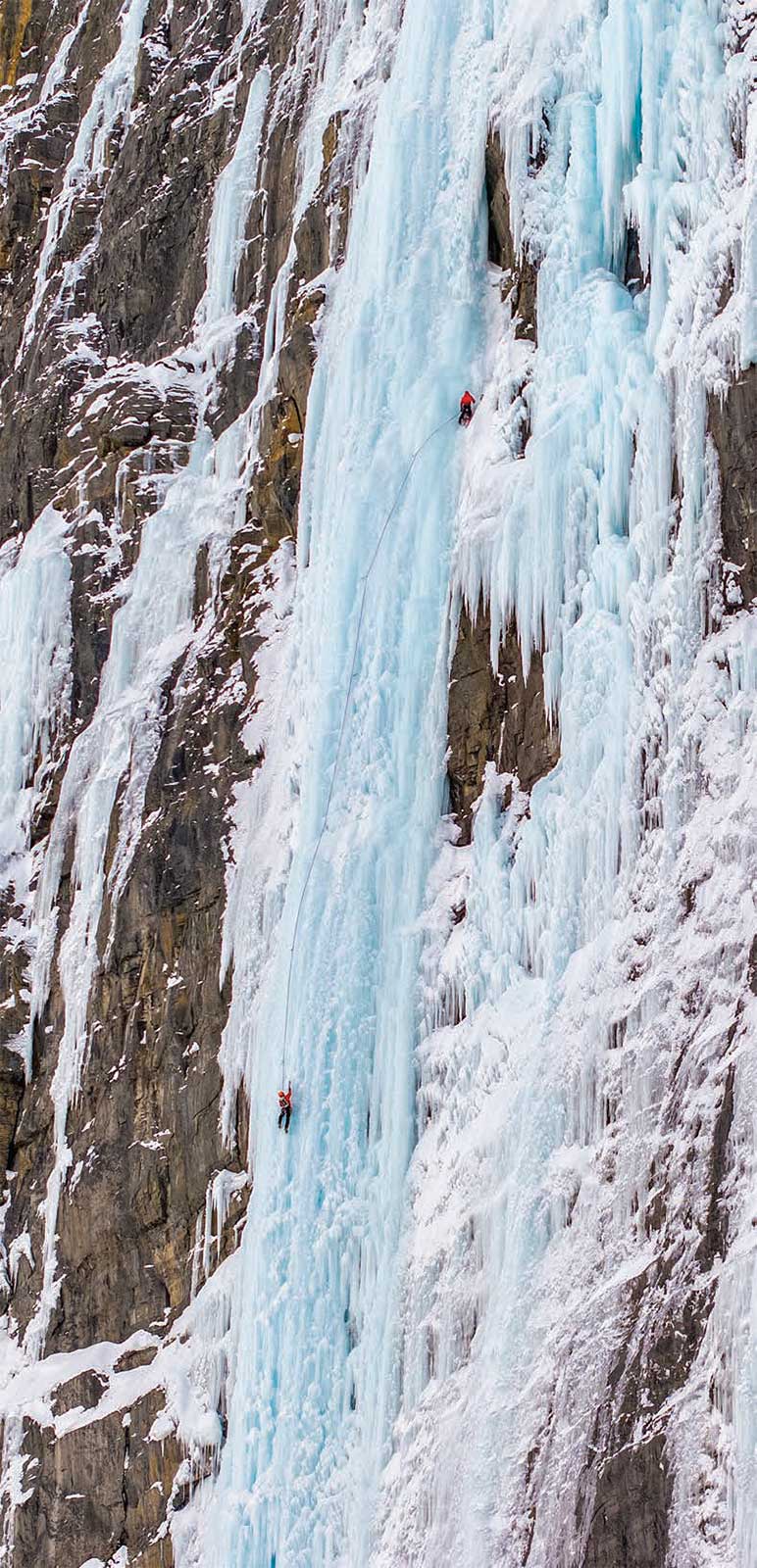 The second year, we finish off two routes before the snowpack gets too hideous to brave and rename the feature the Endurance Wall, because it’s proven to be just a different beast from the Stanley. You have to ENDURE. You can be at the base of Nemesis two hours after leaving Canmore. It’s five hours minimum to the base of the Endurance, with a lot more complicated terrain. Once, while guiding the uber-classic WI6 Pilsner Pillar, I realized you climb about ten of those to get to the top of the Endurance Wall. And Pilsner is only steep for about twenty-five meters, usually well traveled and thirty minutes from the road. The Endurance Wall is really steep for the vast majority of every pitch, and you are OUT there. The only ice routes I’ve ever climbed at this level are in Norway, and they didn’t have the avalanche hazard to get there, nor the approach, nor the poor ice quality. These are the biggest, most complicated and most sustained climbs I’ve ever done in my life. Every one of the thousands of climbs we’ve ever done gives us a puzzle piece to do what we’re doing now.
We name our second route Relentless because it truly is. Pitch after long pitch of techno-funky ice mayhem, with caves to hide in as tons of ice rains down from above. Every swing drains the battery, and if even one stick of your ice tool is bad, you’re going to take a huge fall on less-than-optimal gear. The ice is made up of layers of water and snow, crystal petals stuck together with more crystal glue, frozen water. The climbing is a battle, requiring five to ten swings for every tool placement. It is relentless, steep, rad climbing, like a buffet of everything you ever wanted in life and ice climbing, all at once. We feast—and bleed from the shards flying back at us.
The third route is awesome, just gorgeous climbing, and we somehow get lucky and send it in only a couple of tries. It’s everything any alpine ice climber could ever want. We know how special it is because we’ve both been climbing forever. I’m fifty-eight. Kirk is two years older. We qualify for senior discounts. As we reach the top we talk and are filled with deep appreciation and gratitude that, at this stage in our lives, we can still climb at a reasonably high level together in this magic place. We acknowledge how lucky we are to have the time, fitness, freedom, resources, experience and stoke to climb these amazing lines. We call the route Infinite Gratitude, because that’s what we feel.
Things change during our third year visiting the wall. Previously, we’d fit our trips into whatever free time we had, but now we’re fully committed. Kirk and I sync our schedules and both turn down good, high-paying work to keep our time free for the rare windows of snow stability. Freedom is worth more than money if you have enough of it, and it doesn’t take much to be enough.
Up to this point, we haven’t talked about our area publicly at all. As a professional athlete I’m supposed to spray about the rad shit I do, but in this case we just don’t. These lines are special experiences that we know mark highpoints in both of our long careers. I share what we’re doing with a few close friends, but even they don’t get to know where we’re doing it.
As the season starts, we realize we need to be faster getting in and out, and spend a full day building a trail. The path also helps us avoid more of the avalanche terrain. By adding margin and saving time, we’re adding capacity for unpredicted events. We’re also not comfortable being on the climbs with no safe way down the huge avalanche slope if it snows. So, we build a bolted traverse line that allows us to ski up and down on belay. Always have a way out. Trip after trip, learning, learning, working together, figuring it all out.
The last line is the steepest, thinnest and wildest looking—improbable, sexy smears up a ridiculous set of features. Kirk and I start calling the whole wall, simply, “WoW,” short for the Wall of Walls. No matter how many times we ski into the valley together, that’s what we always say when we see it, it’s just that big and cool. We wanted to finish the four most prominent lines on the wall before going public, and this is the last one. But it snows. Then the temperature drops to -30°C. And it snows again.
We run away more than 50 percent of the time, even with our improved approach. The ice is sublimating, and eventually it won’t be climbable. We find an alternate start. The trail is better. We ignore the other good but smaller lines in the valley, focusing on the remaining big rig even as we run away over and over.
Our friends Josh Lavigne and Alex Taylor put days in freezing their asses off to get the shots you see here, and it’s a comfort to have someone else in the valley watching. I normally bring camera people up to get the story, even on big routes, but on the WoW it’s simply too big and wild for me to feel good about that. I’m willing to roll the dice with my own life, but not other people’s lives. Drone videos and stills, plus what I shoot on my “Teletubby” camera, are all we can do.
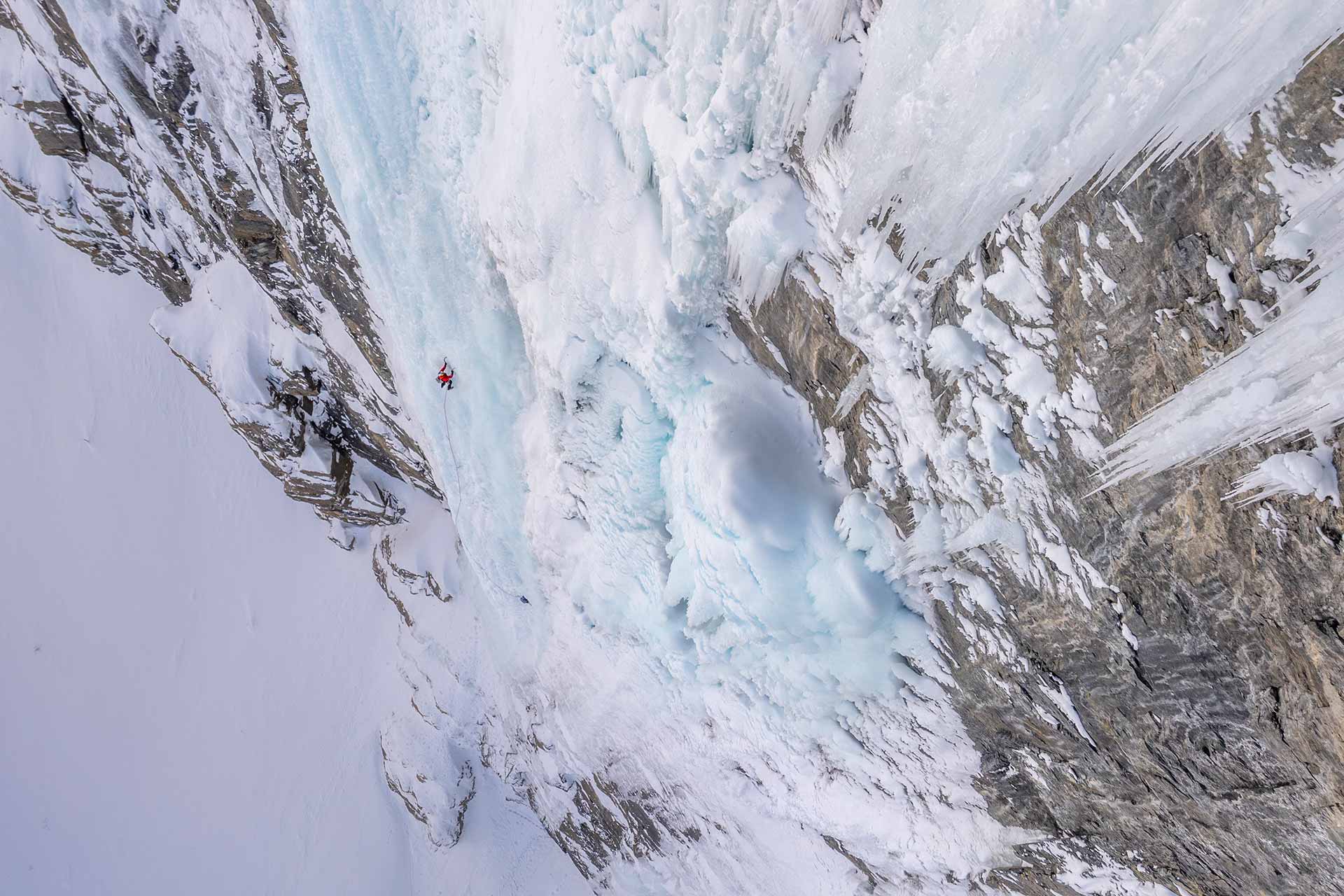
Finally, after I don’t know how many tries, we are one pitch below the top of what we’ve simply been calling the Mixed Rig. I’m tired, and Kirk is too, but we are still stoked to go up. It’s the right time to push. Kirk has been climbing longer than I have, which is rarely the case in my climbing partnerships, and he’s been training hard in his “woodshed” sessions all year. I have my own woodshed, where I do weighted pull-ups until I have more power than I’ve had since I was twenty-two and train harder on my tools than any season since I won the World Cup in 2000. I start up the last pitch, which is a crazy chandelier that explodes into shards that fall away into the night below me. My feet blow hard once, but I have the capacity to hang on even after 280 meters of hard, technical climbing. I don’t train to climb harder; I train to survive. Capacity is survival, not just prediction—thank you, Conklin.
Even when Kirk is destroyed, he still climbs with a beautiful, smooth economy of motion that shows the hundreds of thousands of swings burned into his brain and arms. He’s also incredibly tough. One day I was lead-ing when the ropes went tight sooner than I thought they should. I down climbed a few meters and over to a mediocre belay spot, but when I pulled the ropes up, I pulled in more than ten meters. Why? When Kirk arrived at the belay, he said, “Um, I can’t feel my arm, and I think I kinda got stunned down there when a piece of ice hit me. But I didn’t let go of the rope, just lost track of time for a bit.” I looked into his eyes for even pupils and suggested maybe we should go down, but he said he’d been hit harder in judo (national-level athlete, don’t fuck with him) and he was sure he was OK. I asked more questions to check for concussion or stroke (hey, we’re both at that point in life!), but he was still in the game despite being in a lot of pain. We went up. No reason not to, according to Kirk, but I could see him wince every time he swung, all the way to the final belay.
In the end we call the mixed rig 118, which is the sum of our ages. We add an extension to Relentless on our last epic day up on the WoW, and then call it for the season. It is a twenty-two-hour day, and on the whole approach, climb and descent Kirk and I work together perfectly, our systems honed after so many huge days. The best partnerships are those where the sum of your vision and power is far larger than either individual’s skills. There is no way I could have done any of these routes with anyone else, nor enjoyed the process as deeply as I did. So many talks, laughs, shared snacks, so much time living fully, so much LIFE! That is worth it.
All the big lines are done. Well, not really: there are still at least six left to do on the WoW and twenty more in the valley. Will we do them, or are we done? I don’t know, but it’s time to share this place with the world. It’s just too cool not to. I admit that it’s going to be hard to see another truck at the sled parking area, but I want to hear the story of when someone else goes in there and says, “WoW!” With time, I think this valley will become a top area in the world, but even the best climbers will need every skill they have to climb here. But if you really, really want it, then you’ll find what you need up there. Good hunting.
I still struggle with the basic question: Is it worth it? I don’t honestly know. But I do know that the answer has to be not just yes, but “Fuck yes!” for it to be worthwhile. As my friend Will Stanhope once wrote, you can’t just want to have done a dangerous thing, you have to want to do it, to revel in the activity, not put the outcome before the experience. I think Kirk and I lived by that idea for three years, and for that experience I am forever grateful to him, and to all the people in my life who make these sorts of adventures possible. I have had luck and skill in my life when I needed them, and continue to love wrestling with the hard question of risk and the meaning I find in the mountains with good people. I have no crisp answers, but I deeply value the process of answering the question as best I can.
Now it’s time to go sport climbing in the sun for a while. We hunted, we bled, we survived, we feasted. It’s time to recover.
Posted in: Latest Adventures
No comments yet... add your voice!
Add a comment
I'm more than happy to hear your thoughts on what I've written. Please note that all comments will be moderated before publishing. Thank you for joining the conversation.