Will Gadd – Athlete, Speaker, Guide     Athlete     Speaker     Guide    
Instagram     Facebook   YouTube

Mountain Heptahlon

Date: August 27th, 2010

The Heptathlon is an eight-sport track and field event. A friend and I were out for some heavy breathing (that sounds more exciting than it was) the other day and got into what sports would define a “mountain heptathlon.” The scoring on a Heptathlon is interesting because it’s based on an athlete’s performance against a list of standard times (which look pretty tough to reach). This “scored against a standard” system is interesting because it allows comparison across a wide range of venues and athletes. That comparison would be harder to do with mountain sports, but it’s interesting if you’re interested in that sort of thing…

-Rock climbing. 5.13a onsight.
-Mountain running. No idea for longer courses, but check these times and courses out from the world championships.
-Mountain biking. Standard? Hard to define.
-Backcountry skiing/off-piste skiing with some serious down. Ski mountaineer races seem good?
-Whitewater kayaking (downriver race).
-Nordic skiing of some kind (going fast on little skis).
-Ice climbing/mountaineering/winter climbing stuff.
-Paragliding (includes hiking to launch).
Marginal “mountain” sports, or sports we couldn’t agree on:
-Road biking
-Horseback riding
-“Freestyle” snowboarding, skiing, anything that is judged can’t be a mountain sport.
-Canoeing
-Rafting
-BASE jumping
-Swimming (lakes etc).
-River surfing.
-Snowshoeing
It would be pretty much impossible to do all of these events in one place, but how about a season of events that would tie all of the above together into one event? Hmmm….

Posted in: Blog

Fitness: A Unified Theory, and intervals

Date: August 20th, 2010

It’s been a lot of fun working through ideas on fitness by experimenting, thinking, reading, talking and emailing with different folks in the last couple of years. I think I’ve finally figured something useful out: I care most about performance. That’s the top of my priority list in terms of athletics. “Fitness” is one component of performance, yet it’s often not even close to the most important component of athletic performance. But fitness is the easiest to measure, and the easiest to improve at (at a relative novice level). This idea was driven home to me recently when my wife quoted her old Norweigan XC ski coach (say this with a thick Norwegian accent): “You North Americans are all better than us on the treadmill and eat so well, how come the Norwegian skiers kick your ass then?” Performance first.

This philosophy is at the heart of how I look at sport, and how I coach myself and other athletes (only a few). What I coach for and care about is performance. Clients pay half up front, and half when they reach a specific performance goal. If they don’t reach it they don’t pay. It’s all about performance, all about real-world results, full stop. “Fitness” is relevant to that goal, but the vast majority of the people I work with need nothing more than dedicated and semi-organized sorts-specific training to develop the fitness required to perform. If they need a base level of human function then I’ll pull from other areas to get that, or send the individual to someone else first.
The real reason I train using non sports-specific protocols (Crossfit, Yoga, Gymnastics, old-time strength stuff, etc) is that I like being a functional human. Deadlifts help my back feel better. Squats help my knees not hurt. I like the way I feel if I hit the WOD regularly. I like to be able to sprint (although I would be mocked at any serious track in the world). It’s good. And within that “human” training performance still counts. Better form. Better range of motion. More. Faster. But deadlifting will not help me redpoint my project as much as spending the same amount of time climbing will. So I’l cycle general training and skill training. One for sport performance, one for life performance, both important to me from a performance standpoint at different times in my year.
So there, it’s resolved enough for me. Do sports-specific stuff to perform better at sports, especially the mountain sports I do and know well. But also enjoy having a functional body, and find a protocol that works for that. Have performance goals, and be honest about what they are. Be savage like a chain saw in examining the successes or failures of reaching those goals. Learn, think, evolve, try not to be a dogmatic ass, grow as an athlete and human. Train, perform, give ‘er, but listen to that old Norwegian coach in the back of your head. There’s honesty in saying, “I train ’cause I like the way I feel, yeah!” I can tell when my wife has done her 7:00 a.m. WOD ’cause she’s happier. And that’s worthwhile.
Give ‘er!!!!
Intervals
Intervals rock. I just want to say that. They hurt, they’re annoying, but man do they get results. More on this later, just something I’m excited about right now. Intervals…

Posted in: Blog

Odds and Ends

Date: August 11th, 2010

A month or so ago we did a Mountain Movement course here in Canmore, which was a lot of fun, and I learned a lot. One of the participants wrote up a really funny report on the experience, love it! “Gravel Boarding,” ha ha! Can’t wait to build the “Playground” up again, I have some new ideas for torture…

I’m playing with some new ideas in climbing training. I’ve spent 25+ years climbing, so my movement patterns are half decent I think. Unfortunately, due to a few injuries, other sports, etc., my climbing fitness is pretty weak right now. Normally I start with a very high volume base cycle, but I have limited time right now as well as some decent base fitness from other sports, time for a plan B. I’ve been doing relatively short but higher intensity sessions in the climbing gym, trying to pack larger volumes of movement into shorter periods. The classic version of this type of exercise is the 4×4, but my goals involve longer days on terrain up to 5.12, I don’t think I need more power endurance than I have right now, just more endurance and the ability to absolutely blast pitches. What I really is another gear, another way to put out more watts faster in a shorter time period.
My experiences with both Crossfit and training “long-interval” style for the dZi Foundation 24-hour climb have led me toward trying to do bigger sets of fast intervals and then adding a “big gear” load on the end of each total interval. I really felt this gave me one hell of a base for the 24-hour climb, and that’s sort of (no more 24-hour stuff though!) where my head is at. So 4x4s with heavy kettlebell swings as the fifth station to totally fry my system, or a long traverse with thrusters at the end to mess me up. One thing I’ve noticed with doing intervals is that the ability to handle that kind of “Now we’re going to gasp for three minutes!!!” load responds much better to training than I used to think, and unlike many forms of training the response isn’t sports specific. Putting out at an anaerobic level is a skill, whether it’s racing up a pitch or doing thrusters. Anyhow, it’s an idea, we’ll see how it goes…
I’m also not happy with my definition of fitness from the last post. I think I missed a few things, namely that there is a sort of “base” fitness level where the participant is fully functional, meaning not grossly overweight, can move up stairs quickly without gasping, etc. My definition is more based around athletic expression, which is a narrower definition. I’ll keep working on my definition, but it’s not as good as it should be yet.
Time to go get after it!

Posted in: Blog

Fitness, Calves

Date: August 9th, 2010


If you could only pick one muscle or area on the human body that would tell you how fit someone is what would that area be? Pecs? Quads? You might say that it would matter what the definition of fitness is, and that would be fair, so I’ll deal with that first. At length.

Lots of people put up arguments for what “fit” means on the comments part of my last fitness post. What I see in all those well thought-out comments is that fitness is highly situational, and very difficult to measure without skill at the fitness activity being tested playing a large role. There is no way to test for “fitness” without the testing method or apparatus playing a large role. The most empirical and non-apparatus “fitness” test would be blood tests; that might give a hint of how “well” someone is, but blood tests will tell the tester very little that’s useful for predicting how an athlete will perform. “Gee, this blood work looks fantastic, I bet whoever gave the sample can run a 400M really fast!” That’s obviously funny to me. Running a 400M fast is legitimately cool. Everything after a blood test involves skill, not just power or watts put out. And if the test is based even partially on skill then how “general” can any fitness truly be?

Even the most “general” fitness that I know of and practice, Crossfit, is still highly apparatus and skill-specific even as it develops a reasonably broad level of general fitness. For example, an athlete may have the base power to do overhead squats, but until the athlete has the shoulder flexibility and movement patterns an overhead squat will be very difficult (I use this example because I truly suck at overhead squats). An overhead squat may help with athletic performance in other sports, but by itself the skill will, until learned, likely trump the “fit” component of the movement. Every activity in the Crossfit games had a major skill component (even the wheelbarrow event, I could sure tell who had run a wheelbarrow before!); what the Games are testing is the ability to do a lot of different skills at a reasonable–not elite–level, cool.

Comparing athletes in different sports is fun and interesting, but comparing their performance or fitness levels is pretty hard to do unless the football player puts on skates, or the basketball player straps on a set of slalom skis. I think everybody would see that would be kind of ridiculous, and that’s why claims of being “The fittest athlete in the world” are the same. Fitness without a specific expression of fitness doesn’t exist. Put another way, fitness is inextricably based on the skills required to demonstrate that fitness. Fitness without performing a skill is impossible to define as fitness; inevitably the skill shapes the performance.

Most of the improvements in the opening weeks of any training program come not from increases in strength but in increases in skill. Even after years of sports-specific training skill will still often trump pure power in athletic events. Pick any sport out there; the ability to squat 800lbs is less important than the ability to read the action, see the game, and execute the movement, whether the sport is climbing, skiing or NHL football.

However, having a functional body that is strong is obviously a hell of an asset for any sport or life, and I do think Crossfit does a great job on functional movements. That’s why I do it; not to be “fit,” but to be functional. Big difference there. And before anyone involved with CF gets bent, I think Crossfit athletes are incredibly fit, even though I can only measure their performance at Crossfit.

My definition of “fitness” is this: An athlete’s ability to successfully perform at whatever activity or task he has trained to engage in. For a person who wants to run the Grand Canyon rim to rim in a day then doing that successfully means they were fit enough. For an ice climber on a difficult first ascent that means doing it without injury. For a military group on a patrol in the mountains that means getting the job done and being able to patrol again without excessive recovery time. For a Crossfitter it might mean eventually doing Fran in under three minutes while also deadlifting over 500 pounds. For my friends in chairs it might mean being able to bust it out down a flight of stairs and remain solidly in control. All cool expressions of true fitness, but obviously impossible to compare meaningfully. The Crossfitter would die on the ice climb, the ice climber will suffer on the Grand Canyon run in the heat, and all of ’em could die on the patrol… Fitness is just impossible to separate from the situation it’s performed in. A fit individual will be able to perform and successfully function in a given situation, or he isn’t fit. Being able to do a select set of exercises (Crossfit Games) reasonably well means that someone has trained for just that, and may be the fittest in the world at that combination of those motions. Cool again, but I’m still not buying that the top Crossfit Games athlete is the fittest in the world at anything but Crossfit. Of course, it’s fun to argue the question as I’m doing here.

Now, having defined fitness as successful specific task performance, here’s a very general question: What one muscle or one area in the body immediately displays someone’s fitness level, or at least the broadest prediction of reasonable fitness? If you had to line a bunch of people up and use a screen that would only allow a small glimpse of each person’s body to predict their fitness level what part of the body would you focus the screen on?

In my world that one area is the calf and muscles on it. I was sitting with my wife in a cafe the other day that had a huge volume of people walking by and through it, mostly in shorts as it was a hot day. The busloads of tourists basically didn’t have calves; it was like a surgeon had cut the muscle bodies out. The cyclists who rode their bikes in did. The climbers on their way to the crag did. One old guy and his wife sported calves cut into granite blocks from decades of walking in the mountains. A “display model only” body builder in a white wife-beater had no calves, and I’m pretty sure he could only define his fitness level with a bicep curl contest, which he would win (pro bodybuilders have rad calves).

Developed, cut calves tell me that the athlete spends a lot of time moving on his feet, whether it’s playing basketball or running. Almost every good real-life athlete (as opposed to a gym poseur) from the military patrol in Afghanistan to a mountaineer, will have solid calves. If I had to predict an athlete’s performance in the mountains without knowing anything at all about him or her I’d look at the calves for a rough answer; mountain athletes always have strong lower legs.

And that’s just it. I’m a mountain athlete; that’s where I do my sports in general. If I were looking for the “Fittest Athlete Alive” I’d have a radical kayak race, a deep water soloing competition, a distance paragliding competition, a mountain bike race, a hike and huck paragliding event, etc., and I’d call whoever won that the fittest athlete ever, ha ha! And I guarantee that the winner would have some solid lower legs. No Crossfitter could touch my definition of “fitness,” just as I would be mincemeat in the CF Games, or on a pro basketball court. Now I’m going to do the WOD just ’cause I like it, which when I think about is a hell of a huge plus in any “fitness” regime. If you don’t like doing it then eventually you won’t, and that’s the biggest problem with most “fitness” bikes etc., they are deadly boring long-term.

Posted in: Blog

Canadian Paragliding Nationals, etc.

Date: August 3rd, 2010

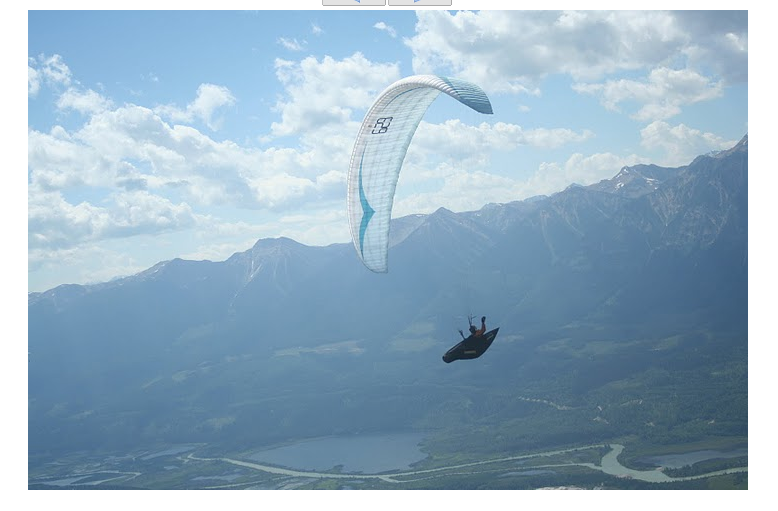
Eric Oddy Photo, a whole lot more at the same address.

I just finished competing in the Canadian Paragliding Nationals. Some of you who know my history with paragliding competitions might be laughing, as I’ve said repeatedly that I’m retired from that scene. But the Canadian Nationals are different; mellower, more fun, and less gaggle flying. I went to the meet with a relaxed attitude and a commitment to leave the comp and chase distance records if the day presented itself, but ended up doing the whole comp and learning a few things. Here a few observations from the week relating to both paragliding and life:

1. We often need less stuff than we think we do. I’m used to flying with a fairly high-end Flytec flight computer that does all kinds of stuff, but I launched on the first day and the vario and altitude functions totally failed. That means I had no “Beep beep” to tell me when I was in lift and when I wasn’t. Initially I kinda freaked out and pounded on the instrument etc., but it still wouldn’t beep, and I was sinking lower and lower as I worried about not having the reassuring “beep beep” to indicate lift. I sunk well below launch and almost to the ground before thinking, “OK, no electronics, what can you do without electronics?” I fly occasionally without a vario, but not in a national-level competition, in my mind that was like not having chalk or something in a climbing comp. But, as I sunk lower and lower in a sort of mental paralysis, I remember a story about my bud Chris Muller flying huge tasks in a paragliding world cup without a vario. That made me smile; Chris is always in my thoughts when I’m in Golden, and the image inspired me to focus not on what I was missing but what I still had: a decent glider, a lot of experience in the air, and a fun-looking day if I could figure out how to stay in the air and fly it!
I had to fight my way back into the air by listening to the glider, feeling the forces in the light lift, and tuning into what my body does naturally without listening for the beep beep. I would honestly never have thought it possible for me to fly an entire comp task without a vario, much less do OK. But, 110K later, I landed at the goal field in a good position. I’d rate that flight as one of the cooler experiences I’ve ever had, both for the silent 3 hours in the air, and because I was able to shut down the negative talk and just fly with what I had. I was ready to fly out and land at the start when I was sinking out, the transition to landing at goal three hours later was something I’m actually way more proud of than winning the title of Canadian Champion five days later (not dissing that, I’m always happy to do well, but that flight on day one was really cool for me).
I’ve sometimes forgotten “critical” gear on trips before, and yet we often still ended up succeeding somehow. Good gear is beautiful and I lust after it, but day one of the Canadian Paragliding Nationals was a good lesson for me in not letting what I don’t have define my experience. What else in my life do I think is essential that really isn’t? And I’ve ordered another Flytec vario, ha ha!
2. Trying to beat other people generally doesn’t work out so well in any competition. This is hard to explain, but in every comp I’ve ever won I didn’t think about the other people in the comp much if at all. I just did my thing as best I could, and the results showed some version of how we all did relative to each other. As soon as I start trying to beat other people in any comp I usually lose. In this comp there was a very good German (and hopefully soon Canadian!) pilot, Robert Hauser, on an Ozone R10.2 glider. This glider kicks ass, and because I wasn’t really even planning to compete in the Nationals until just before going I was on an older glider that was a couple of generations behind the R10. Anyhow, the first few days I was able to hang with Robert, then I started pushing to beat him by flying low and fast. His skill and superior glider made that tactic just fail, as it always does, and I would repeatedly get stuck soaring some bump down low while Robert’s glider flew over my head. He won the overall meet in the end and I was second, fair enough. I think, even with an inferior glider, I might have been able to pull a better result if I had of focused more on my own flying and less on getting in front of other pilots in the last two tasks. Focus on your own stuff first… And well done Robert, it was a pleasure!
3. Situational awareness is everything. I’m currently learning to fly airplanes while getting my private pilot license. This has been a dream of mine for a long time, and I’m lucky to have some time to get it done. Learning how to fly a plane has not been easy for me; a paraglider has three controls, you just fly it like you paddle a kayak. A plane as simple as the trainer 172s I’m learning to fly in have a huge quantity of dials and buttons, and eventually you have to know how to use them all. Each lesson a new control or maneuver is added, but only after you can show enough situational awareness to handle it. At first just pointing the plane in the right direction took everything I had, now I can use most of the controls and do most of the maneuvers required to fly (they let me go alone now, ha ha!). My situational awareness is growing every flight. In the Canadian Nationals I noticed my situational awareness shrink and expand depending on blood sugar, comfort level, emotional state, sleep level, etc. etc. As I think back over all the competitions and big efforts I’ve battled with the one common denominator in the “success” bracket is how aware I was in the situation I was battling in. If I had a high level of situational awareness I generally did well. Low level, poor result.
I often make an internal game of watching other people’s level of situational awareness in different situations. A mother may be incredibly tuned into her kid, but totally unaware of what’s happening around her as she drives. I do the same. In a paragliding competition I can watch pilots make the oddest decisions because they aren’t thinking about the big picture around them. I do that too. If I had a switch that allowed me to get rid of extraneous thoughts and just work on my situational awareness I’d be a lot more successful in life I think. I haven’t yet figured out to how to mentally train my mind to see the big picture or the appropriate picture in different situations, but I’m working on it in my usual ten steps forward 9.9 back. Mental training is way harder than physical training.
4. It’s fun to do stuff with friends. I had a great time seeing many old friends at the Nationals, yeah!
I’ll try to post some followup thoughts to all the excellent posts on Women and Fitness, thanks to everyone for those.
WG out.

Posted in: Blog

Partners

  • Red BullArc'teryxBlack DiamondScarpa
  • Sterling RopeGin GlidersMuller WindsportsSmith Optics