Date: February 24th, 2010


After a week with my friend Andreas Spak in Norway I’ve got some things to say about speed on big routes. Andreas climbs faster than most, is always up for a big route, and is tough enough to get the job done, but I always seem to learn or re-learn some stuff when doing big new routes with him in Norway. Here are a few “speed” tricks for big routes that are primarily multi-pitch without walking steps (those steps call for T Bloks etc., not covered here).
-Belay the leader with an auto-lock lead belay device. This allows the second to eat, drink, organize the belay, etc. Impact forces are a big discussion when using an auto-lock, I’ll just say it’s not something I’m concerned about with a good rope, good belay and decent rope management.
– The leader’s belay sequence at the top of first pitch goes like this:
1. One super-solid screw in, clove hitch it to the upper hole (BD screws have two holes on the hanger), “OFF!.”
2. Second super solid screw in higher than the first, clove hitch it the upper hole, tighten up a bit.
3. Pull up rope, belay second off an ATC guide on on the lower ‘biner hole on the lower screw (yes, this actually matters!), stack neatly on one foot, or loosely if you’ve been smart and are using a cave or other feature for protection (which you always do, don’t be all British/American and stand right in the way of the leader’s falling ice).
4. “ON!” can be yelled, but by now you’re vigorously yanking on the rope like mad to make it clear you’re on belay, the second should already be moving by the second good yank or so. If he’s not it’s a felony for the second, “Slack belay management,” and is payable by one beer.
5. While the second is climbing you drill the V-thread. I like to use cord rather than use the ropes to feed the thread when descending, keeps the friction lower (stuck ropes really, really suck at night on the descent), plus the cord gives a nice place to clip into on the descent (saving more time on the route…). Build as much of the V-Thread as possible, normally you can get it all done unless the second is absolutely flying. He finishes it if you don’t.
6. Second hits belay, clove hitch him to the V-thread with his rope first, then to the lower biner on the upper screw keeping things all neat and organized so the leader’s rope will run free and leaving enough free rope so that when you take him off the ATC you have room to clove-hitch him neatly into the lower hole on the screw. Now you have three bomber pieces in the ice.
7. Quick switch of gear (second racks screws and draws separately, don’t leave draws on screws, slow), leader on belay, gone.
8. Once the leader has two or three good screws in the second takes out one belay screw. After four screws the belayer take out all the belay screws, he’s still attached to the V-Thread (I use 7mm cord for this).
9. When the leader yells “off” or the rope is down to a few meters the second takes off the belay jacket, and is totally organized and ready to move when the rope goes tight. Just unhook the ‘biner from the V-thread, gone in way less than 60 seconds, like zero second.
I’ve spent way too much time thinking about the descent also, I’ll cover that next time, but because you’ve already put the V-threads in most of the work is done and the descent should be very fast but not too fast, ha ha!
No transition should take more than five minutes. On a six-pitch route you waste at least an hour if each transition takes 15 minutes; most ice parties take a crazy long time on each transition, it’s painful to watch. It’s one thing to piss around on a three-pitch route in the sun, but even on that type of route I like to get up and down quickly if possible, it’s good training for bigger routes or bigger links, and you only get better at moving fast by practicing the systems.
The second has to wrestle the rope a bit at the belay, but with an auto-lock that’s OK.
I’m starting to use two super light packs on long routes (forgot mine for Norway unfortunately), the leader and the second each have a good light jacket, a little water, a little food, headlamp, etc. Works better than one heavier pack for the second most of the time, plus the second often has the rap line in his pack to keep the cluster at belays lower. I’ve yet to find a pure ice route where the weight of a belay jacket, 250ml of water and a candy bar makes a jack bit of difference to me on the lead (OK, maybe Spray On, that would be harder for sure!). But normal ice, no.
Repeat to top.
This is based on the leader doing two or more pitches at a time. I basically don’t swing leads ice climbing unless it’s really warm, the climbing is mellow, and I don’t care at all about time. The second should arrive at the belay fully winded and sucking air; this is not the time for him or her to lead again, plus the leader is probably getting cold. In Norway Andreas led all of one climb, I got the two ugly ones, it worked well for us.
Note that there are no slings or cords used at the belay; what normally happens with a sling or cord is the knot in the sling or cord gets totally stuck if it’s loaded at all, and is then useless for the rest of the climb. Plus using the rope to clip directly into the anchor reduces the impact forces a lot if the leader pitches straight onto it. Equalization is not something I really believe in anymore (long story, but basically it doesn’t work practically for real climbing situations), I like to have two bomber screws as a minimum for a belay, and then back that up with a bomber V-thread. Using the rope allows these screws to be as close as 30cm or as far as 3M, which is a lot more flexible and faster, plus no more messing about with frozen knots in slings!
Posted in: Blog
Date: February 16th, 2010
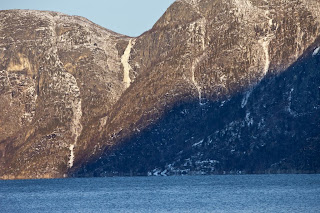
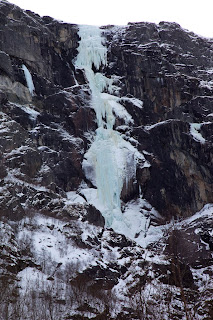
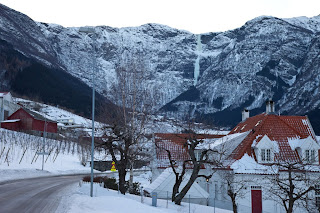
Norway 2010 is wrapping up. It’s been a great trip–as always, Andreas Spak and I found insane ice, climbed it, and are destroyed. Christian Pondella came along to shoot some photos, but also ended up climbing a lot–dang photographers climbing our routes!
Link to Andreas Spak’s blog, with LOTS more good photos!
Waterfalls are called “Fossens” in Norwegian, so everything has some consonant-colliding letter disaster followed by “Fossen.” We climbed Fun, Sketchy, and Freaky Fossen, or at least that’s what the real names sound like to us with our horrible ears for the language. We’re going to use the “real” name of the waterfall from now on when reporting on it, this should cut confusion down. Full details below.
Yesterday Andreas and I climbed the classiest, the cleanest, the most stellar waterfall line I’ve ever done. It’s the plum line in the Eidfjord area that I’ve seen (there are probably ten more equally good, the place is that insane). It was an all-day boxing match, a battle between desire, physics and sanity. Darkness started to fall on us while we were 7 pitches off the deck and standing below a 50M+ column of glass soda straws held together by crazy-climber glue. Below us was 450M of difficult, tenuous, downright challenging climbing. Maybe something like doing Sea of Vapors, then Nemesis then Curtain Call but, at least for me, more demanding all the way. You can’t call a route an FA until you get to the top no matter how much you want to. Headlight on, shut up and swing. Then the spindrift started. Each placement involved 20 to 50cm of digging, same for the screws. Eight raps in the dark back down. I kissed the last V-thread on the way down that we had put in on the way up. done. Except for the walk down and four-hour drive. Stimulants were abused.
I’m pretty sure all the routes we did were FAs, but maybe Guy Lacelle did ’em, that’s happened to me before. And does the FA of a water ice route really matter all that much? It’s going to be different again next year, and if you don’t know it’s been climbed then what does it matter? And even if you do know it’s still different every season, totally new ice… FAs are most useful for sharing where the ice goods are so others can go and have an experience on ’em.
Grades are increasibly sort of the same to me; beyond “it’s steep, not steep, whatever” ice grades generally have far less to to do with how technically hard something is than what’s going on in the leader’s head. And, speaking personally, my head is a confused place while leading tenuous water ice… In kayaking we’ve pretty much given up rating rivers past class 5. All hard rivers are class 5, it’s the people, picture and story that matter. For example, if a bud of about your ability and fear capacity runs a waterfall then it’s about that hard. If he breaks his back then it’s maybe more technical. Drops develop reputations–gnarly, friendly but looks gnarly, gnarly but looks friendly, etc. etc. People keep coming up with technical vs. danger vs. flow size vs. rescue options etc. for rating rivers, but in the end it’s about the people, story and photo (I’ll post some later, we’re failing on that this morning, more coffee required). I think ice climbing grades past, “It’s kinda vertical for a good distance and therefore WI 5” are likely useless. Almost all “hard” ice routes are some version of water ice 5 with bad gear. So all hard ice routes, like hard rivers, are “grade 5” plus the stories and photos… Yeah, I just rated something WI10, ha ha!
Photos etc to follow but here are the particulars so people searching the web will know how to get there etc. We found all of these climbs on the web or by looking out the window of our car.
Eidfjord New Routes 2010
Big Rig Across the Lake from Eidfjord (“Fun Fossen,” not sure of name)
300M, like “Cascade” but way better.
FA Spak/Gadd/Pondella
February 9, 2010
Skykkjedalsfossen “Sketchy Fossen”
400M, WI 5+ R. A big piece of ice, nice.
FRA Gadd/Spak
February 12, 2010
Skrikjofossen (“freaky Fossen”)
500M, (WI grade it whatever you need to feel good about the grade) Gives you everything you need.
FRA Gadd/Spak/(Pondella first three pitches)
February 15, 2010
2011 Note: Although it would seem pretty obvious, there is avalanche hazard in the Eidfjord area.
Check this report out for why it’s important to keep thinking about avi hazard anywhere in the mountains.
Posted in: Blog
Date: February 13th, 2010
Norway! I love climbing in the land of big new routes with my friend Andreas Spak. Yeah!
I’ve done more ice climbing this season than I think I ever have in a season–Norway is just the latest round. The dZi Endless Ascent effort started it all off, but for some reason I’ve just been swinging the tools a lot with a variety of partners. I love working on technique and tricks for moving on ice, and thinking about how to do it with a higher safety margin and less effort. Here are a few things I’ve been thinking and see a lot of:
-If you get a stuck tool regularly you’re likely placing them both at the same horizontal level. Don’t. It’s a waste of effort, time and makes the leader far less secure because they have to wrestle a tool out while it’s off to the side. Place tools roughly 30 to 60 cm apart vertically and roughly shoulder-width or a bit narrower horizontally.
-Completely stand up and drive you hips into the ice to finish the stand-up part of a movement. Most climbers don’t, which puts more weight on their arms.
-If you’re getting pumped and you’re not a complete novice it’s almost always because your feet aren’t at the same horizontal level, and aren’t solid. Solid feet make for relaxed hands. If one foot is low when you stand up it will come off, making you out of balance. Kick twice as much as you swing.
-Look at the ice. LOOK at the ice. I can tell within about one swing and one foot placement how experienced an ice climber is; swing at corners in the ice, pockets, spaces between icicles, and kick in roughly the same places. But even if you know this you can’t execute it without looking at the ice for every foot and tool placement…
-Swing with your elbow high, and the pick, head and shaft of the tool all in line with your wrist, forearm and upper arm. It’s about getting the pick moving fast and accurately; 99 percent of people drop their elbow when they swing, which is a waste of effort, compromises accuracy, and reduces the vertical gain on each swing. Even worse is the “chicken wing” swing, with your elbow out to the side at roughly shoulder level…
-If you want to be a better ice climber go hang a rope on a vertical piece of ice and climb it a whole lot. Like 200 or more times. With crampons off, on, no tools, one tool, etc. etc. Many aspirant ice climbers drop the sport after spending a weekend climbing 4 pitches and freezing their asses off. Go TR like mad, then you lead fast, follow fast, and be secure while doing so.
Back to ice climbing here in Norway, only another 50,000 FAs to do until we run out of ice…
Posted in: Blog
Date: February 9th, 2010
Here’s a little video sports action of the Endless Ascent effort, shot by my friend Scott Milton. Memories, memories! Nice work Scott and team Arc. There are a whole whack of linked videos if you open the video directly on Youtube to.
I’m looking out the window on Norway, where an epic season is in progress. Jetlagged, over-traveled but still STOKED to get it on!
Posted in: Blog
Date: February 7th, 2010
I just spent two days at the Redstone Winterfest, in Redstone, Colorado. Redstone is a small town on the western side of the Colorado Rockies. I’ve spent a bunch of days in the area over the years kayaking, hiking and a little bit of bouldering, but it’s not a place I’ve ever really thought of as an ice or mixed climbing location. I was wrong about that, there are some great ice climbs and a whole horde of really good mixed routes, all on this interactive soft red sandstone.
I showed up on Friday morning, and wanted to warm up as I’ve only done one of day of mixed climbing this season. Since about October I’ve been focused on ice climbing, huge quantities of ice climbing; this has left me with pretty good endurance, but a little low on mixed power. Fortunately the first route I got, an M9, had an aggressive in-your-face boulder problem overhang to start with. Why, out of all the Redstone routes, did I get on that one? I am an idiot at picking warmups, but the local vibe was good. I fell off right away to get that over with and then spent an hour figuring out the intricate hooks, pebble grabs and micro-ice placements. Thanks to MB for the long belay. In what was to become a pattern, I got pumped right away, but the routes there often have cool rests if you’re creative, so I’d de-pump, do a move or two, rest, sketch up a few feet pulling on cobbles, it was super fun but definitely a new style of climbing for me!
The locals run rock shoes sometimes, and switch back and forth from rock shoes to rock shoes with crampons bolted on, sometimes twice in one pitch! Chalk bags are common, and as the air temperature is often around freezing you don’t really need gloves once you warm up. It’s odd to bust out a 5.11 pebble move in the middle of a mixed route, but after a bit of a head-fake mentally I got into it, it’s super fun!
The rest of Friday and Saturday turned into two of the more “pumper” days I’ve ever had. So pumped, almost falling off, hooks breaking, the smallest icicle I’ve ever successfully stood on (perfect temps for small icicles, warm but not too warm), just on the edge of pitching off but making it to the anchors. That type of, “I’m falling off now! No, wait, not yet, no falling, snagged a hold, OK, de-pump” climbing is pretty much my favorite thing to do in the world. I had a couple of decent onsights that I was psyched on given my relative lack of “M” fitness, super fun to get back into the mixed game! Lots of old friends from the Colorado days also showed up; Colorado was my home for almost ten years, and a piece of my heart will always respond to the blue sky, warm sun, mountains and good times I had with people there over the years.
I finished out my visit with a couple of laps on “The Drool,” a classic pillar. Blue ice, red rock, Redstone! Thanks to the crew who let me rotate in with their TR session, good form.
I’ll definitely be heading back there, maybe as a tie-in with the Ouray festival next year. I have some good-looking routes left to do, and some of ’em weren’t even in! And this whole mixed climbing thing with a chalkbag has got me interested, Duane Raleigh and Jeff Jackson are coming up with some new ideas for sure.
Thanks to DR, AO, MB, Quint, Jefe and the rest of the psyched crew there, great trip!
Posted in: Blog
Date: February 1st, 2010


I’m just back home after climbing the coolest ice I’ve ever seen or climbed, anywhere in the world.
Tim Emmett and I had a great trip, during which we climbed some insanely challenging and fun spray ice behind Helmcken Falls. There, I’ve said it, the rest is details in some ways, but here they are. It’s a long read, but I’m just so psyched! I have seen the future of ice climbing, and it is sprayed on.
About ten or so years ago David Dornian and I started using the internet to look for big waterfalls. That’s how we found Hunlen, which EJ and I climbed last spring (and that is the coolest waterfall I’ll never want to climb again). I also saw a lot of photos of Helmcken Falls, in Wells Grey provincial park in BC. A huge quantity of water blasted off the lip of a supposedly 140M cave. Sick, but no way was that going to freeze, ever.
But I found one winter photo, with the comment under it, “
Helmcken Falls in Wells Gray Provincial Park. Even when it’s -30C out this waterfall is too high-volume to freeze. The spray that turns to hoarfrost on the overhanging amphitheater walls could probably be climbed to give a really hard route though! (not by me) .” Drew B. posted that photo and caption, so in some ways he is responsible for the seed in the back of my mind.
But it’s a long way out of the way to Wells Grey provincial park, and Helmcken. I just never got there, and didn’t really believe the hype on the height anyhow. Finally, after years of scheming and thinking it could be worth checking out but not right now, my mostly English but slightly hybridized Canadian friend (he stole one of our women through marriage or the other way around, not sure) Tim Emmett showed up in Canmore (a day late–he seriously missed his flight by a complete day, amazing for someone who travels so much) and we were off at 4:30 a.m. to get to the falls in time to climb the route if there was a route. At 1:00 we stood on the rim and dropped our jaws. Helmcken is a stunning, complete bad-ass of a waterfall. There wasn’t much white ice stuff on the back walls, but Tim and I sorted out a route down to check it out involving rapping over a really nice 20M column of ice. At least we’d have something to do on the way out.
As soon as were down at the bottom of the canyon our minds just flipped out. The scale is so hard to fathom in the pictures and even in person until you’re down in the canyon. A pretty good-sized river rips off the edge of a massive cave and falls 141M (about 500 feet) to a pool below. You could play soccer (football if you’re Tim) on the ice shelf behind the falling water. And the lower 100 feet or so were covered in the most insane ice formations I’ve ever seen. Have a look at a few of the photos and make up your own mind, but we were blown away.
But it’s not all happy land; sharp daggers of ice line the ceiling of the cave, and the huge blocks of debris on the ice ledge along the wall told of serious death missiles falling from above. We sat on the edge of the huge (stadium sized, really!) cave and freaked out on the roar of the water, the mist, the ice along the bottom edge, the icicles in the roof, the whole scene. It was way too overwhelming to even think of climbing; we were afraid at first to even go into the cave. Or Tim was, I was up for it but Tim whined a lot. It would be funny if that were true, but if you know Tim at all then you know that hanging with Tim is like hanging out with the best dog in the world, a Labrador. And there was a very tasty stick to be had… An enthused Emmett is a dangerous thing, and he’s always enthused. Soon we were moving again.
After figuring out a path on the ground through the dangers from above we headed in. It was warm, maybe minus two, and we found out right away that the huge spray ice formations were really unstable. If you just nudged them they fell off. We could push the little ones off the wall to make forward progress along an ice ledge on the side of the cave, but the big ones blocking our way forward were too scary to touch. We quickly figured out that a soft-ball sized piece of ice would knock multi-ton stalactites down, and carnage ensued as progress was made.
Eventually we were in the back of the cave in a relative safe zone. Huge banana-shaped icicles littered the walls and ground, and in fact blocked us from even getting to the back wall. It would have been suicided to walk under the danglers, but more thrown ice (Tim favored something called a, “Cricket Bowl Hurler” shot, while I was more of basketball shot kinda guy) cleared a path through the Indian Jones terrain traps and back to the wall. At that point we both sort of ran out of energy; how to climb the ice? For there was ice, but it was on a 45-degree or steeper wall, and not anywhere thick or strong enough to hold a screw…
I’ve put up a lot of mixed climbs on lead, and after a while the solution became obvious if not really what I wanted: Bolt it. I wanted it to go on natural gear and screws, but the compact volcanic rock wasn’t having any of that. I stood on a huge fallen stalactite and the first bolt went in. The next one went in while I was hanging on two equalized ice tools in the soft ice, as did the third bolt. I got the fourth in after ripping a tool and slamming violently off the wall when I fell. Did I mention that Tim is an experienced British “trad” belayer? Good thing, as I would have decked it hard without him being on the rope. Nice one Tim, thanks.
After that Tim and I sat on the ice and looked up; the fourth bolt was directly overhead, and they were spaced well enough to prevent a groundfall while climbing but barely. We climbed out of the canyon by headlamp that night with smiles, and the realization that there was no way in hell we were getting to the lip without a week’s worth of effort and time, likely more. Our psyche was massive, just running around in circles massive. Now I know how Labradors feel all the time, it was just awesome to discover something so damn cool!
In the morning we were back at it. I got about four more bolts in then turned the sharp end over to Mr. Emmett, who was nearly ready to levitate up and help out. Despite never having aided off ice tools before (Tip: put short tie-offs around the upper grip of the new Fusions for extra reach) he did a great job and got us to an alcove at the end of the continuos spray ice, about 90 feet of climbing from the back wall, but only about 40 feet off the ground!
And then it was time to send. Our fallen pillar had unfortunately broken, so you had to stand on the stump end and literally jump through space to latch a couple of blobs on the wall. Seriously, that was the mandatory start! I have never had so much fun climbing ice; sometimes you’ll get a big roof from a broken off pillar or something, but this was just mental. You had to be really careful to swing accurately in the blobs of ice, and test the placement each time. This is incredibly strenuous when hanging locked-off on a 45-degree wall. Poor placements would rip, which was funny if you were belaying but not so funny on the lead. I’ve been doing a lot of endurance training this year but not so much power training… I got so damn pumped my forearms are still hurting, but a combination of desperate tricks (hooking an elbow on my ice tools) and a really wild stemming rest at the mid-point got me to the anchor, and then Tim had a nice battle but pulled it off (nice work for your second ice route of the year amigo!). We sat around eating and talking about the grade; it is a whole hell of a lot harder than anything I’ve ever climbed on ice. The only thing I could compare it too is M10 or harder drytooling, but you have to swing for placements instead of just hook. WI 10 is the lowest grade I can give it with a straight face; many people who can drytool M10 will find the ice climbing a lot harder I think, it’s real, honest, cuts-on-your face ice climbing. Not one single drytool move in the whole pitch; pull up, lock off, work for a placement. Just like normal ice but on a 45-degree wall. So much fun!
On day three we were back in the stadium to see what we could see, but the temperatures were jumping every hour, and massive danglers were cratering into the floor of the cave like something out of a bad movie where the whole evil-guy palace blows up and the heroes run away. Or something like that, it was sketchy and we ran away.
It’s been a very warm year in Clearwater and Wells Grey Park, so apparently the spray ice is a lot smaller than it normally is. It may all re-form, or the sun may be too high already for it to come back, nobody knows. What I do know is that I’m going to be back next year for sure. You could theoretically do a drytool route with the odd bit of spray ice to the lip right now, but there are pictures where the whole thing is spray ice… That’s the future to me; another hard drytooling route is just that, but a 500-foot route on the spray ice? Magic.
I’m always looking for evolutions in my favorite sport, ice climbing. Mixed climbing was one step for me, now I’ve seen the possibilities for another development. Thanks for a great trip Tim, yeah!!!
Notes:
In winter the
Helmcken Falls lodge offers rooms for two people (two beds) with breakfast and a hearty dinner for $125 (total–not each, total. $62.50 per person per night with food). It’s a really cool lodge, friendly owners, and a great place to base out of. There are other possibilities in the area for climbing that warrant a visit, let’s leave it at that… Happy Exploring!
PS: The height of most waterfalls is exaggerated. Helmcken is supposed to be 141M high, but I figured that was an exaggeration. In the photo it looks about 100 feet high. But those trees on the lip are BC trees, not spindly little Alberta trees… It’s fucking huge. Cool photo here.
Posted in: Blog