The Christmas tree is already showing signs of pine needle exfoliation, the sun doesn’t come up until 8:30, there are beer bottles in the streets every morning and my liquor cabinet is stripped almost bare. It must be the week between Christmas and New Year, which is often a great week for ice here in the Canadian Rockies if it isn’t -30. Temps are actually great, lots of friends rattling around, Happy Ice Season to everyone!
Some things to think about relating to training:
Range of Motion: You get what you train.
A few weeks ago I was in Bozeman, Montana and hit a local gym because I had no ice tools, no clothes beyond what I was wearing (thanks United!), and it was too late to scrounge. I note why I was in a gym because going to the gym in Bozeman is silly in the middle of ice season, go climbing already! But in the gym was a guy doing “pullups” by jumping up onto the bar and flexing his shoulders back and forth for ten “reps” at a go. I counted. I couldn’t help myself, I asked him if he wanted to do some pullups, next thing he knew I had his feet and he was busting out legit pullups with a bit of a push from his feet. I’m a complete freak for grabbing his feet, but damn, a pullup starts with the arms straight and finishes with your clavicle nearly hitting the bar, elbows behind your front ribs. And full range of motion is not just getting your chin above the bar or bouncing your chest off the bar like a spastic, it’s getting your Adam’s apple (or equivalent) above the horizontal plane of the bar and at least breaking the vertical plane of the bar with your entire chin, not the dimple on the front of it. If you’re a climber I think it’s important to lock that top position for a brief moment, especially if you’re an ice climber.
One of the best things I’ve learned through Crossfit is how to scale pretty much any exercise to get full or as close to full range of motion as possible. Doing one full “ROM” rep of any exercise is far, far superior to ten “fakie” reps. A good strong set of full ROM reps done with assistance are 1,000 times more useful than one “fakie” rep done without help. Use bands, use a friend, use the fancy anti-gravity machine, but for God’s sake do a real full ROM pullup! Being mentally lazy in the gym will lead to mental laziness in life. STFU and do the full ROM or you’ll get no respect from me or yourself, and you know it.
A quick note on “kipping” pullups: Crossfit popularized these, and they kick ass in general. I’ve seen many people who couldn’t do one pullup learn how to do tons of ’em using this technique. But many kipping pullupers fall far short of full ROM, and the full kipping motion may be less useful to climbers if there isn’t a brief pause or at least control over the bar. I did a lot of kipping pullups last year and found my lockoff strength collapsed compared to doing “normal” pullups. I now use momentum as I fully buy that theory, but try to get and maintain control over the bar, and keep active, engaged shoulders at the bottom of the pullup. Edit–the main site WODs have had a fair amount of weighted and “chest to bar” pullups in the last while, I think that would address the weak lock off issue that can come with kipping pullups. I just noted that today’s workout has L-sit pullups, you can’t kip those, that’s a nasty workout!
Workouts:
We tilted the plice back to between 30 and 45 degrees overhanging. This is stellar training for both mixed climbing, and radically overhanging ice climbing, which is the current obsession that I’m training for. I can handle day on, day off on the plice, it’s more than enough! Here are a few “fun” workouts we’ve been playing with, useful for working in groups or just keeping the motivation high:
Do a plice lap every minute for as many minutes as you can keep it up. Mentally as well as physically painful. If your plice is vertical either tilt it back a bit or add a pack with 1/4 your bodyweight in it, that’ll make it hard enough that a lap every minute will be an adventure.
If you’re working out with more people add more exercises. We’ve been doing a plice lap, then ring dips, then air squats, then back into the plice. Or thrusters, or deadlifts, whatever. Resting is useful for pure power training, but I’m becoming more and more convinced that resting is a waste of time in general when training for sport… Lots in that idea, but rest for power, go the rest of the time. Except when doing the long slow distance sessions. One of the reasons I think specificity counts in training is that “training” is a massively broad idea. Like writing, or engineering, you need to know what you’re trying to do, but somehow people think one form of “training” is going to do it for them. “I do TRX.” “I do Crossfit.” “I do XXXX” Cool, but the definition of what you do is not in the training but in the action, not in the gym but in the real world.
Tabata Training on ice tools:
Get one of those Tabata apps for your phone (one with sound so you don’t have to look at it), hang your ice tool over a tree branch, whatever, hang one-handed for 20 seconds, rest ten, repeat on the same hand eight times. This is so much fun… If you can’t hang on one hand use two. I ripped this idea off Crossfit too, tons of fun protocols on there for your own training. I don’t follow the mainsite WODs at all this time of year, but my training is heavily influenced by the ideas there, plus info from many other sources. Use what works, leave the dogma in the sweat pool.
An interview I did with Gregor over at Some Good Adventure, ranting and raving. Which I seem to be specializing in lately after doing a half-dozen shows from Tofino to London, England in the last four weeks–I’m finally back home and de-spinning from the travel, no place like home! Unlimited good coffee, good food, as much as I love traveling, meeting new people and generally going for it on tour it’s always a pleasure to get back home to the Canadian Rockies and my family.
And this is funny, not exactly correct but never absolute correctness get in the way of good writing! Overall I’d agree with the ideas.
Ice Tips for the week:
I taught a few clinics while down at the Bozeman Ice Festival. The Bozeman Festival is one of the longer running, well-attended and all-around fun ice festivals going. Joe Joesephson ran it, did a great job, I’ll definitely head back there! But, as always, I learned a few things about teaching ice climbing by teaching it.
Swing your tools, swing your feet. I’ve always taught a kick done with your toes high so the frontpoints contact the ice, not the toe of your boot. We all learn to kick a ball with our toes low, and as that’s the only point of reference that’s how people tend to kick on ice. But you swing a tool, and in reality a kick should be done with momentum and is more of a “swing.” Bring your foot back, bending at the knee and not at the hip, and swing it toward the ice with your toes high. Swing HARD, most people peck with both their tools and their feet. Ideally there is a ledge to put your foot on, but if there isn’t then you need to basically make one for your points. That’s not possible without some meaningful violence. Do not be shy.
Unweight the foot you want to move first. I see a lot of people “hopping” their feet on ice. In rock climbing this can sometimes work OK even if it’s awkward, but it just won’t work on ice as have to kick your crampon points or at least place them extremely precisely in order to get good security. So, move your hips over to unweight the foot, then move it, repeat. Same motion of feet over to the side and then up with the upper arm straight, not a big step up.
Pretty much all steepish climbing is basically versions of the same move: Have a hold in your hand or hands, position your feet to push/pull, and push/pull up with your feet using as little arm strength as required. If you watch someone good drytooling, rock climbing or ice climbing that’s what they do… Check this out, and watch from 2:22 to 2:32. He might as well have been ice climbing: hold, feet up, push, grab, straight arm, repeat… Rock climbing has more limited holds and is a lot steep than ice climbing so the movements are different, but I think anyone can see the common ground in the movement pattern. Sharma is one strong mofo, but check out how much time he spends on a straight arm as he sets his feet. The holds in rock climbing don’t always allow this obviously, but the trend is clear, cool to watch! The more I climb the more I realize it’s all the same stuff under the hood.
Oh, and I almost forgot: Homage to the masters of the pose. In my show I talked about climbing being what I love, and the posing being the work. Blue Steel!
I recently wrote an article for Climbing about what I feel is the basic sequence for steep ice climbing: Squat, stand, swing. I’m on a roll today with the video, I just pulled a clip from the Ice Mines video that illustrates this pretty well. When this clip was shot I wasn’t even thinking about how I was climbing, it’s just how I climb. Kinda cool to see it. Anyhow, here it is:
A few people emailed to say that my text explanation for how to grip and swing an ice tool wasn’t super clear. Here’s a fast video shot in my back yard about 30 minutes ago that might help explain the two different grips used to swing and then hang onto an ice tool.
A few additional notes on hanging on and swinging:
-My hand rotates from the “Swing” to the “Grip” position every single time I get a placement and then hang off the tool. Easier than it sounds.
-The tool rotates around my pinky finger pretty much, the middle and index fingers are relaxed.
-The same rules as ever still apply for an overall good swing–elbow at or above the shoulder,fingers, wrist, lower arm, humerus all aligned, look before you swing.
-I underestimated the amount of rotation around the ice tool that my fingers go through. It’s not 20 degrees, it’s closer to 45 degrees from the “grip” to the “swing” position and then back. I got that wrong in the video.
I shot this right after a training session involving the “splice,” or steep plice plus ring dips and deadlifts, and I’m a bit hammered. Thanks to Keith for the help.
Edit a little later–and the reason for the leash on my left hand is that my left middle finger is broken, a leash makes it easier for me to hang on during the training sessions.
I’ve done a whack of ice climbing and coaching the same in the last two weeks, and it’s made me think of a few “small things” that make a huge difference for climbing ice. Most of this stuff is in my book or other writing somewhere, but I have to relearn it myself every season.
The basic technique of steep ice climbing is pretty well diagrammed now (Put in a high tool, straight arm, walk feet over and then up keeping arm straight, stand, not pull, up, place high tool, repeat to top) but there are endless refinements. So here’s a list of “small stuff” for ice climbing that makes a big difference.
-Look where you’re going to swing next and swing there. Probably 90 percent of the people I see ice climbing don’t do this. Same with your feet, LOOK before kicking.
-Most people don’t swing leashless tools very well, mainly because they wrap their hands too far around the shafts of the tools and the human wrist just won’t swing well in that position. This “wrapped” position feels solid and is how you hang onto leashless tools, but it sucks for swinging. If you’re climbing leashless, and most people are, rotate your hand around the grip about 15 degrees to the outside or the side or away from your chest while swinging, and rotate it back again to “grip” while hanging on the tool. If you hold your hand in karate-chop or thumbs up thin hand crack position and keep all the fingers straight then move your thumb so it’s making a sort of half-oval at the same horizontal level as your index finger your ice tool will fit exactly into that groove. The knuckle on your thumb will naturally be in the middle of your ice tool’s shaft. Now close your pinkie and ring finger around the ice tool. The groove between your thumb and index finger guides the swing, the index and ring finger hang on… That’s the “swing” position. After planting the tool (and I plant mine, not peck), close all your fingers and rotate your hand slightly so it’s easy to hold the tool. That’s the grip position. This system works whether you’re on Cobras or any other tool I’ve seen out there. I’m sick of seeing bumbling swings with leashless tools even by otherwise decent ice climbers, no reason for it, we can do better.
-Fluffy pants. Like belaying in a sleeping bag, absolutely dreamy when it’s cold out. Love ’em. I have these.
-I just figured out how to describe the last tip in this list, and I’m really stoked about my geeky discovery. Here it is: If your right rear deltoid is feels tight or feels “strung” while climbing I’ll bet a dollar that your crampons (edit, ADD strikes) off to the left side of your tool. That “barn door” feeling usually happens when both feet are too far to the inside of the tool, and one foot is lower than the other. So, if you feel “tight” and slightly out of balance while your rear delt (and probably also most of your rotator cuff…) is freaking out move your feet under the tool. Cool, I’ve been trying to describe this for years but just figured it out. For some the “rear delt” visualization works well.
I could write pages on this stuff (and have!), I just love thinking about ice and working with people on how to climb better–it’s an endless challenge to find the right way to explain something to somebody, whether they will be leading grade six this year or have just started ice climbing. And ice climbing changes as our gear and understanding evolves, cool.
In about a week I’m going to do a couple of “Review” and “Gear” issues of this blog. For some reason people I don’t even know have been sending me stuff, ranging from foot warmers to little crampons for your street shoes. I have sponsors obviously, and any “review” of their gear would be compromised by that relationship in the justifiably scornful eye of the public, but I’m going to go through what I’m using for this season and why, hopefully that isn’t too materialistic. I put links to my sponsors on this page, but there are no ads from them or anyone on here, I try to keep it as honest as I can on these pages.
PS–If you are a telemarker reading this blog, welcome! I sure stirred some people up with the last couple of posts on skiing, it’s all good fun, let’s SKI!!! The funny thing to me is that I still likely ski better with my heels loose; I only got back into AT skiing a few years ago, and do most of it on my ice boots. 25 years of telewhacking doesn’t just disappear overnight.
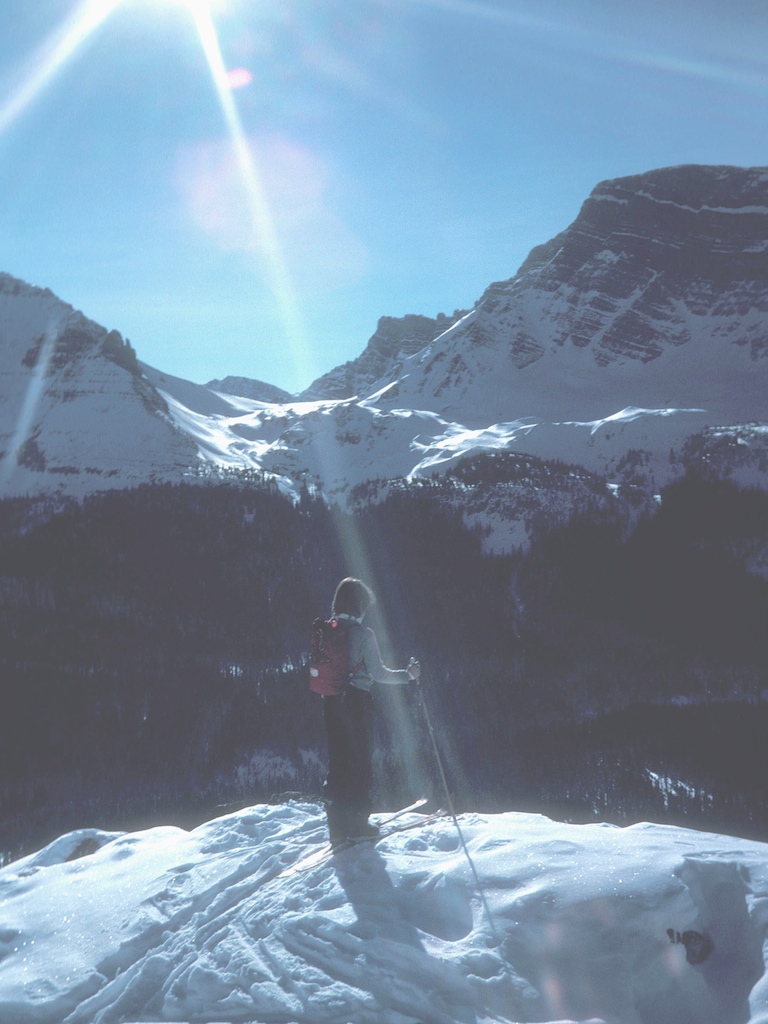
This photo is from a ski tour I did with my dad in about 1977 in the Canadian Rockies (maybe Dolomite Pass?). I’m ten years old. The gear I’m on is far less supportive than modern BC NNN gear, the skis have minimal sidecut, and yet the fun level is for sure at least as high as it ever has been, was, or will be. Yesterday I was out with my daughter; I was on high-end XC classic gear, she was on plastic waxless rigs. We both had fun. Skiing rocks, it’s not fundamentally about the gear but getting outside and skiing. I want to be clear on that, it seems some people are missing the point that gear is a means to an end, not an end.
That said, function and style are related. Personally, I like using functional gear, meaning gear that fits the use, no matter what the sport. If my goal is to do tricks in a kayak I’ll paddle my play boat. Creeks, you want a fat creek boat. Paddling a play run in a creek boat is relatively boring. Skiing flats on AT gear with skins on sucks compared to the same terrain on well-waxed race XC gear. I can not find one place where telemark gear is, for me, more fun, more functional or better fits the “spirit” of what I want to do, at least today. That could change; I did a lot of tele skiing in resorts for a while because it was more fun than alpine skiing there for me and a real challenge, but I burned out on that eventually. That was still a good period in my ski life, no regrets, but not where I’m at now. Function and style are not all exterior, a lot of what forms the definition of “fun and functional” is in the skier’s head. Some people want to run sick creeks in low-volume play boats. Cool, I’ll watch. I’ll skate up skis resorts in the early morning and fly on the velvet on the way down, that’s fun too…
Just to clear up where I’m coming from, if I could only have one set of skis/boots I’d run a set of NNN backcountry gear with metal edges. I can ski just about any resort run in North America on that setup (not rip it, but get down OK), ski set tracks, ski the back country, do just about anything. That’s the most versatile gear for a solid all-around skier who wants to ski anywhere. Not the best for skiing into ice climbs obviously (have to change boots), but it would work. The learning curve for this gear is brutal compared to AT gear, the best prep is XC race skiing. A lot of people are more into the yo-yo style skiing, or hucking their meat, great! I’ve got skis for that too, let’s play!
Some of the comments on the Teletalk site (ten pages and going strong) seem really defensive to me, like how the insecure and religious act when their God is questioned. Those secure in their faith are fun to talk with; those who scream, “Blasphemy” get old fast. Telemark skiing doesn’t need “defending” if it’s working for you and you’re secure in your belief that dropping a knee gets you closer to god. I just think telemark skiing has gone off in a weird direction, and so far it’s not coming back.
I did some telemark racing back in the day, but gave it up when an alpine-racing friend of mine (Jim Grossman, surely one of the more talented skiers I’ve ever seen) tried on some tele skis and proceeded to shred the course on his first run. He did a “pretend” tele turn, but really just rode the outside ski hard and relied on his years of alpine racing experience. His comment was, “Why not just parallel?” If you have to pose to compete then it’s getting closer to figure skating, and that’s weak sauce. On hard, consistent snow with big gear tele turns make little sense other than to pose. Trim yer goatee.
But the telemark turn is just as functional, useful and all-around fun to do as ever even if the gear named after it now has little real relation to the turn itself. I use the tele turn more on my lightweight “nordic” gear than I ever did in the last years of my “tele” career; on heavy tele gear I generally just do some version of the parallel turn . The telemark turn is great for dealing with softer conditions on lighter gear. In consistent conditions the parallel turn rules no matter what gear you’re on. Telemark skiing to me now means doing tele turns on light BC NNN gear during a big tour; works great.
I was cleaning out my garage yesterday evening (I’ve got a serious Cultfitter infestation going on, had to make some more room!) and found an old pair of Voile Mountain Surf skis, with cable bindings on ’em. They are my wife’s, and she won’t get rid of them because, “Old skis are like horses, you can’t just shoot ’em!” My old “tele” skis are gone, but I can see her point, even as the dust gathers on the old boards.
And, never forget, I’m a damned ice climber, not a skier, ha ha! The super-steep plice is destroying us!
 Photo to left is of a cool “Plice” (is it a plice if it has ice?) from my bud Tom Comet. And someone needs to tell me how to put photos where I want ’em…