Date: October 31st, 2010
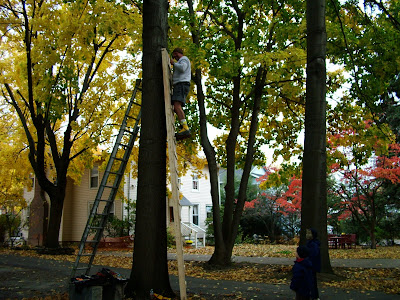
First off, specific training rules for performance results as measured by time expended and real-world results. I received the photos of a Pennsylvania “plice” (plywood ice,
like the one in my back yard) today, so cool! Nice one JW! Total cost: $82. No excuse not to have one.
Next, I don’t think I did a very good job of differentiating between “core” strength, body tension and “abs” in my last post. So I’ll try again to clear it up in my own head.
People wouldn’t have to work their “core” if they just did exercises that build a strong core instead of isolating muscles with exercises that exclude the “core.” Basically, almost every exercise done sitting down (even on a ball, maybe especially while balancing on a ball) is getting rid of the body’s natural “core” function, and will therefore result in a weak “core.”
Do squats, deadlifts, front levers, your core will be plenty strong. Do hamstring curls, exercise ball ab curls, exercise ball flys, etc and get a weak core and strong extremities, which leads to problems that may require “core sessions” to fix.
Put another way, if someone does leg presses, hamstring curls and leg extensions they are doing exercises without using the “core” and will have to work on that on a ball. Isolation breeds imbalanced weirdness in a body. Do squats, deadlifts, knees to elbows and your “core” will get strong at the same rate as the extremities. If your “core” is weak while doing any basic movement it will be the limiting factor in the exercise, and will get stronger. Cool.
Body tension is the ability to put your feet on the wall from a hanging position in a roof or steep terrain, and then to keep ’em there. Front levers and deadlifts are good for this. Even better is to climb steep terrain.
“Ab strength” is only part of the puzzle in body tension or “core” strength. Body tension must be trained as a whole; training abs to do crunches is worthless without also training the shoulders to hold the load. Doing L-sits is better than doing crunches because it also engages the leg flexors, but again misses the shoulder/lat component, and then again the hamstring lower back engagement (although it has more of that than twitching around on a ball with one side of the body supported).
I used to think isolating muscle groups was good. It is, for a body builder. For an athlete it’s all about training muscles t0 work together to produce useful power.
I’m happier with those definitions and ideas.
Otter, Westjet
I flew to and back from an athlete meeting in Tofino on Westjet, with a leg on Harbor Air. It was pretty pleasant overall, especially the Harbor Air leg on a old Otter on floats. I was in the seat right behind the cockpit, and got to watch all the dials. Because I’m close to my private pilot license I was able to understand a lot of what was going on; flaps, fuel, prop, etc., all pretty much the same. I kept searching for the RPM dial, which is really important on a piston plane, and finally figured out the Otter was a turbine… No huge RPM dial, ha ha!
The Westjet legs were good. I’ve got no status on Westjet, but as usual there were flight issues etc., what would have cost me $lots on Air Canada only cost me $50 on Westjet. Thanks for that.
Posted in: Blog
Date: October 21st, 2010
My ideal training environment has the following in it:
Some sort of ice climbing simulator thing (Plice).
A place to run around outside.
Rings, both Rock Rings and gymnastic rings, place to hang ’em.
Some weight and a bar. A stylie set of Olympic bumper plate weights would be nice, but I’ve got a bunch of weights we got at garage sales for pennies. They work fine.
Anything after this is gravy. Really. Exercise balls, machines, etc. etc. are somewhere between comfortable accessories and shiny garbage. It’s nice to have a squat rack and stands and so on, but it’s not necessary. I go work out with my friends down at
Athletic Evolution when I want the comfortable gear or a controlled environment (or for fun, good people), but you don’t really need anything more than a jungle gym at a kid’s playground and a rock. Or a tire…. There are a ton of
wicked workouts here that don’t require any gear at all.
I figure that about 90 percent of the machinery in the average health club is wasted space. Movements should be done as you do them in real life. A squat is not composed of a quad extension and a hamstring machine, it’s a movement that involves just about every single muscle in your body working together. I generally reject Crossfit T-shirt slogans (you shouldn’t wear T shirts with bad-ass statements on them unless you’re a bad ass) in general, but “machines are the enemy” is a good one.
Anyhow, I had a long discussion with a guy on a flight the other day about all the junk in gyms (he was convinced a lat machine was better than a pullup), and it bothered me so you get to read about it. The most ubiqitous POS in the gyms I visit while traveling (and I do visit ’em even if I can barely see the micro free weight area over the sea of machines) is the exercise ball. Exercise balls should only be used for rolling target practice at 200 yards. Want to involve some more muscles in a situp? Do a front lever or a knees to elbows or a windshield wiper or whatever. If you can’t do that then sit on the floor and try to balance on your own butt while picking your feet up. Anything can be scaled. Rolling around on a ball is only extremely useful for sports that require rolling around on a ball. Are you working out to get stronger in a useful way or working out to get better at rolling around on a ball?
But rolling around on a ball is better than rolling around on a couch for sure, so right on if you find it fun to get your ball on…
Now on to “core strength” as it relates to climbing and balls. I often get into discussions with people who think their “core” is weak for climbing. They usually can’t get or keep their feet on an overhanging wall. Most “trainers” will prescribe rolling around on a ball like a spastic to increase “core strength.” The ability to get your feet on a wall while climbing is NOT determined by your abs or anything having to do with that ball anymore than your ability to do a squat is determined by hamstring curls. To put your feet on the wall you need to be able to do just that motion–hang on two holds, swing up and place your feet and hold them there. You need more shoulder strength and front-lever style training than anything else. You could have the abs of a ball exerciser and not be able to do shit about getting your feet on the wall because, like the hamstring curler, the whole system has to work together. The shoulders, not the abs, are almost always the weak link. If I see one more “core” exercise for climbing that does nothing for actually climbing I’m going to burn the magazine I see it in on the spot. At least I’ll be able to work out in my jail cell.
I had coffee with a good bud of mine,
Greg from Crossfit Canmore, yesterday, and he made an interesting point that deadlifts improve his “body tension.” I had to think about this for a minute, but he’s right. If you’ve ever done a lot of steep-wall training for climbing or deadlifting you’ll notice that your hamstrings and lower back muscles (not joints or ligaments, muscle) will be sore the next day. Front lever training gets your feet on the wall, but holding them there takes a combination of dead-lift hamstring/back contraction (and every other muscle involved in that motion) and shoulder tension. If you had bomber footholds you wouldn’t even need any shoulder strength once your feet were on the wall, it’s all back and legs. Many good rock climbers I’ve trained with are disproportionately strong on their deadlifts; I think this is because they have strong body tension and REAL “core” strength.
My measures of “strong” core strength would be this:
-Can do 15 knees to elbows in row (and not swinging spastic knees to elbows, controlled leg lifts), or hold a half-front lever for 10 seconds.
-Can deadlift 1.5 times bodyweight.
Anyone who can do that is not in general going to have any problem with “core strength” or body tension in life or while climbing. Very steep routes or tougher forms of life may require more than that.
So, if you’re a climber that has a hard time holding your feet on the wall practice by hanging onto two good holds in a roof and swinging your feet up and “catching” holds with them, repeat with holds to the side, etc. The good news is that this strength does come relatively quickly compared to pullups or something. Some deadlifts may also help, as will knees to elbows etc.
Send your used exercise balls to me, I’ll take good care of them.
Posted in: Blog
Date: October 13th, 2010


I haven’t been
writing lately because I’ve been traveling a ton, trying to finish my private pilot’s license (maybe by December at this rate!), training a bit despite a really gimpy foot, etc. Plus writing about four articles for various publications, prepping for shows, climbing (went drytooling yesterday!), planning for 2011 and some other stuff like being a dad and finishing house projects. Life is great really, but sometimes there’s a lot of it to wrestle all at once. I feel incredibly lucky every damn day to be alive.
Social Media:
I’ve been on Facebook for a year, and it’s a fun combination of voyeurism, communication, posing and public heckling. I’ve also got this Twitter feed thing, Linkedin, and some other stuff I can’t figure out what the hell to do with. But at some point I have to ask this: Is all of this communication making my or your life better? More fulfilling? I’m still working through that one, and while I do there’s this cool vid on Facebook I’ve got to watch… Attention Deficit Disorder and the internet just had to be made for each other, it’s brilliant. What were we talking about?
Paragliding:
Over the years I’ve had a lot of people ask, “How do I learn to fly paragliders?” I wrote the following over the years to answer that question, here’s what I generally send back.
What I tell everyone who wants to fly is this:
-Flying is “time expensive,” especially when you’re learning. It’s going to eat about a minimum of 100 hours of your time to get going, plus dicking about driving to and from the hill etc. Once you’ve got basic skills it’s about the same entry cost as skiing without the lift ticket prices.
-Flying is the only sport I’ve ever done where you absolutely must complete a good instruction course or you will die. You may die even with good instruction. The risk is comparable to riding a motorcycle, but as the air is invisible the dangers just aren’t apparent without some good schooling. You’ll likely survive learning how to climb, kayak, cave, even maybe ride a motorcycle, but good instruction is critical to staying on the right side of the odds bet in the air.
-It’s very addictive. You may quit your other sports, spend money on tickets to warm places with thermals, and generally squander all kinds of time and money. In fact, you’ll need to do this for a couple of years to get a solid base level of skill.
-Don’t buy equipment until you have your basic ratings. Even then use the school’s stuff for as long as possible, and then either buy used from the school if you’ve got Moroccan bargaining skills, or have an experienced friend help you buy stuff off the web. You can get a solid used setup that will get you through your first two years of flying for about $2-3,000, and which will actually be worth something when you sell it ’cause you will want to upgrade, maybe $1500. If you have a fat wallet then by all means drop the $6K on new gear, your school will love you as they often make more money on gear than on instruction, good to understand this.
-If it’s sumer and the weather is reliable in your local area learn there. If the weather is not super reliable in your local area then go someplace where it is more reliable for two weeks and fly your brains out, get the basic ratings done, then continue your training locally. I like Point of the Mountain, Utah, and Santa Barbara, California in general. Lots of other good schools out there too and this is not meant to slight anyone, just that these two places have a selection of schools so you can find one that fits your personality, and the weather is generally reliable in both places. A good relationship with your local operator is important; even if you get your ratings somewhere else you’ll still want to get onside with your local school/shop/guru. Paragliding likely has the most retarded politics of any sport I’ve ever been involved with at the school level, it’s insane, but there it is, better to just recognize it and do your best to work with it.
-Your learning is really just starting when you get your basic ratings; if you can find a good local crew of pilots to fly with you will progress faster, have more fun, and be safer. I owe a huge debt to the all the “crows on the fence” at the two places I really learned to fly, everyone does. Do NOT be the guy who knows it all, you suck and will for some time. On the other hand some very good pilots are also idiots, you’ll likely figure out who is helpful and who isn’t pretty quick. Buy the guys who are helpful beer, they will become more helpful. If someone yells at you in the air figure out why, and remember that in the US a significant percentage of the pilots are armed. In Canada they’re just fierce and don’t need guns.
-I do not regret one hour of time I’ve ever spent in the air. It’s great, have fun, stay open, learn, yeah!
Right, I’m back on the blogging train, yeah! I hope your fall is going well, it’s finally Indian Summer here in Canmore, which is gorgeous after a truly horrendous August and September. If we hadn’t had the last two weeks of good weather I’d be booking tickets to Vegas or something, it was truly a dire late summer here in the Canadian Rockies. But now it’s perfect, stoke!
Posted in: Blog