Date: May 31st, 2010
.jpg)
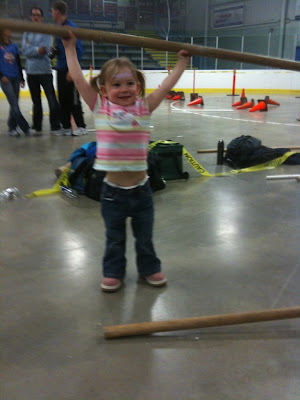
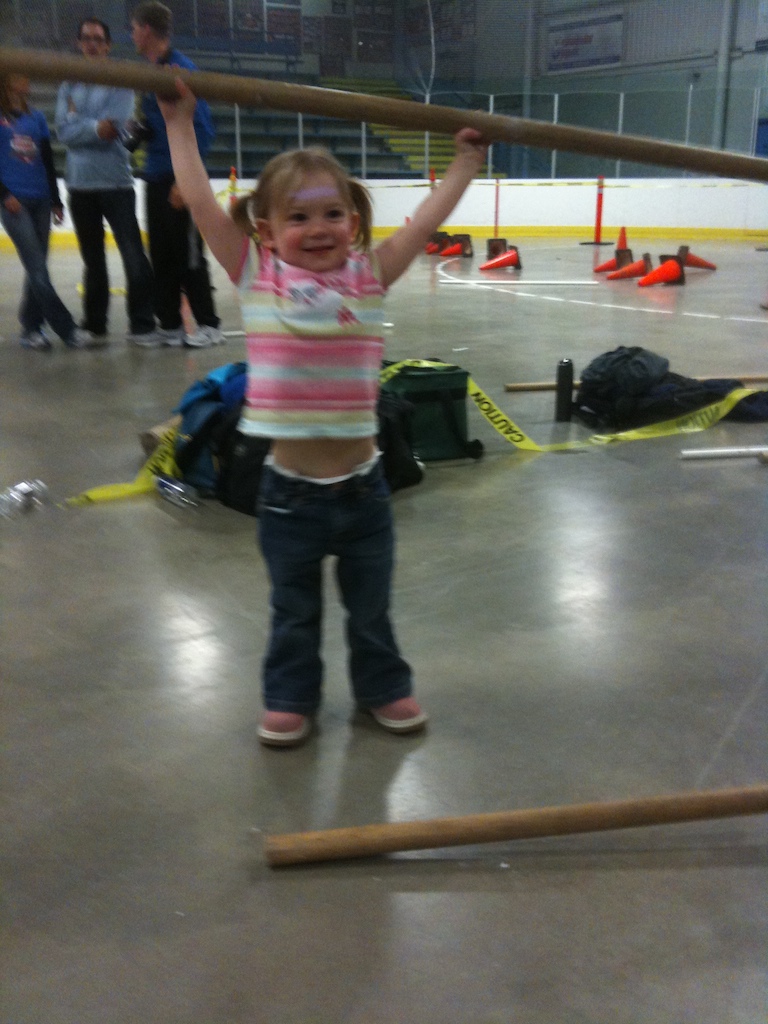
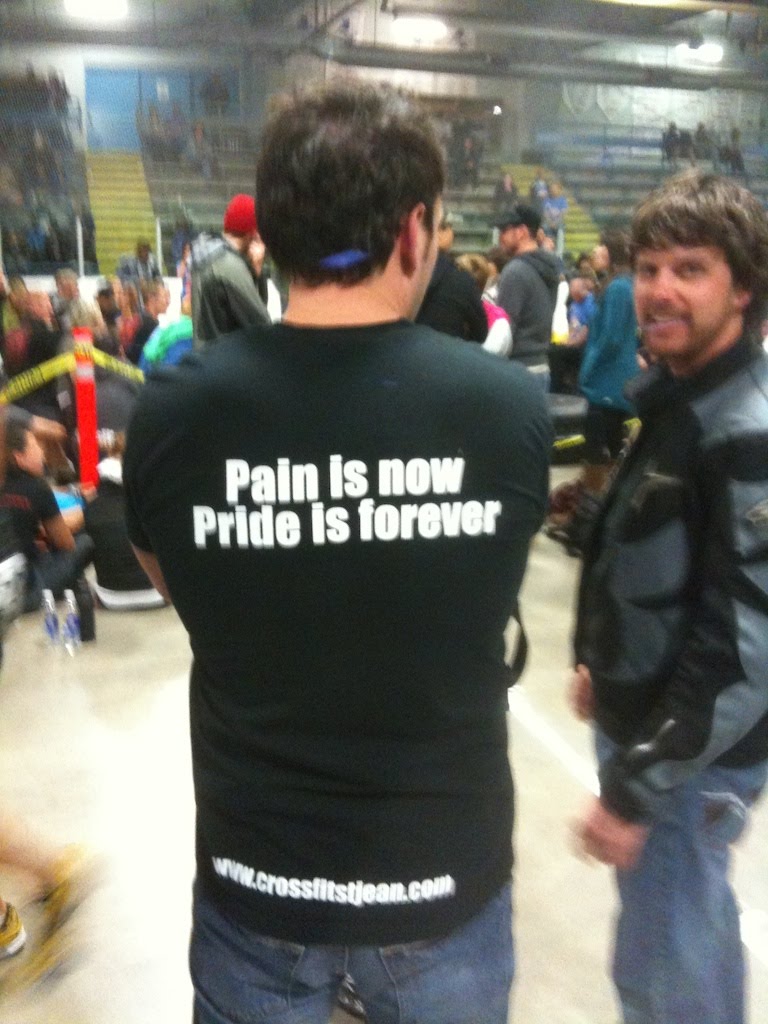
I spent the weekend cheering/coaching my wife, Kim Csizmazia, and all the other athltes at the Canada Crossfit Regional Games, which are a sort of athletic torture festival. Athletes at the Regionals have already qualified through a “Sectional,” and a top six result at the regionals will send them to the Games finals in California. The competition is fierce, the events nasty, and the effort level high.
I wrote most of the following as notes on my phone during the event, so it’s a bit rough, quick sort and here it all is:
Impressive:
-Masters. The over-50 athletes are strong, every time I caught a little of their action I was incredibly stoked. I would love to be over 50 and still putting strong numbers like theirs. Solid.
-Crossfit athletic skills. Double-unders (skipping two revolutions of the rope per jump, it’s harder than it sounds), overhead squats, wall balls, etc. If you didn’t have these skills dialed you were going home in the bottom of the pack. Watching someone bust out 50 double-unders without breaking a sweat is impressive, give it a try… The level is now high.
-Going hard. These athletes try hard. That “dig deeper” effort is a hard thing to teach, but Crossfit does a uniquely good job of getting people to reach way outside the individual comfort zone many people never leave. Respect for that, it’s one of the most valuable things Crossfit can teach.
-Ability to do an incredible amount of work for short (under 20 minutes) time. Tire flipping, clean and jerk, running, going like a total nut case for about 10 minutes for the winners. I’m super impressed, that’s sick.
-Physical results. The top athletes, male or female, were physically impressive, and also impressive for what they could do. I did a workout in a local gym one day during the event, it was funny to watch a guy doing bicep curls after seeing a CF woman bust out sets of 20 pullups straight (full ROM too). No arguing with the look of the athletes, if you wanna look good naked this stuff works.
-Good vibe. Overall very positive, pretty much standard stoke for any good athletic event.
-Kim. She has a hip that’s been resurfaced, a gimped knee, she’s 42 and many other things that generally don’t help athletic performance, but she gave it the whole comp and placed mid-field despite starting this up only nine months ago. If she could do double-unders she would have been ten places higher. Solid.
-The women. Crossfit is a great venue for athletic women to fit in. Kim said, “I’ve found my tribe.” There’s truth in that. A lot of the world still would prefer women to wear dresses and sip tea in the shade. Crossfit is for everybody, but I think it might be uniquely suited to bringing out the athletic best in women. Cool.
-The mental strength of the top competitors. I always watch for this in athletes, it’s usually the biggest determining factor between winning and not. The top competitors were STRONG in their heads, cool.
-James Fitzgerald, of Optimum Performance Training. This guy is obviously one switched-on dude. He was quickly on weak judges, always cheering athletes, and generally giving it everything he had. It takes an army of hard-working volunteers to make a big event work, but the tone and direction comes from the top, and “OPT” did a great job from what I could see.
I’m less impressed with:
-The run. It was a 5K run, mostly on grass, damp mud and paths, Kim and I checked it out an hour before the race and thought it was a fun course. It was supposed to be 6.7K but the organizers cut out 1.6K at the last minute because it was “too dangerous.” I ran the “dangerous” portion of the course immediately before the event, it was muddy but not bad at all. You’d think a bunch of people with sayings like, “Today is a good day to die” on their shirts could handle a little mud and even the possibility of a muddy abrasion or two, eh?
-Running times/skill. I’m sure an average junior high school trail runner would kick ass on all but a few of the running times (which, for some reason, weren’t kept, just places), and an average trail racer would destroy all the times (and a trail racer would get destroyed on clean and jerks, but these athletes are meant to be “elite” generalists–this level of physical performance is like a 90lb bench press). I ran most of the course with the men to see what parts had been cut from my scout an hour earlier, their pace was generally anemic (and I’m a below average runner), as were the times I recorded. I ran almost all of it again with Kim ten minutes later, she was gimping hard on her hip, hadn’t done any real running in ten years, and still finished mid-pack (which is a good effort for her). Several women and men would have easily gone to the games if they hadn’t sucked so bad on the run. it was obviously a huge hole in their training even compared to the performances of others. This level of running fitness is tragically low, and really rips the heart out of the “Fittest Athlete in the world” hype for me. Running is a basic athletic skill, the Canadian CF programming is weak on this skill, no way around it.
-Event organization. Crossfit is a young sport, and young sports always have teething problems, but this event really, really needed an experienced event manager. Maybe there was one, but starting the running race almost two minutes early (there were women running hard for the start line 30 seconds after the gun went off) and a few other errors I saw like that hurt the event’s credibility. CFers suck this sort of stuff up (
read this woman’s comments on her wall-ball experience), but it’s not right.
-Communication. Kim had to restrain me from going and grabbing the microphone and doing some announcing on the last day–there were a lot of spectators there, but nobody was getting any useful information or even PSYCHE over the PA. Here are some athletes doing some RAD shit, and the announcer has nothing useful to say at all about what they are doing, who is in the lead, fastest time in the heats so far, nothing. If Crossfit wants to make these games spectator friendly, and I fully think it’s deserving of spectators, then it needs to be more spectator friendly! I was so stoked by what was going on, but unless you personally knew an athlete there was no way to figure out who was battling, or how the heat was doing relative to other heats.
-This lack of organized communication is a real problem with the Crossfit Games organization as well; the Games web site is getting better, but it’s still near-useless compared to what it could be with a little work. There are no athlete bios (beyond the occasional “featured” athlete) so you can’t click on a results or registered athlete page and know how old an athlete is, where he or she is from, what they weigh, sporting background, etc. I’m sure every CFer in Canada and likely around the world was checking the event out, it would have been a lot better to have all this info available, and it’s relatively easy to do today.
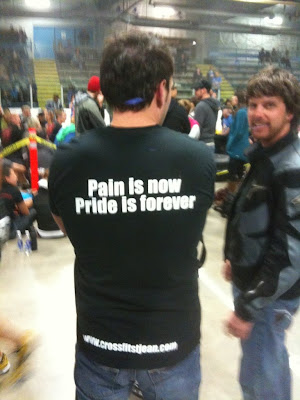
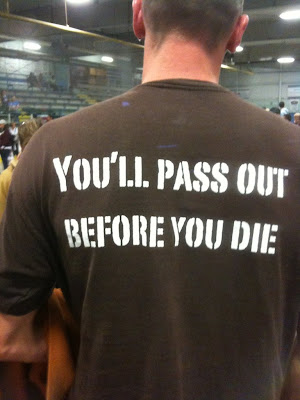
-The hype, the “Ultimate proving ground for the world’s fittest athletes,” the T-Shirt slogans, “forged” stuff. This type of poseur rhetoric is a lot like the fat kid on the playground telling everyone how he’s going win the elementary school running races the next day. No he’s not, and you know he’s not cause the kid who is going to win is out playing soccer…. Crossfit kicks ass on all general physical training I’ve ever seen, it is highly athletic, so talking big only makes it look weak. Talking all this smack about “being the fittest” is a form of “
Compensatory behaviour” in psychological terms. When someone talks endlessly about how great they are they’re usually not secure with their own worth or accomplishments. Crossfit obviously isn’t very secure in its own rightful place as a worthy form of training and athletic event; grow up, get rid of the insecure hype, and celebrate what Crossfit is.
-Weak Calves on almost all the athletes. This relates to the run; most of these athletes must spend most of their time on relatively stable, flat surfaces, the relatively weak lower leg musculature shows it. More running, more time playing sports. “Paleo!” is a big rallying cry in the CF world, no paleolithic guy or gal had weak lower legs.
Overall, I completely dug the Games, it was a worthy experience to watch even if Kim hadn’t been there. I’m proud of her, she put in a hell of an effort. Watch out in seven years, we’re both gonna give ‘er in the Masters!
Posted in: Blog
Date: May 28th, 2010
It’s been a really good spring for interviews with top rock climbers. Climbing’s “The Low Down” just did an OK one with Dai Koyamada, surely one of the all-time best boulderers on the planet. He is repeating cutting-edge problems in short order, while living in a country without very many high-end technical rock climbers (Yuji and a few others obviously are amazing, but Japan isn’t Europe).
Part of becoming really good at any sport is hanging with the best in the sport, at the places in the world with the best venues for the sport. Surfers go to Hawaii, Sharma moves to Spain, Graham to Switzerland, etc. etc. That Koyamada does what he does in relative isolation is extra impressive to me. This “get together with the best” program is important no matter what your climbing level; the fastest way to go up a grade or two technically is to climb with people who are a grade or two better than you. Anyhow, in keeping with Ondra, Sharma and others, Koyamada describes his training as, yep, climbing:
For training I just climb in the gym. But I climb kick-ass hard problems and volume! And I also do campusing occasionally.
If anyone has any doubts about what basic training apparatus is required to become a stronger, better and higher-performance climber the last three links to interviews with the best climbers in the world should remove them. Want to be a better climber? Climb. Of course there’s some art and science with quantity, quality and programming, but that’s secondary and not that hard to figure out if just get a little guidance from a book, coach, friends, whatever, and track your performance.
Specific injuries, rehab, etc. may require gym time as
Clyde Soles noted in the comments.
Personally, I’m doing some Crossfit-inspired programming for general fitness as well as short rock and gym sessions, along with paddling, mountain biking and running. Yeah, I’m a multi-sport mess, but I’ve got some goals that are going to require high fitness in three different sports, so stoked!!
My elbow feels good, but I am sure that if I push it too hard it will blow up, I need to build it up slowly. I’m also getting some great results with these
thera-bar exercises, which is what I’m going to do as soon as I stop typing on here.
Today’s workout is going to involve a short (45 minutes of movement) session at the climbing gym, followed by moving a ton or two of logs (we heat with wood, time to get next year’s wood!), then driving to the
Crossfit Canadian Regionals in Okotoks, which my wife, Kim, has qualified for! I’ll likely run part of the course before she has at it this evening, busy day. And some kid wrestling….
Posted in: Blog
Date: May 24th, 2010
There’s a lot of information on the web and in print about how to get stronger for rock climbing, but very little on how to actually get better at climbing. Those two aren’t the same thing. Being stronger will help, but really you need to climb a lot to get better at climbing. Anybody promising that doing any form of non-climbing training will make you a better (better means climbing harder) climber is flat-out missing the point. I really mean that: If you want to climb better then climb, and structure the vast majority of your training around climbing or climbing-based skilled movements. Why this is so hard for people to understand I don’t know, but let’s flip the argument around for a minute: If you wanted to be a better Olympic lifter would going climbing help you more than doing Olympic lifts? No. So why would traditional weight lifting make you a better climber? I have yet to see anyone fail on a route because they couldn’t do enough bicep curls, lunges, weighted pullups, or bench press. Not once. But I have seen those with huge biceps, quads, and pecs fail on 5.9, which is a grade anyone not clinically obese, missing more than two limbs or massively brain damaged ought to be able to climb on TR after a few days of actual climbing. Enough said.
Then I finally read something that actually makes sense, like Dave MacLeod’s training blog. I’m sure Dave and I could find something to argue about in terms of climbing performance, but it might take a while. Here’s a quote I like from the same blog about moving fast (one component of climbing well under duress):
“Climbing fast comes from being good at climbing. And being good at climbing comes from having a lot of routes under your belt. So if you realise you are climbing too slowly on a redpoint, but can’t seem to go faster without making mistakes, there’s no shortcut unfortunately – if you clock up more routes, you’ll slowly be able to make movement decisions quicker.”
Lots more there, worth a good long read.
Now it’s time to start rock climbing again. I’m in sad rock climbing shape, but most of my winter injuries are healed up (I can get my feet into rock shoes again, elbows healed up pretty much, etc). I’m also paddling a fair amount through May and June, and have a hideous travel schedule in June and July, so my climbing training is going to have to be effective to get results. I’m going to post what I’m doing with my overall and specific rock climbing training time on here, which over the next six weeks will amount to about 6 hours a week of actual climbing time at the most. I aim to be back to onsighting at a reasonable (for me that’s 5.12c or so more than 50 percent of the time) level by August 15, which is when rock season gets really going for me, and when I have a few big rock climbing goals to throw myself at. Giddyup.
Posted in: Blog
Date: May 21st, 2010
Floyd Landis finally admits he WAS doping. I had a conversation with a friend about this just last week; I thought it likely that Landis was doping, but still had some doubts based on Landis’ exhaustive defense. My friend said the lab screwed up, and he had a whole list of rationalizations and conspiracy theories to explain the positive drug test. Finally, the truth is out: Landis is worse than just a failed doper, he’s a long-term lying doper. The guy extracted almost a half million dollars to defend his “innocence,” but it was all lies. I wonder how Landis feels about that? I wonder how the people who gave him money based on his and his mennonite family’s “ethics” feel about it all? Is there a lynching in the works?
I could almost have some respect if Landis had of simply said, “I doped, everybody is doping and I went along with it, and I got caught.” OK, we all know pro cycling is full of doping, fair enough. But this circus that Landis put on has done massive damage to pro cycling, and bike racing at all levels. Who wants to be associated with a sport defined by lying drug uses? Landis of course accused everyone of doping, and that’s believable to me. The mountains of circumstantial evidence around Armstrong’s doping are just that, same for all the other riders. Whether they are or not, the Landis saga has now painted ’em all as doping liars. It’s basic psychology 101 to never believe what an addict says; why do we treat these riders any differently? They’re a bunch of addicts on bikes, no difference.
Why do I care? I guess it’s because I want the best for all athletes. I want to believe in the power of the human mind and body to overcome obstacles. I want to believe in the Landis staging a dramatic comeback from a horrible stage. When somebody dopes it knocks my belief in the magic feats of athletes down a peg, and that pisses me off. It’s childish maybe, I should be more cynical, but I’m not. One of the reasons I love outdoor sports is that doping, as far as I can tell, just isn’t much of an issue. Some fool might be on the juice to climb harder, but I’ve hung out enough with the best sport climbers, alpinists, back country skiers and so on to feel confident they aren’t doping (well, maybe smoking green stuff and pounding Red Bull!). When Steck climbs the Eigre in an incredible time I feel confident his ascent was “clean” from a performance perspective (insane from my risk standard, but not his).
Anyhow,
I wrote about Floyd Landis back here, boy was I a sucker. My message to Landis, for what it’s worth, is this: Fuck you Floyd, not because you doped, but because you lied about it for four years. You’re Madoff on a bike, suckering money, support, even dreams from people, all the while knowing you were a liar. You’re an addict; you can clean your life up and move on, but it’s gonna take a long time of living well to get over this mess.
Posted in: Blog
Date: May 11th, 2010
As most who follow Alpinism know, Steve House had an accident on Temple a month or so ago. I saw him in the hospital, he was a mess but in far better shape than not being a mess (Being alive sucks sometimes, but it’s better than the alternatives). Anyhow, he wrote an interesting report on his blog, which got me going on his training blog.
I am a very firm believer in looking at what the best in any sport (or business or whatever) actually DO. There are many coaches who have a lot of theories, but I always look at the very best to see what got them in that position, and then work backwards. It only makes sense, but many athletes somehow follow some junk-science “program” that does little to nothing for their performance levels. In the spirit of examining “the best” I posted a link to an interview with Adam Ondra, likely the current best sport climber in the world, so that others could look at what the best did there. It is much harder to define “best” among alpinists, but Steve House is certainly successful, and is a thinking alpinist for sure. I think his training regime is instructive for anyone who wants to be an alpine climber, good of him to share it. Check out his training blog, it has some useful info and thought, and the last entry is an account of his fall on Temple and also definitely worth reading.
One of the things I’m working through in my own training is intensity, and Steve gets into that in a way I can relate to. About 20 years ago I blew up as a sport climber due to too much intensity, and then I blew up (injuries, headspace, etc) due to too much volume. As Steve notes, any training is training, and we can only handle so much of it. I’m feeling incredibly good at the moment due to a few days of rest; I was likely training too intensely in the last month, and not allowing myself enough rest. My back is still injured, but I WANT to train today, and that’s a sign to me that I’m back fresh. If a workout is drudgery then you’re over-trained… Get really overtrained and it may take a month or more to totally recover, and there are still sport climbers form the 90s battling chronic fatigue and other issues brought on by horrendously hard training regimes with famine-like diets, that was a very, very bad combination for a lot of us (we would all have likely been better off just eating high-quality food instead of the caloric restriction and resulting mental waste of time).
Anyhow, good reading from Steve, who I course wish a speedy recovery to!
Posted in: Blog
Date: May 9th, 2010

I injured my back last monday, and made it a lot worse on Thursday. Now, injured is a relative state–I define an injury as anything that keeps me from going 100 percent, or having full function compared to historical levels. My back first “twinged” while doing the 21-15-9 Snatch/chest to bar pullup combo last week. I did it as prescribed, meaning 95 lbs, ’cause I can snatch more than that relatively easily, why not try? I should have scaled way down to do 21 reps of course… So this injury is my own damn fault, as most are. I felt strong on the snatches and pullups, and went hard, especially in the last set, trying to get it unbroken, and set a competitive time (ha!). I let my back round out a bit (OK, a lot), jerked the bar a bit (OK, a lot), and basically did piss-poor quality snatches (true). I was racing the clock, myself, etc., and not focusing on what is for me a technical and complicated lift, the snatch.
My back was darn sore and tender the next day, and not in the good muscle sore way, but it didn’t prevent me from working out, and doing a quick paddle session across the Columbia Gorge in my boat (fun in the wind and waves!), as well as a workout at Crossfit Hood River on Wed (thanks for that!). But on Thursday my daughter was using me as a tree, and I was bent over with my back basically parallel with the ground when she jumped forward onto my shoulders. I felt something “pop” or chunk in my lower back where it was already a bit sore, and I’ve been messed up (barely walking at first but getting better fast) since. My back was strained a little already, my daughter just loaded it up in a weak position. Feels like L2, but hard telling, and harder knowing what is wrong without a lot of testing that likely won’t add much to the recovery prescription, which is to go easy for a bit and then re-develop function and strength with time as pain permits. There’s not much that can truly be done for back injuries, even surgery (for chronic pain vs. broken bones) has a relatively low success rates. Anyhow, I’m already doing way better, but it’s made me think a a lot about about doing complicated strength motions for time (for me–likely just fine for many people, I’m just not real good at moderation).
My only other injury this year was a tweaked shoulder from doing kipping pullups really fast. The kipping swing is brutal on shoulders when you’re trying to punch reps out against the clock. Hmm, does my mild kipping shoulder injury have any parallels to my back injury? Racing for time, complicated motion? Hmmm….
What I’ve learned from this:
1. I’m not going to do any sort of highly technical lift or movement with what is for me relatively heavy weight for time. Lift heavy, go for time, but not at the same time.
2. I will drop the weight to less than half my max on any workout involving a race against the clock. Or less–if the goal is more work then less weight may mean more work…
3. I’m not doing full kipping pullups anymore, it’s too temping to use shit technique in order to squeeze fast reps out at the expense of my shoulders. Maybe I’m getting old, but for me the most efficient kipping pullups are done on a “relaxed” and therefore unsupported shoulder, mine don’t like that motion at all. I’ve had almost zero should problems over the years, it was a surprise to have ’em with kipping pullups. I’ll still kip, just not full-out butterfly kip, and I’l keep the support muscles of my shoulder engaged, not relax dead-hang style on the swing. If I can no longer support my shoulder I’m getting off the bar until I can. Plus “strict” pullups are more manly, no more swinging around the bar like a d-bag, ha ha!
4. I see a lot of videos of people doing CF workouts with rounded backs, poor squats, chin below the bar, etc. etc. (like I’ve done!), even on the main site front page. This sort of shit technique obviously helps to get a faster time, but I don’t think it’s a good idea in the long run, at least for me. I would much rather be a healthy athlete long-term than a faster CFer. You can’t perform if you’re injured.
5, My first goal for CF workouts is now excellent form. If a rep isn’t done in good form then it doesn’t count (for me). If my workouts lose ten or even 50 percent of “work” done then I’m fine with that, I fucking hate being injured, and both of my recent injuries have involved racing the clock and using bad form in complicated movements as a result. If you’re Rob Orlando then maybe you can round your back with a deadlift of twice your own bodyweight and apparently not suffer injury; me, I’m a skinny-ass climber, that sort of poor form is going to leave me messed up, as it has twice now.
6. I’m not bagging on what anyone else does; give ‘er. I love being stronger and more functional, I just want that path to continue and not lose time ’cause I messed myself up. If you can bust out 200 pound snatches for time without injury then you’re rad, I just figured out that I’m not at this type of training and have modified my approach as a result.
So, form first!
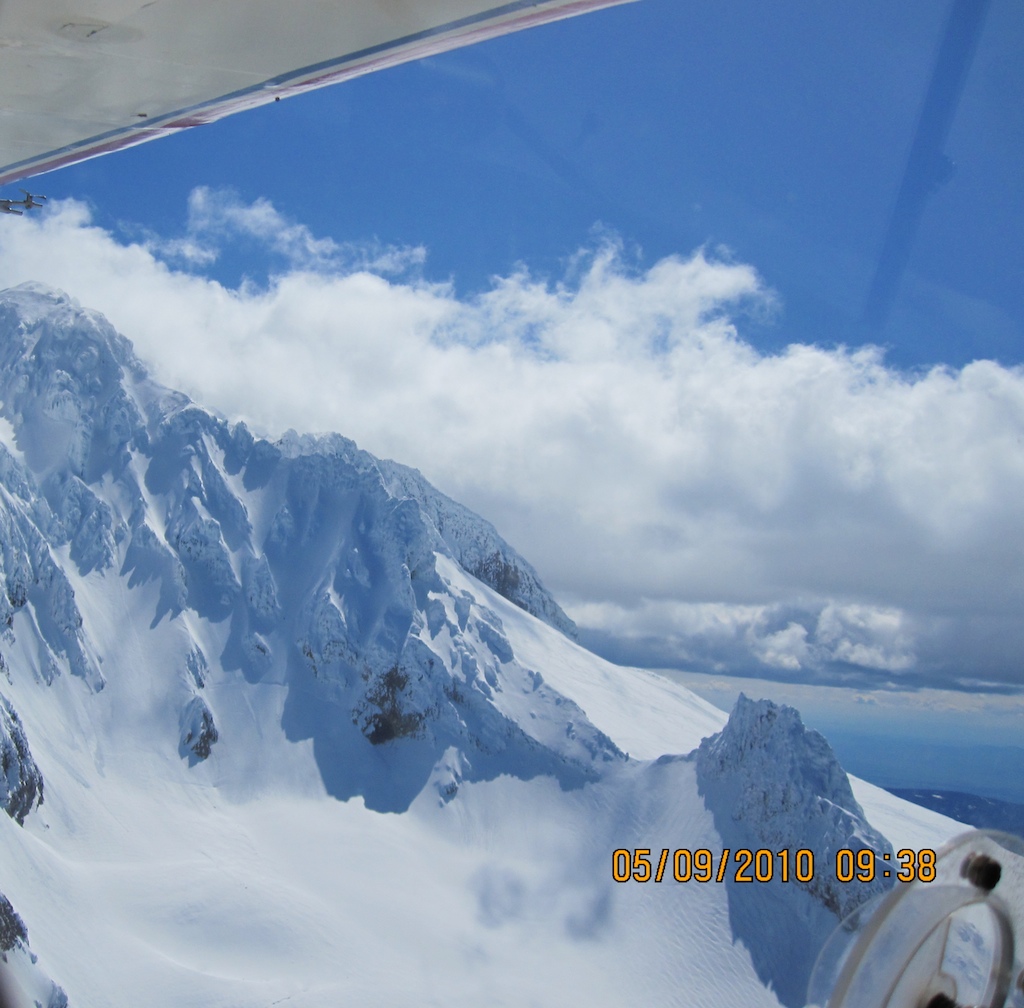
In other news, life in the Gorge is awesome, I’ve been out flying a Piper Pacer every day (even with a tweaked back) with Kim’s dad, Joe, today we flew around Mt. Hood, fantastic! I can even taxi the thing sorta straight at a walking pace now, that is one twitchy plane. I’m fine in the air, but I’m definitely not going to be taking off or landing it anytime soon. Amazing plane, feels like you’re wearing it. The difference between it and a Cessna 172 is the difference between a Ford F-150 and a Lotus. In the spirit of getting slapped down that I’m experiencing this week, I’m no Lotus driver! But I am still having a damn good time, yeah!
Posted in: Blog
Date: May 2nd, 2010
A year or so ago I read an interesting book by Malcolm Gladwell, Outliers. Gladwell looks at why some people on the edges of human potential, or “outliers,” succeed brilliantly while others don’t. Extremely high I.Q. people who don’t succeed at much of anything are contrasted with less bright but still smart people who dominate intellectually. Why does one person succeed and not the other?
A repeated theme in the book is that you don’t necessarily have to be the smartest/strongest/whateverest but you do have to be smart enough, strong enough or whatever enough, and then you have to have the right environment in order to succeed. You don’t have to be seven feet tall to play in the NBA, but you do have to likely be at least six-two. Six two is the threshold (I just made that number up, don’t have the book anymore, but I imagine you get the idea). So, for different mountain sports, what are the thresholds that mean “good enough?”
To start with, I believe that performance is the acid test of any training program. We all choose to train three main performance components (our skill, muscles, and head); how we perform is the test. An athlete’s performance will generally depend not on which one of these three are the strongest, but which one is the weakest. The absolute strongest athlete often doesn’t win a climbing competition; the guy or girl with adequate strength and excellent skill combined with a strong competition head usually wins. We all know climbing gym monsters who can’t lead 5.10 on real rock. They don’t have the skill or head part. But, and this is the almost funny part, the easiest things to train are muscles, so that’s where most people focus most of their time while trying to get “better” at a mountain sport. I really believe this physical-centered approach is wrong for most athletes in the mountain sports I know.
In my experience the fastest performance gains for athletes are usually made when they train their sport-specific weaknesses, specifically skills. I try to get the athletes I work with to attack what they are worst at first; many times that means reading sports psych books, or changing their training to reflect competition stress, or some other aspect beyond just moving things around physically. But, and it’s a big butt, if they don’t have Gladwell’s “Threshold” strength then they will also need that. Any athlete can also use a fully functional body, and a general physical prep program is good for that. A GPP approach is also great for athletes who switch sports around a lot, as I tend to do.
So what are threshold strength levels for a few different mountain sports?
With zero scientific methodology I’d offer the following threshold strength levels for what I would call a “solid” level in each sport:
Alpinism:
-Hike up 3,000 feet in under one hour, 5,000 feet in under three (Messner could reportedly do 1,000M/3,200 feet in under 30 minutes or something…).
-Do 10 pullups (not because pullups are necessary, but because anyone who can do 10 real pullups is sorta trained up)
-Do “Angie” in under 20 minutes if you think you’re “elite.”
-Climb grade IV ice all day on minimal gear and be relaxed about it, lead 5.6 with a pack.
Technical rock climbing at a solid 5.13 level
-Do 10 pullups on a half-inch ledge.
-Hang a 1 inch ledge for 5-10 seconds one-handed.
-Campus up the smallest rungs in your climbing gym.
-Climb ten 30M pitches of modern mid-5.12 a in a day (all different pitches, no laps).
Trad Rock climbing 5.10:
-Do one pullup on a one-inch rung.
-Do three pullups on a bar.
-Hike 1,000 feet vertical in 30 minutes.
-Climb all day on 5.7 and still think it’s fun.
Kayak class V and up with physical reserves:
-Mountain bike for an hour straight without having to stop and gasp.
-Row 2K in under 10 minutes.
-Bench their own weight.
-Play anywhere in a class IV run.
Mixed climbing M12 (without trickery):
-Ten pullups with tools staggered lower head to upper spike.
-Front lever for two seconds, 20 knees to elbows straight.
-One-handed hang 20 seconds, 20 seconds other hand, repeat for ten cycles.
-Onsight M10 sometimes, always do it second try.
Ski Touring
-Gain 3,000 feet in under one hour even after smoking up.
There are definitely people who will be able to meet the technical standard without having the threshold strength, but by and large these are the physical standards I think are required if an athlete is to be at a roughly equal personal level (strength, skill, head). Chances are that if you have these strengths then you can get the day’s job done at that standard. If a kayaker can’t bench his or her own weight then they are paddling without a physical reserve and are relying instead on reserves of skill and headspace. I see physically strong paddlers get bit off because they lack skill and headspace more than I see skilled but relatively weak paddlers get into trouble, but I see both regularly. Often the paddler doesn’t know he or she is weak or has lost skill… A paddler who is strong in all ways is better than one who lacks in one area, and one day that raw strength is going to really, really count.
But I also put a sort of “skill and head check” in each list; many people claim to want to climb 5.13, but can’t climb ten pitches of mid-5.12 in a day. They can likely siege a 5.13 into submission if they have the threshold strength, but they won’t be doing a new 5.13b in a day with regularity (and that’s what climbing at that grade means to me for the purposes of this discussion). I know a few “alpinists” who can hike up hill like mad, but can’t lead basic water ice smoothly… They will not succeed on major winter alpine objectives without a basic skill set.
So, are you strong enough, skilled enough, and mentally together enough to actually perform at the level you want to? And if not, why not? This is where it gets interesting, and self-examination becomes more important than another set of squats. Which may also help, but if you’re at double or triple the threshold strength for what you want to do and still not getting it done then perhaps it’s time to try something different. Immediately. And if you’re not at threshold strength then you’re very late for a training session.
This stuff is really fun to think about, especially as I work through my own goals, limitations and successes with my own sports and training.
Posted in: Blog

.jpg)