Date: July 31st, 2011
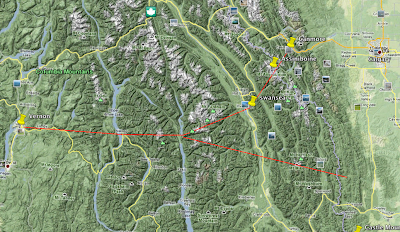 From here to There?
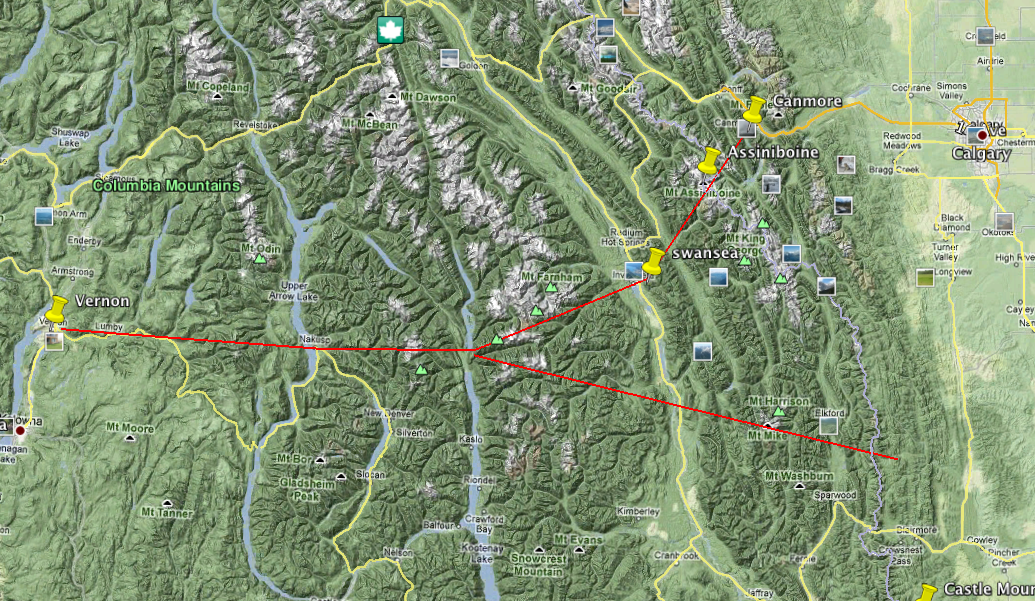
After two weeks of frustrating delays due to bad weather I’m off at one tomorrow morning on a Greyhound bus to Vernon, BC, along with my glider. The basic idea is to ride the dog 350k west to Vernon and then try to fly and walk back home or to the eastern edge of the Rockies somewhere. I should be walking from the bus station toward the Vernon paragliding launch by about 8:00 in the morning. Beyond that I don’t know much other than there’s a lot of mountain terrain (all of the Columbia and Rocky Mountains) between Vernon and here. There aren’t any “rules,” but I want to do it all under my own walking power or by flying thermals, and do it self-supported meaning no chase crew.
The inspiration for this trip comes from a few places: The incredibly cool
Red Bull X Alps that just concluded, and the uber-suffering Tour Divide/
CTR bike races. I raced the Red Bull X Alps almost ten years ago, and loved covering terrain by foot and in the air, it’s a magic combination. The
Tour Divide bike race is a self-supported monster-length backcountry bike race from Banff, Alberta, to the Mexican border. The Colorado Trail Race is similar but more on trails and less on dirt roads, and crosses Colorado by mostly burly single track.
My brother, Toby, starts that race tomorrow, so there will be some suffering Gadds by eleven or so tomorrow morning. What I like about both bike races is that racers bivouac wherever they can; in a hotel if they are near one, but mostly just by stopping beside the trail and sleeping. The rules in both races are “no non-commercial support,” meaning hotels and gas station food is OK, but you can’t have yer mom bring you a sandwich because that’s not there for all racers.
All three events are races, and each is about taking a cool line across the terrain than just the fastest line. The Tour Divide follows the continental divide as closely as possible, the CTR takes the proud mountain biking line across Colorado, and the X Alps traverses most of the chain from the mountains to the sea. All of these events are races, but the on the X Alps each athlete has a “supporter” driving a van loaded with happy little presents like clean socks and food. This is good, as the vast majority of the walking in the X Alps is on paved roads. I hate walking on paved roads (every athlete in the X Alps is far tougher mentally than me, I would shoot myself in the foot before I’d walk like that again on paved roads), and in the Alps it’s nearly impossible to be more than 10K from a paved road. I also like the self-reliance concept of the long bike races, that suits my individualistic style more. And I’m not going to race anyone; if I land high on evening I intend to enjoy the place.
One of my paragliding heroes,
Pierre Boulliux of Sup’Air (one of the sport’s originals, along with my friend
Gin Seok Song, who runs Gin gliders) also did a lot of what he called “Vol Bivouac” flying in the alps. The point of this flying was to fly and stay high in the mountains, and what I want to do probably most closely follows this ideal. Some of the Pemberton monkeys are also on this program.
So my idea is to walk on paved roads as little as possible, ditch the “supporter” concept, and fly far while camping high. The forecast is pretty good, there’s a lot of interesting terrain between Vernon and east side of the Rockies, let’s see what happens! Ideally I’ll fly during the peak hours of the day, then land high in the alpine, go for a bit of a walk around the landscape I love being in so much, and then take off in the morning from a happy little high alpine meadow (unfortunately our mountains lack the cows of the alps, so there are far fewer perfect little meadows, but there’s the idea). If I land low in a valley I’ll beat my way through the BC brush back up to the alpine or a logging cut block and take off again. If I can walk on a trail or even logging road I’ll do that, but I flat-out refuse to walk on paved roads just to make distance.
Another huge chunk of inspiration is really the biggest source of motivation for me: Flying in remote areas. I’ve flown all over the world, but the mountains here in Canada are relatively unique because of their low population densities. I’ve done two or three forays into remote areas in the Rockies, but by approaching the Columbia and Rocky Mountains with a sleeping bag, tent, food, and expecting to land in remote areas I’ll be totally mentally free to fly the coolest lines, not just the lines near roads. In paragliding we often talk about “Tiger Country,” or places with no retrieve. I’m aiming for those places on purpose. I want to get high over Vernon, look east and take the best possible line even if there are no roads there to get retrieved on. I think that’s going to be a tremendous feeling of freedom, of throwing off one of the most basic ideas of paragliding, to land somewhere where you can get back to where you took off…
My good friend
Othar and the Red Bull X Alps team is also
planning to run a race somewhere in Western North America next year, which I’ve been helping a bit with. Othar and I talked about doing a long hike and walk trip in Canada (we also did one in that involved hiking completely across the Andes with our gliders but not flying once!), so maybe my trip will help out a bit with understanding the unique challenges of an X Alps style race in North America’s much more rugged mountains. Years ago my friend Jim Grossman and I flew our motorized paragliders across the US too, so there’s some history in this idea.
I figure it will take about a week; I wanted to do more, but I have another time commitment coming up, and with the delayed start due to weather I want to do something I think I can get done in a week. This is gonna be fun!
Gear:
Part of the fun of this was to do it with the gear I have lying around. So I have an old light harness, Gin GTO paraglider, BD First Light tent, ancient but still solid Feathered Friends sleeping bag, some food (no stove, weighs too much), bear spray, bug spray, vario, sat phone, and a Spot for safety and so friends and family can watch the game unfold. All told it weights about 20Kg, not too bad. I’ll put the Spot tracking URL up later in case anyone wants to watch the silliness that will ensue. I hope to blog a bit from my phone if I can get cell service, which is increasingly likely from up high even in the mountains here…
Posted in: Blog
Date: July 15th, 2011

Buy this book: A great new resource for local sport climbing, thanks to Derek for his work.
Yesterday I got out with my least-repressed friend, Mr. Tim Emmett, along with Mr. Slawinski and Mr. K.H., who does not want his name on the internet. We visited The Notch, another really good craig in Echo Canyon (and covered in Derek’s Bow Valley Sport). The Notch looks across the wide canyon to the Lookout, where I’ve spent at least 10 days this spring. Both craigs are over an over an hour of walking from the car, but totally worth it. Echo Canyon has been my primary hang this spring, as I beat an old ice climber into a half-not-such-a-junk-show-sorta-OK-has-been sport climber again. I went from grovelling on the 5.11s to sending my project, Spicy Elephant, the best 13b I’ve ever done. It took three months go get back into half-decent (well, not compared to Ondra, we all SUCK, but it’s been fun) shape. Tons of days, tons of climbing, tons of loose rock, it’s a reminder of just how much pure sport climbing is!
Yesterday was a load of fun; good people, a good environment, and enough routes to stay busy. The Notch isn’t as dialed in as the Lookout; broken holds, confused grades (My view is that the 12c with the rope ladder start is 11d with the rope ladder, the left 12a is 11d, the middle 12a is 12b, and the right one is 11c), but all-time fun climbing. The Notch feels sort of alpine; colder, crisper, windier, but it’s a fun craig I’ll go back to. I broke a hold on the 12d around the corner on the onsight effort, but that’s a great route, and Mr. Tim killed it first go, well done! There is truly endless quantities of rock up Echo Canyon, thanks to Greg, Ian, Gerry, and the many, many other people who put the work into the area! These crags were all word of mouth sorta places until
Derek’s new guide recently came out; more traffic will really help these areas break in. We were all worried Derek was going to downrate everything to 5.9, but he protected our egos and kept consensus grades generally.
Now it’s paragliding season, and not a moment too soon. I’ve been pushing injuries, shirking work, and generally going hard at the rock monkey program for the last three months. Now that will slow down as I hang in the chair in the sky for a month, fired up, stay tuned for some new projects there, as well as the Canadian Paragliding Nationals, starting this Sunday.
Serial Vs. “Open” or “Comp” gliders.
The paragliding world is still in an uproar about the recent banning of some paragliders from some competitions. The FAI (governing body of air sport) tried to make the World Championships safer by creating a certification process for competition gliders, but it’s becoming increasingly obvious that this idea really didn’t work out. Two deaths, many reserves parachute tosses, etc., all in the first two days… I think a lot of the problems were directly due to the FAI’s efforts to make things safer. That story is too long to go into here, but I firmly believe in the law of unintended consequences in complex situations.
Now there’s a huge debate about making all competitions “serial,” or production gliders only that are certified to a reasonably high passive safety level. This is a bit like putting airbags and ABS brakes on race cars. I have been against this for many years, and broadly still am. I do not in general feel safer on a serial glider than competition gliders of previous years when competing on them. Pushing a serial glider to do a comp glider’s job is like pushing a Corolla to do a Porsche’s job. But I’m also less current (lousy weather means I only have maybe 10 hours in the air this spring, not the usual 50 or so by this point), and the class of competition gliders flying right now takes very different inputs to fly well. I am concerned that my “driving” patterns will not match those required from the new gliders, and I’m “rusty,” so I’m competing on a glider that flies more like what I’m used to, and also has a higher level of passive safety.
Some people see my decision to fly a serial glider as an endorsement of the serial class only position. It’s not. But I am making as honest a judgement as I can about my current (not what I have been, where I was, but where I AM) piloting ability with respect to the current comp gliders. If we fly a lot at Canadian Nationals then by the end of it I should be back on top of my game. I’m planning a little XC mission in the mountains of Canada in early August, and I might even fly a comp glider for that… But today I’m a very experienced pilot with rusty skills. That’s a fact. I do have a serial glider I really, really like, the Gin GTO, so there’s not a lot lost by flying it. In fact, it’s going to be a lot of fun, and I will be seriously competing for the serial class national title so don’t think I’m relaxing any! One thing I will say is that if the day looks epic I’m going to blow out of the comp and chase some records, grin…
I think that in the coming years all competitions are going to be held on “serial” or certified gliders with good passive safety. This may in fact ultimately be a good thing, I don’t know, but I am sure that most of the reasons being put forward for serial gliders have far less to do with the gliders than the people behind the opinions. Ultimately paragliding is a dangerous sport; but if people blame the gliders for the accidents then it’s possible to also say, “I don’t fly one of those gliders, so I must be “safe.” Never mind that the vast majority of accidents every year are on those “safe” gliders… By focusing on the equipment the delusion of safety can be maintained, when in reality not having an accident while paragliding is 99.99 percent about the pilot’s decision ability. A comp pilot with a 200+ hour season under his competition wing is far safer in the air than a novice with a career 100 hours on a certified wing…
More Gear does not mean more Safety:
In every sport participants attempt to make the sport “safe” with equipment, and some decry those who participate with less equipment. Never mind that the vast majority of accidents in every sport I’m involved with (possibly with the exception of kayaking) tend to occur to those with MORE, not less, equipment. I think if we all take an honest look at our sports this trend holds true; it’s the mind, not the gear or even the training, that effects the safety of the participant. Agree? Got examples of where the gear rules? Share…
Posted in: Blog
Date: July 13th, 2011
OK, the name is kinda dorky but these are the coolest new carabiners I’ve ever seen:
The guy in the video, my friend Bill B., handed me one of these a few months ago to look at, but didn’t tell me how they worked. I wracked my brain trying to figure it out as I effortlessly opened and closed the gate, and finally it was like, “MAGNETS!!!!!” I’m a gear geek, and this is a huge step forward. No more fumbling one-handed with tricky gates, ropes unscrewing screw gates, “auto-lockers” that are total pain in the ass, etc. Huge step forward for boring old carabiners, a subject I thought was pretty much done in terms of huge evolutionary steps.
I’ve been just dying to talk about these ‘biners since I saw the rough protos, now I finally can. I can’t think of one thing these do less well than the best lockers on my rack now. Must be something I’ll still use a screwgate for, but these truly autolock without the hassle of an autolock. Wicked.
Posted in: Blog
Date: July 11th, 2011
 First off, paragliding can be a “reasonable” activity. I’d let my kids fly tandem with most any commercial operation in North America. But there are some problems lately with the competition scene, which is like comparing F1 to driving to the grocery store. The following commentary is opinion and ranting, but I’m thinking about it a lot so here goes:
The 2011 Paragliding World Championships were cancelled a few days ago. I don’t think that’s ever happened before. The FAI (uber-governing body of air sports globally) basically said the current “Competition” class gliders were too unstable to fly fast, and banned ’em. It’s hard to argue with their reasoning; two pilots died and six or seven others threw their reserve parachutes, all in the first two days. There was no day three.
The big question in the paragliding world now is whether or not the 2011 comp gliders are more “dangerous” than usual. Some very good pilots I trust say they aren’t, some others I also trust say they are. My sponsor, Gin, didn’t have one of the new “2-line” gliders last year, so I didn’t fly one. This year Gin does have one, reportedly a very fast one, but as I wasn’t competing in the worlds this year (too much climbing of late) my order hasn’t even shipped. I will be competing in the Canadian Nationals in a few days (defending my title, grin), but I didn’t want to be charging on a new glider I hadn’t flown at all so I cancelled my 2-liner order. I’ll be flying a certified glider in a comp for the first time in almost ten years, it’ll be fun! My decision also has something to do with the fact that these 2-line gliders also require very different flying control than what I’m used to. The accident and reserve rate in Spain certainly looks bad, and I don’t want to add to it.
I think that maybe what’s happened is that the new technology is relatively untried, and also demands new skills to fly. I doubt there were many pilots at the Worlds who had more than 50 hours on their new wings. Maybe it’s a bit like going from a steering wheel to a joystick on a car while at the same time increasing the horsepower from 150 to 1,000 and dropping all speed limits; people are going to make errors, and those errors may be higher consequence. Maybe in a few years when everyone is used to driving fast with a joystick it’ll all be good, but right now things are pretty crazy out there. But I don’t have any time on 2011 2-liners to say really…
Or maybe the gliders had nothing to do with it, and it was all the low-skill pilots at the World Championships. This sounds somewhat unlikely to me, as any pilot who makes it to the worlds has some degree of decent skill. The two pilots who died were good pilots, and the one who died in the last world’s was one of the best. But when accidents happen it’s always tempting to say, “That can’t happen to me because I’m (pick one) smarter, stronger, better, etc.” The two pilots who died were, judging by their resumes and times flying, very good pilots and to believe I can do better in a competition on a new wing than they did is pretty much delusional to me. I’ll learn how to fly these new gliders outside of competition, and then see about maybe competing on them after this year’s Paragliding World Cup provides some answers. The pilots on the PWC are the best in the world, as opposed to the best in individual countries like the Worlds are.
If the PWC accident/incident rates remain relatively consistent then we’ll have to look at something other than the gliders for clues to the problem, like pilot quality. If there are a lot more incidents than is historically normal at the PWC then we’ll know that there is likely an issue with some of the 2011 gliders, even in the hands of the pilots who should be most capable of handling them. Until then we’re all just guessing I think. The 2010 gliders certainly didn’t look to be totally unstable, and some of them were 2-liners so things are weird out there.
I have been against mandatory serial gliders for competitions for many years, as I always felt safer on comp gliders. I almost threw my reserve twice on my Proton GT (serial glider from ten plus years ago, using it as an example) before I got back on the Boomerangs, on which I have relatively few close calls and none due to the glider. I am wondering if these new 2-liners share some of the problems of the GT.
The problem I had with the GT was that it felt rock solid, then it would just blow up incredibly violently and unexpectedly while I was flying on the speed bar. On the comp gliders I could feel the air very well, and adjust my speed or angle of attack to keep the glider open. The new comp gliders apparently feel very stable, but everyone admits that when they collapse they go big and may be totally unrecoverable. That sounds a lot like that old Proton GT of mine–everything going fine, then ka-boom, line twists and cascades. That glider for me was like a crazy relationship, all happy and then your stuff is cut up in pieces on the front lawn… By the way, I’m picking on the Proton GT from over ten years ago I think, I flew several other Ozone gliders back in the day that were simply awesome, and obviously they are a fine company today.
Until recently I did not feel that glider behaviour was in general a problem at competitions; most of the accidents I saw had far more to do with pilot error. But now I’m not so sure. I’m holding off on the latest “comp” glider technology for a season to see what’s up. It helps that for once I have a serial wing I really like, the GTO. I have enough hours on it in strong conditions to feel good about flying it in Golden.
Over the years I’ve learned to recognize a sort of “smell” in the air when something isn’t working right, and I smell that odour now around these gliders. Could be a passing bubble, could be the ball of shit from a wing that is non-recoverable from a stall (apparently how stalling was described in reference to recovering the current comp gliders), time will tell. Good luck to the PWC pilots, I really hope they don’t need it!
Posted in: Blog
 From here to There?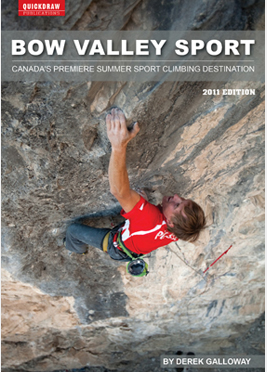
 First off, paragliding can be a “reasonable” activity. I’d let my kids fly tandem with most any commercial operation in North America. But there are some problems lately with the competition scene, which is like comparing F1 to driving to the grocery store. The following commentary is opinion and ranting, but I’m thinking about it a lot so here goes: