The discussion on “Ice climbing is NOT rock climbing” has generally been useful; I learned a few things for sure, and I appreciate Jeff (the videographer) and the guys in the video taking it all well. I’ve talked to Jeff and the climbers, they’re good people. I write this blog pretty much like I talk to my friends over morning coffee, and went a little overboard in not editing my comments a little. My sincere apologies to the Fall team for that, and I look forward to getting out with them next year.
Now for some more harshness: I see the errors in Jeff’s video pretty much every single time I go climbing at a popular area; that’s why I used his video. Bad sticks, poor knowledge of ice, standing under falling ice, equipment errors, the list goes on and on of what not to do. But these guys aren’t special; the average day in Haffner, G1 at Hyalite or any other popular ice crag sees every single one of the errors in the video except perhaps the fall. I’m not picking on these guys personally; but novice ice climbers everywhere. These guys aren’t especially stupid, ignorant or wilfully dangerous; they’re about average from what I see out there. Yeah, that’s right, it’s not personal with these guys, I think that broadly most novices I see pretty much suck, and are a menace to themselves. I’m also arrogant enough to think that writing about errors, discussing errors publicly with all of you and sharing those errors around among the ice climbing community will help reduce the quantity of bad decision making I see… So, here’s how not to suck:
Protect yourself: Every time we go climbing stuff is going to fall down either from our group, from people above us, avalanches, etc. etc. An ice climbing area is an accident waiting to happen; protect yourself at all times. I do not have to think this way at most sport crags, although I try to keep it in my mind. Ice climbing is different.
Toprope. I keep writing this, but I do not think it’s possible to have much understanding of ice until you have done at least 150 pitches of it. I didn’t learn this way, and I shudder to think of how many times I came close to maiming myself. I only truly learned to climb ice when I ran hundreds of laps on TR while training for ice climbing competitions. Think about how many pitches of rock climbing it takes to have even basic technical skills, never mind the ability to judge gear in what is a really simple and stable environment compared to an ice climb. So, toprope, lots. I hear people whine that, “I can’t toprope in my area, not enough ice.” Please. Walk a couple of hours, I can’t think of one major ice climbing area that doesn’t have plenty of ice if the climbers will walk a bit and get away from the crowds. Use a roadcut, flow some ice off the side of your house, it doesn’t take much vertical at all, just run laps, play, learn. A week of toproping in Ouray will do more than ten weekends of sketchy leading one or two pitches a day.
Climb with good people. A basic class is a good start, but most of us enter ice climbing from rock climbing and don’t want to be novices. OK, If you can’t find a friend to take you who is solid (and by that I mean over 150 pitches of ice) then hire one. The money spent for a good day of instruction is a hell of a lot cheaper than a broken leg, skull fracture or death. If you get a couple of people together or even a small group the cost for a competent guide is pretty low for a day really, we probably spend more than that in the bar or on coffee. Look for guides that have been ice climbing for more than five years, and climb more than 50 days a season. Less than that is not enough. If you’re coming to Canmore email me and I’ll help you out; I don’t guide, but have a lot of friends who do a good job at it. I can and will do the same for a lot of areas around North America and parts of Europe. I do not get a referral fee or anything for that btw.
Watch: There is a tremendous amount of material on Youtube and elsewhere about how to and how not to ice climb….
Read: I wrote a book on how to ice climb. I’d change a few parts of it today, but overall it’s still what I believe. But get all the ice climbing books, articles, web stuff, whatever, and read. There is always more to learn. I read a tremendous amount about ice climbing, it’s an obsession as those of you who read this blog regularly may have noticed. I’m an ice nerd…
Obsess: No detail is too small to get right, or wrong. I guarantee that you will make errors while climbing, and only if you do enough things right will the errors not kill you. I know this because I’ve made a lot of errors over the last 30 years of active climbing. I’m going to post my top screwups next post…
Be Honest: Did you climb that route with every single stick a reasonable belay, no foot slips, good gear, and relaxed hands? If not then you weren’t climbing it at a “proficient” level. Getting up an ice climb is not good enough if you want to keep doing the sport for many years. Do not judge yourself by getting to the anchors or not, but by honestly how solid every single move was.
Don’t be this guy at 1:40: Horrible sticks again, guy pitches off… Later in the video there are shots of top-roping, and it looks like technique may be improving. Cool. Falling off not cool. But it does look like a super fun trip, and unless the video is edited out of sequence the sticks are better at the end than the beginning… Let’s be nice in the comments section, thanks.
PS–and for anyone who thinks TRing is boring, check this stunt out. I guarantee they weren’t bored, and likely learned a few things. But keep the rope tighter while toproping than this team is, a guy I knew managed to fracture his femur while on TR when his points caught… Tight rope good.
First, sorry for the delay in posting. I’ve been on a speaking tour, an 80-hour first aid course and some other busy sports actopm. But all good!
I answer a fair number of questions about ice, rock and paragliding gear and tactics. I try to always reply to these emails, but it recently hit me that readers of this blog might enjoy the answers as well. I’ll try to post some of them up here for grins, using sorta made-up names. Got a question? Send it in, I’ll get on it, thanks.
Tied Off Ice Screws:
Hi Will,
I was wondering if you had information about the shear potential of an ice screw that’s been tied off? Geoff seems to remember seeing a test that shows a fall, then subsequent sheering of the head of the screw. But I can’t locate it.
Thanks for your great analysis of the ice climbing video!
Hi JX,
Tied-off screws are pretty close to worthless from all the data I’ve seen. For starters, the screw has to be placed with the “hanger high,” so that the tie-off doesn’t slip to the head of the screw immediately. That’s not a very strong angle for a screw, the load levers the screw out of the ice very fast even with a full-depth screw. In practice the tie-off is loaded, screw starts to break out of the ice and the tie-off slides to the head of the screw, where either the screw totally breaks out of the ice due to the unsupported “lever action” on it, the screw bends (actually better), and the tie-off is cut by the hanger or stretches enough to slip over it. Not good.
It’s far, far better to use a stubby than a tied-off screw in any situation I can think of. Plus a tied-off screw almost always hits the rock under the ice, which ruins the teeth… I carry mostly 13cm screws with one 19 for threads, maybe a few 16s for grins, and a some stubbies.
Hope that helps!
Best,
WG
Additional Notes: Screws used to only come in long lengths, which meant that even in six-inch thick ice we had to tie ’em off. Now screws come in all kinds of useful lengths, and I haven’t tied a screw off in years as a result. I would far rather have a “too short” screw than a “too long” screw. In good ice you can make even a very short screw very strong.
Will Gadd note after the below was posted: Please keep the comments somewhat civil and constructive. There is a lot of good information (harness, gi gi) getting added, let’s focus–as most people are–on what can be done differently rather than attacking either the climbers or the video effort. Just for reference, I’ve personally made a lot of the errors in the video, we all have, the idea is to learn and do better, thanks.
And the two screen capture pictures are of the BD Bod harness that’s not doubled back (you can tell because you can see the two silver pieces, shouldn’t be able to see ’em both!) and the Kong Gi Gi, which is getting used totally inappropriately. That the harness and the belay both held is pretty amazing to me, I would not have put money on either system holding even a short fall. Thanks to the comments section for noticing both, I didn’t until it was pointed out, which kinda scares me…
One of the biggest problems I see in ice climbing starts with people approaching ice climbing like they do rock climbing. That mindset is totally inappropriate, and leads to really avoidable accidents. A friend of mine recently sent me a link to a video shot Dracula, a one-pitch classic WI 4+ in New Hampshire. The leader gets pumped, struggles to get a screw in, and falls. Skip to 3: 28 to see it go bad, but the whole thing starts to go bad way before that point. I’m going to pick a few key points out of this video that are really serious errors. These errors are unfortunately very common, and they shouldn’t be.
Fortunately this video is on Vimeo, where you can load the whole video up then click and hold on the timeline bar below the video to move around the video easily. This video is not, as the narrator suggests, a film about “change.” I see and hear very little about “change” in the film, what I see are common errors leading to a completely avoidable accident, and not much mental switch among the climbers in the follow-up footage.
The first and biggest error in the thinking of the climbers is expressed at the end of the film when the belayer says at 14:20, “Falling is very common, it should be expected.” No, it isn’t. In 30 years of ice climbing I’ve caught exactly one lead fall (Guy Lacelle of all people), and never fallen on lead. Most of the people I climb with are the same; a few fell off once or maybe twice early in their careers before figuring out it was a really bad idea… Very occasionally things just go bad, but I can count those type of accidents on one hand. I know three people with fused ankles or worse from taking very short falls on ice. Falling is not common and should not be “expected.” A major mental reset is called for.
2:00 Apparently the belay is a in place subject to falling ice. The belayer decides the solution to this problem is to have enough slack in the system to move to avoid the falling ice because, “If I get knocked out by a piece of ice what good am I as a belayer?” I’m not making that quote up. A better solution would be to have the belayer not in the line of fire at all. Full stop. I can only remember two belays ever (ironically, one with Mark Twight) where I could not protect the belayer from falling ice, and in retrospect I put the belay in a shit place both times (sorry Mr. Dornian). Do shorter pitches, whatever it takes, but having your belayer in any position where he could be hit by falling ice is flat-out stupid or ignorant. Even the video guy is standing under falling ice at 3:20; Dracula is a one-pitch route for god’s sake, move out of the way! If the first rule of ice climbing is don’t fall off then surely the second is, “Don’t stand where you can get hit with falling ice.” This is rock-climbing thinking, where it’s abnormal to have falling ice. It is a given that a lot of ice will or can be falling down an ice climb, plan for it.
Lots of shots of the climber swinging tools, etc. This is going to sound harsh, but there needs to be some reality interjected into this film: The climber had absolutely no business being on lead on ice. His sticks were shit (3:17 is a good example of a lousy stick, you can see his tool wobble as he pulls up), his footwork is terrible, and I’m amazed he didn’t fall off earlier. I don’t say that to be insulting, but because I suspect less-direct commentary would be ineffective given the rest of what is said and done in the film.
Quote, “Yeah, I have great faith in the equipment now, and it gives me even more reason to put pro in.” This is just wrong on so many levels, but first of all it misses the entire point that ice climbing isn’t about the pro, it’s about first not falling off. Have enough pro so when something really surprising happens you don’t die (and he did have enough pro in for that), but thinking that, “Hey, the pro works, great, I can fall off more now!” is just wrong. The thinking should be, “Damn, I fell off, and only through incredible luck did I not completely fuck myself up for the rest of my life, I need to re-think my approach to ice climbing.”
I want to know what the climbers around 8:50 to 9:20 or so are saying under the voice-over. From my read of it they are saying, “Dude, get better fucking sticks into the ice, like this. And here’s how to clip into the pommel or lower hole on your tool to so you don’t fall off and nearly die again.” These are basic skills the climber should have known, and obviously didn’t.
The climber should have stopped way, way before he fell. In rock climbing it’s often OK to climb deep into a pump, even to the point of falling. In fact, that’s often the point in rock climbing. It is NOT ok to climb super-pumped on ice, the consequences of a fall are simply too high. This guy could have been paralyzed for life, broken both ankles, or died. If you’re getting super pumped on ice do what the other climbers suggest at 9:00: CLIP INTO YOUR TOOL and put a screw in. Train doing this on a TR so you’re comfortable with it. I have seen a half-dozen screws over the years placed a little into the ice, and then a tool beside the screw, but no climber… Falling off while placing a screw is a common way to fall, but totally needless. So, stop before you get super pumped, put in a good screw, reset, maybe back off if you can’t climb the pitch without getting super pumped. Or, climb it in five-foot sections putting in a screw and hanging; I have FAR more respect for someone who doe that than gets pumped and falls off. If you’re super pumped stop, reset. No “free” pitch is worth getting injured for.
So what should we do to avoid this accident?
-Climb on toprope more. Many, many laps. Practice putting in screws, climbing with and without crampons, hooking, making placements, etc. I’d bet this climber had done less than 30 pitches total of ice in his life. At least 150 30M laps is the bare minimum to have any sort of understanding of ice.
-Practice clipping into a tool and putting screws in. This normally takes two quickdraws on the harness, or a sling to the belay loop. Lots of ways to do it, practice.
The big problems I see in ice climbing are seldom to do with fitness. Almost always they start with the climber’s approach to the sport.
And finally, and this is an intense situation so it’s small criticism but something to think about, if I fall off like that please don’t lower me head-first back toward the ground. The climber’s legs kip over his head at about 9:50. Again, it’s an intense situation, but I’d suspect a possible spinal injury with that much force and speed… But a small criticism in the whole picture, and the climber is very lucky to have an ER doc on hand–if the situation were worse that could have made the difference between living and dying.
OK, that about sums it up, lots of other issues, but those are the main ones to me. I’d be happy to offer a free day of instruction with these climbers and their video guy to improve their technique and approach to ice climbing; I don’t mean this to be harsh to the individual climbers at all, with any luck I will have caused some thinking among a much wider readership as these errors are way too common, these guys just made a video…
Last year Andreas Spak and I climbed some big rigs in Norway, along with Christian Pondella and his camera. A few nice shots up here along with some captioning action.
Way back in the day(mid-nineties) I was the primary equipment reviewer for Rock&Ice magazine. I loved that job for three reasons: First, I could get whatever gear I was interested in sent to me. Second, I would get all of that category of gear sent to me; hundreds of climbing holds for example, or a massive pile ofroughly 50L packs. Third, I could basically write whatever I wanted to about the gear, and did. Today I get paid by a few different companies to test products and develop ideas for new gear. But, for some reason, products I have nothing to do with still occasionally show up on my doorstop. Normally I just ignore ’em (lightweight jumper cables? Why?), but a few are interesting enough that my latent review instincts kick in, and soon my fingers are slamming the keyboard in rage or love. Here are three products I received last fall and finally go some time to review.
Here in Canmore, in the literal sun-eating shadow of the Canadian Rockies, the sidewalks are icy for months at a time. As are the trails. Every senior citizen has a pair of “clickies,” or some sort of studded footwear to prevent broken hips. Runners also use ’em on icy trails, and, I might as well admit it, I own a pair for whenwalking around in normal crampons would be overkill.I sometimes bring them out for long hikes on icy trails where walking in crampons would suck. The local canyon-walkers all run some version of these strap-on spiky rigs as well. If you don’t want to wear full-on crampons but it’s still an icy mess then something with real traction is very useful.
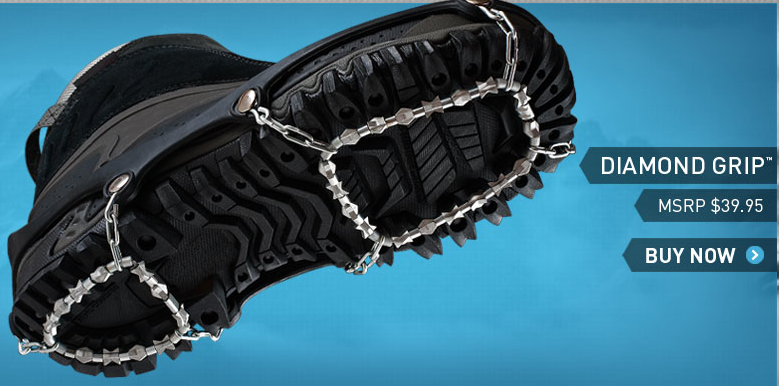
Icetrekkers makes three different types of slip-on crampons, ranging from basically a set of six short golf spikes (called “Spikes) to the full-on “chains.” I didn’t know it, but my mom has been running the Spikes for years, they are popular among the dog-walking set. My package had some “Diamond Grip” rigs in ’em, which, “Provide aggressive traction for all winter walking conditions.” My wife and I went for a few hikes on the icy sidewalks and trails; she used her “Stabilicers” traction cleats, I used the Diamonds. Overall both did well enough and were a lot better than sliding around on the trail in standard rubber. But the Diamond Grips have a fatal flaw; the little “diamonds” can roll on their axles, and when they do it’s off to the races. It takes just the right type of walking downhill or uphill to cause this problem, but that’s whenyou don’t want it. Other than that they do the job.
The Spikes (and other “spike” style slip-ons) are the best for straight ice, but lack enough height or “grab” for walking in softer snow; it’s like being on snow tires with too few studs. But they are the top rigs around Canmore with the dog-walking set because they work.
I at first thought this was a joke; magnetic sunglasses for people with metal plates in their heads or something? But it’s the lenses and frames that contain magnets, which makes for quick and secure lens changes. Or so goes the hype. Actually, the lenses do change really quickly and easily compared to any other system I’ve ever used; you don’t have to clean the lenses after changing them because you don’t have to grab the lens itself, just the edges, click, in and good to go. Both the frames and the lenses seem to be high quality, but all the frames are just slightly dorky, too much engineer and not enough Italian in the plastic mix. On my nose the top frame “bar” is too low, which means I continually have to lift my nose up when riding or skate skiing to see around it. But I liked ’em enough to wear them occasionally. They aren’t cheap, but each set comes with a set of goodlenses, and there are lots of lens options. So far so good. My only complaint is that they are a bit heavy on my large but sharp nose; not crazy heavy, but like wearing a set of glass-lens sunglasses. Many of my glasses have had different lens packages included, but usually I just put one set of lenses in and ignored the other options ’cause they were too annoying to change. These I actually changed a bunch based on what I was doing and what time of day it was, kinda cool, but ultimately I just expect my lenses to pretty much work in whatever conditions I’m in, or I’m too lazy to change them.
When I was about 10 my parents bought me a handwarmer. Just one, we were poor, but it was a sort of sunglass-case like box into which you put a little black stick, and then lit the stick on fire, resulting in a smoldering fire hazard that would last a long time. This was not a good gift for a ten-year old, I almost burned the house down. Since then I’veplayed with various “hand warmers,” toe warmers, etc. Heatmax sent me a collection of different products, none of which burnt the house down.
If you’ve ever used the standard little hand warmers that you throw into your gloves and hope they’ll keep your hands warm then you’ll recognize the Heatmax stuff, but Heatmax has shaped the packages into very thin insoles and added a nicer covering and some adhesive so the things stay put under your toes instead of just hanging out under your arch or some other annoying place. That alone is a pretty cool idea, as anyone who has used the non-adhesive varieties will attest. But there’s a basic problem when putting air-activated heaters into a tight-fitting ski or mountaineering boot: The reactive stuff in there seemingly can’t get enough air, and soon gets cold, or at least it seemed like that’s what was happening to me. It also seems that when the reactant is compressed and isn’t moved around it gets cold; you have to shake it up out in the open air and immediately there’s a lot more warm coming out of it. This tends to mess up the nicely sealed little insoles, which leak black stuff… Even with that problem I still enjoyed the heat on my feet when changing back and forth from my performance winter boots to my standing around boots, but probably not enough to buy more of these things. Maybe people with very cold feet will put up with the hassles of taking them out and shaking them up etc. I gave a few to a friend of mine with “cold feet,” she really liked the extra heat but found some of the same activation problems. They would probably work better in loose-fitting boots.
Right, this concludes the long-winded review issue. I have zero affiliation with any of these companies, just did this for entertainment. Yeah, I’m a gear geek.
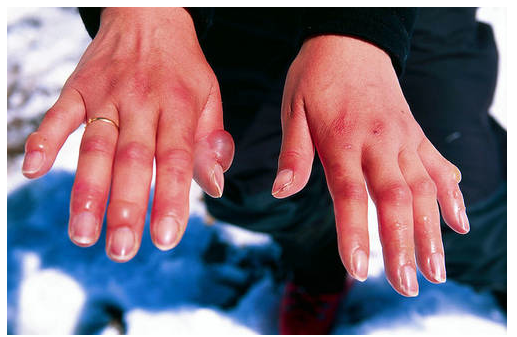
Apparently I’m to blame for some recent frostbite. Here’s the story, as relayed by a friend, about another friend who is a guide. The guide and client are climbing a popular route in K-Country, near Canmore. The guide hits the belay and brings the client up; client arrives at the belay wearing very thin fleece gloves. The temperature is -30.
Client: My hands are frozen!
Guide: Why are you wearing fleece gloves at -30?
Client: Because I ready Will Gadd’s book, and he said that’s what to wear.
Guide is speechless.
At -30 fleece gloves probably aren’t going to be enough. In fact, both client and guide got various degrees of frozen fingers that day. The picture above isn’t from the day of climbing, I just stole it off the net.
Moral of the story: Don’t go ice climbing at -30? If you do wear something thicker than a pair of fleece gloves? Don’t believe everything you read?
Twenty years ago used to climb in full mittens at -30; it was almost impossible to generate enough body heat to stay warm, at least dressed in standard climbing clothes of the day. Now we have better clothes and can stay warmer at lower temperatures (Happy Pants!), but it’s hard to do technical stuff like climb at -30. I can ski OK (as long as the bindings don’t break), ride a snow machine (did that at -40 in the arctic), but climbing is harder. Doable, but harder, especially if you don’t spend a lot of time outside in the cold to get used to it. It’s amazing how warm even -10 feels after the winter we’ve had; I can feel my body relaxing outdoors now that the temps are well above zero C, love it! I worked in a T-Shirt most of today, so nice. Anyhow, fleece gloves are likely not the preferred glove system at -30.
I sincerely hope the client’s hands heal up quick, and I will add a “Below minus 20” section to my book for the next version in three or four years when I get around to updating it.
I’m just happy the ice on my driveway melted enough to chip it all out today, warmth!
A couple of years ago I had a great experience setting routes, climbing, soaking in hot springs and generally enjoying a great competition in Japan (Japan Cup). The trip was too short, but it left a hugely positive image of Japan and Japanese climbers in my head. I’ve been emailing and Facebooking with a few friends in Japan, my thoughts are really with them as the country reels.
I made a donation to the Red Cross in honour of my friends from the Japan Ice Cup, who showed me great hospitality and life. My best wishes to them, their families and friends in so difficult a time. I hope to see them in better times again!
I tend to geek out on gear pretty heavily, especially when there is some evidence to work with.
Reading and thinking on gear is, to me, important. I find fewer and fewer systems that work in all situations; understanding how things actually work and adjusting systems to the best of your ability is better than simply memorizing one tactic for all situations. But if you get it wrong and your improvised approach is wrong then of course yer gonna die… When I started climbing I wanted to know how strong the gear was, how much it could hold in a perfect crack, etc. etc. Now I’m more interested in the limitations of my gear; in what way does it fail? In what “unusual” situations will it simply not work (a cam won’t generally work well in a crack that’s even slightly icy, dry and aerated ice is bad for screws…)? The “worst-case” is more relevant than the “best case” for understanding potentially lethal situations. Put another way, understanding the limits of the gear defines the safe operating zone. A piece of gear may hold “4,000 pounds” on the store shelf, but not if the person using it places it wrong… Obvious maybe, but it’s a mental approach that works for me.
A while back there was a big debate about equalizing anchors, and I wrote about that here and here.
The very short version of my take on equalizing anchor points is that, even in a perfect world with all forces as organized as possible, individual pieces don’t end up very well equalized. One bomber piece and preferably two or more is critical. I just re-read an article on this from strikerescue.com,Multi_point pre_equalized anchors.pdf [396.21KB]
My favorite quote from the ice screw article is this: “Short (“stubbie”) screws when placed in good ice provide a significant amount of protection that was quite unexpected and equivalent to that of rock gear when placed at ≥+10º but ≤+30º. By showing this, we have validated the concept of what angle ice screws should be placed in vertical waterfall ice as previously studied by Luebben and Harmston. While poor screw placement is always a possibility, poor ice screw placement is as weak as “rattly” rock gear. The analogy can be made that poor ice screw placement is similar to just throwing your rock climbing rack on top of the rock, clipping your rope to it and jumping off the cliff, only to hope that the gear somehow miraculously catches on something and holds your fall. Proper protection placement is crucial.”
February was a tough month to be an ice climber in Canmore, especially compared to 2010. In fact, the whole year has seemed colder and nastier than 2010 by a fair amount, especially February, when we normally expect things to warm up. In 2010 I remember walking into climbs and working out in the back yard wearing nothing on m upper body but a T-shirt regularly. That means the high temp for the day was often above freezing. Getting in and out of the Ghost wasn’t too bad in general, but this year it’s been routinely impassable without chains and multiple vehicles to yank the stuck one out. We rely on chinooks in Alberta to melt out the snow, and we haven’t been getting them. The snowbank beside my driveway is head-high, which tells me it’s been a really snowy, cold winter without any good chinooks. I’ve cancelled or just not even planned to go out on more days of ice climbing this year than I can ever remember; I’ll climb down to about -20 or so, but below that it just stops being all that much fun. The highs have often been -20 this year; I shot a TV show in -35 to -25 temps, it was frigid silliness where the crux was just staying functional.
Now, usually when someone says, “It’s a cold month!” the numbers show it to be pretty close to average. But I just spent an hour figuring out that it’s been brutally cold this February, here’s the story from Environment Canada’s historical and climactic normal sites:
HighLowAverage
2010+3.7 (!)-8.8-2.55
2011-5.2-17.6–11.38
Long-Term-0.4-11.6-6.0
So last February was really nice, and this year’s was really cold. But the “funny” thing is that if you average 2011 and 2010 you get very close to the long-term average “normal.”
Anyhow, if you, like me, have been doing some whining about the cold temperatures there is at least some empirical evidence to back that whining up. I suspect that if we did the same analysis for December and January they too would be cold; normally I don’t pack my insulated “Happy Pants” with me automatically, but I have been this year regardless of what the forecast says. The Happy Pants are key items to climbing when the temperature goes below -15 or so. They really do just make life a lot happier. Put on a nice fat belay jacket and a pair of Happy Pants and it’s like belaying in a sleeping bag, brilliant!
The cold weather has also made me re-evaluate my “layering” approach. I’ve been doing a lot more coaching, ice festivals and TV show work than usual, which means I’m standing around more. A month or so ago a friend of mine was visiting the house and warming up by my wood stove (love that wood stove!). I counted the layers she had worn for guiding that day; at least five. A lot of my guiding friends have been out in the cold weather guiding every day; it’s what they do, and they work down to about -30. They also often don’t have the luxury of moving fast. They can sprint a pitch to generate some heat, but the client moves at whatever speed the client moves at. A good guide around here moving at metabolic idle is still pretty damn fast compared to most visitors. So, five to seven layers to store every single bit of heat possible, and stay dry. Those layers don’t come off until she’s in a warm place for a long time.
I was also out at the beginning of the season with a friend of mine who works at Arc’teryx. I was mouthing off about “layers are idiotic” as usual, and he had a different viewpoint. He lives in a swamp (also known as the Vancouver/Squamish area), where the snow is wet and the rain of course more so. His view of layering was a base layer to wick the sweat off yer body, an insulation layer, and a protective layer. He routinely wore a jacket that I love (the Atom) for moving; I would die of heat stroke if I wore that jacket while moving for more than a few minutes. But he, like my guiding friend, tended to move in fits and starts, more like a downhill skier than a climber moving fast at a constant rate with relatively brief interruptions. He also expected his base layer to keep him dry; I don’t, and regard sweat as a failure in dressing properly, or a good time to change shirts.
My whole view of “layering” is based on operating in two states: Movement, and not movement, and having those two states roughly balance each other. I normally wear a thin synthetic or (gasp!) even cotton shirt to the climb with nothing else or at most a soft shell over the top. Or maybe a light piece of insulation with no shell; we don’t generally need “protection” here in the Rockies until we’re actually climbing or skiing down. But you have to be moving fast enough to be really warm to dress like that. If you’re moving fast with five layers on then you’re going to waste water and energy cooling yourself. When I get to my climb or destination for the day I strip my shirt (there goes the cotton, leaves yer skin dry after you wipe it down, unlike a synthetic…), put on a nice fresh Ether base layer, then a thin piece of insulation, then some sort of shell usually. A belay jacket and happy pants top it all off for the “not moving” state. On/off, moving/not moving.
But when standing around at -25, well, you’ll want a whole whack of layers, especially if you never get your engine firing on the approach or while climbing. Without that internal “burn” you’ll have a hard time staying warm. But burn too hard in too much clothing and you’ll be wet, and really, really cold when standing around.
All of this is causing me to learn a lesson I learn over and over again in life: There are systems and ideas that are absolutely right for some situations, but few systems are right or even good for all situations. We all get attached to our idea of what the perfect systems are, but they are the perfect systems for the world we operate in, not across all situations. V-thread or A-thread, cordellete or sliding X, clove hitches or knots, each has a “perfect” place. I will strive to be more open to different experiences from people who actually think and work in different places.
And it’s been a damn cold winter. Today I was out skiing at -1, and it felt so luxurious, so truly tropical. I wore a light Ether shirt and a proto pull-over, no gloves, no hat, brilliant!!!! I really, really hope March is warmer than February for everyone. My Happy Pants are available for a low rental rate if not.


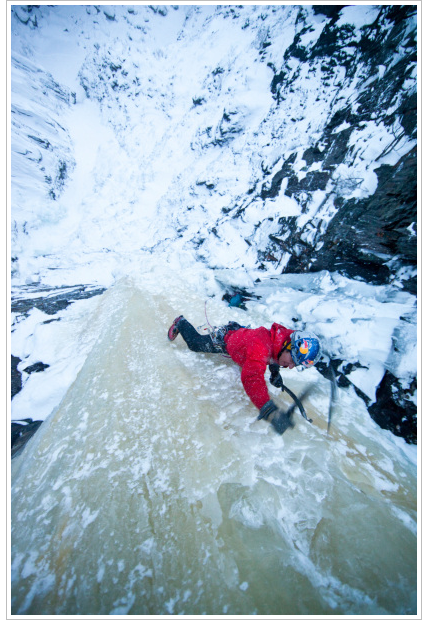 Last year Andreas Spak and I climbed some big rigs in Norway, along with Christian Pondella and his camera. A few nice shots up here along with some captioning action.