Date: January 30th, 2011
Ice climbing is far more mental than rock climbing, and I mean that both in the sense of, “It’s mental mate!” and that ice climbing puts more of a load on the brain. This does not mean ice climbers are smarter than rock climbers obviously… Here are a few brief tricks I’ve found useful for leading ice.
Be a better climber on toprope than you’ll ever have to be on lead.
If you can hike any piece of vertical water ice on the planet on a toprope then you’re not going to be losing it too much leading a 70-degree pillar. Put another way, be better in training than you’ll have to be in combat, ’cause I can guarantee you that you will NOT perform better under pressure than you will in training, at least in any sport that requires fine coordination like climbing. Running or other aerobic sports maybe, but if you haven’t trained to an appropriate level then you won’t perform well in competition. And your training had better look like a performance day; lifting in in the gym will not make you a better athlete unless you can use that strength…
Stop.
In rock climbing the solution to most pumpy, difficult situations is to simply try harder and keep moving. I watch rock climbers on ice do this all the time; most ice climbs just aren’t all that steep, even the “grade 6!” hype. Stop. Put both tools in. Get some good feet. Shake out. Stem a bit. As the pump drains your mind will open up. Put in a screw. If you’re really messed up clip a quickdraw into your belay loop and put the biner on the BOTTOM of the handle, either through the hole or over the pommel. Rest. Once you’re mentally back in control start climbing again. It’s actually the swinging that is the pumpiest thing about fresh steep ice climbing, if you just slow down and focus on finding either a natural rest or one on your tools then life will be far better.
Climb down two feet.
I’ve watched leaders turn into mental gerbils while wrestling with a tough bit of climbing when all they had to do was climb down two feet to a rest and look at the situation from a slightly different viewpoint.
Don’t start until you can see it.
Look at the climb. Figure out where you’ll start swinging, where you’ll get a screw, how you’ll pull the bulge, where you’ll belay, what the tough bit is likely to be and how you’ll deal with it, how many screws/slings you’ll need, how you’ll climb, etc. Then close your eyes and run the climb in your head. If you can see yourself doing it all then you will. If you can’t figure it out. Have a couple of plans about how you’re going to deal with the ice; “If that’s bad I’m going right, but if it’s good I’m going right over the top.”
Climb Lots.
No matter what sport you do the person doing more of that sport will likely be better at it than the person who does less of it… Ice climbing is hard to do a lot of unless you live near the ice, but there’s no other way to get comfortable than to climb a lot of it. A two-week trip will likely make you a far better ice climber than 10 days spread out over two seasons…
And some other stuff, but I gotta go now. Give ‘er!
Posted in: Blog
Date: January 26th, 2011
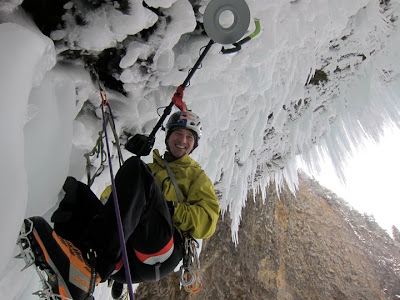
This is going out from the Tim Hortons in Salmon Arm, BC, sorry for the junk show layout and bad grammar but the word was out, and I wanted to post Pondella’s photos of Tim Emmett and me and some words. Yeah!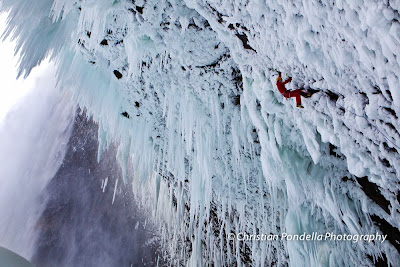

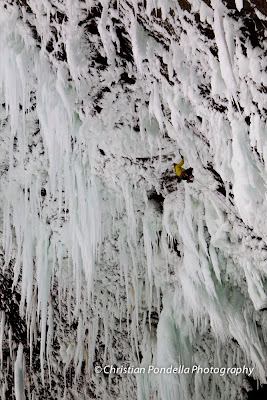


I am sure of little in life, but of this I am sure: The Helmcken Falls spray ice cave is absolutely the wildest, best, most insane ice climbing area I’ve ever seen. It is going to be a destination for some, but it’s a journey, sort of like chasing waves off-shore or climbing in the Himalaya. It won’t be for everyone, but it sure is good!
From January 16 to 25th this year,
Tim Emmett and I worked hard on continuing our route from last year, Spray On. The couple who run the
Helmcken Falls Lodge, Andrew and Lynn, were sending me photos of the 400-foot cave behind the waterfall starting in December; as soon as we saw a reasonable amount of white in the photos Tim and I cancelled all plans, blew off the O.R. trade show, work, and anything that was tying us down to head for the falls.
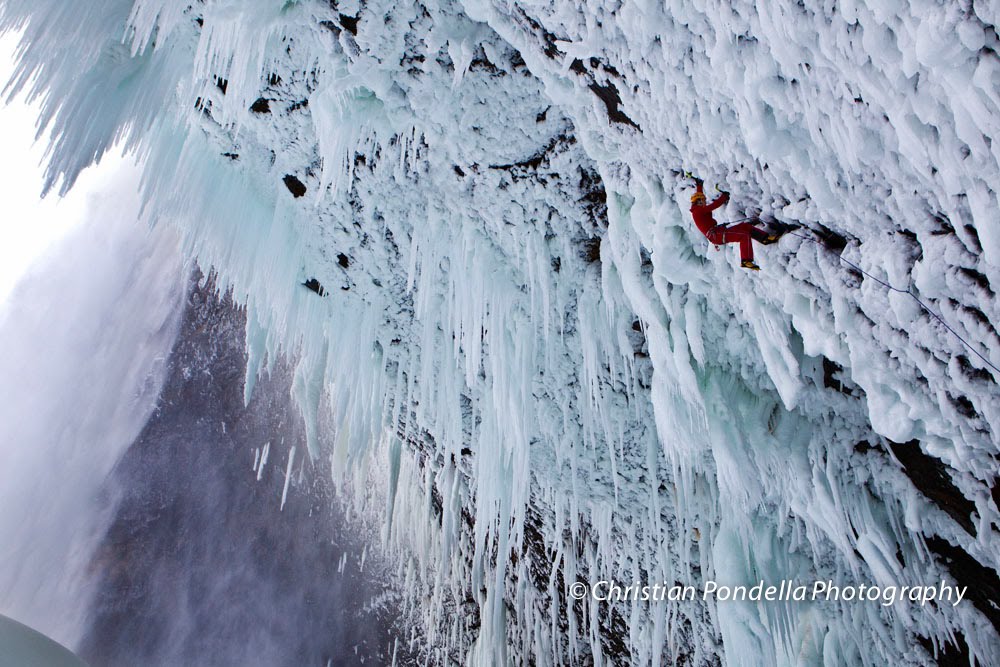
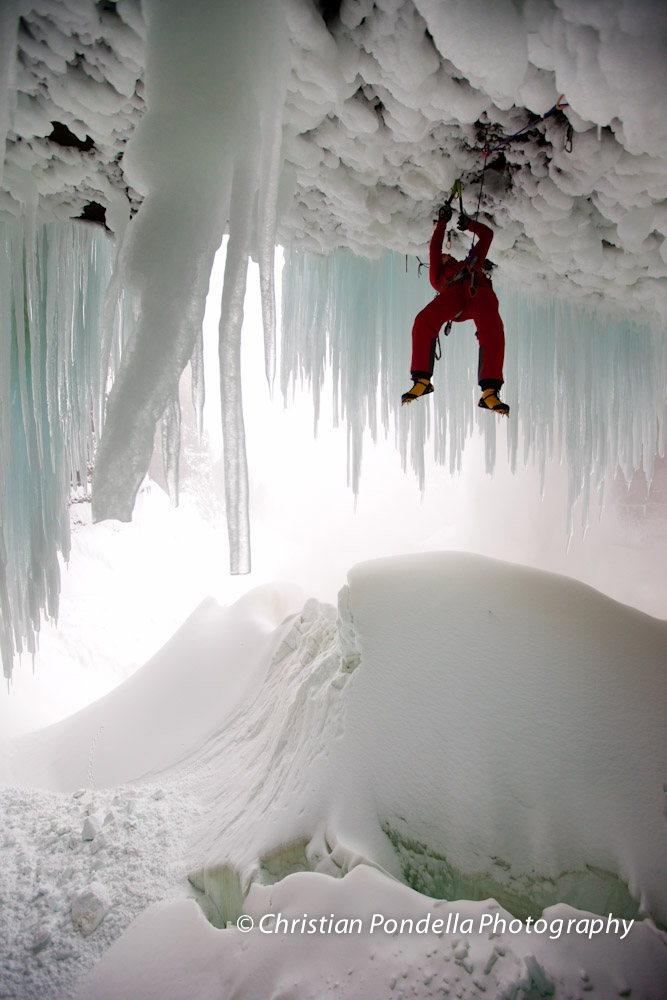
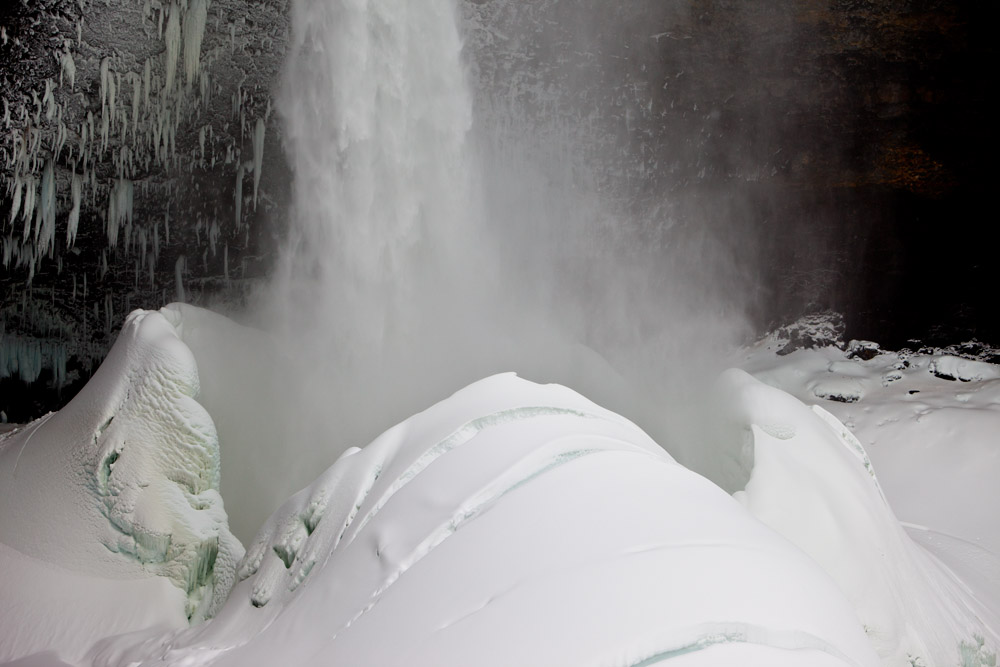
We found a vastly different scene than last year; more ice, a glacier the size of a couple of city blocks complete with crevasses we had to rope up for (and then fix lines across, a first for me), and a whole lotta spray ice! Somehow in my memory I had convinced myself that the first couple of hundred feet of climbing weren’t too overhanging, but I was really wrong about that–the first 60 feet are only overhanging at about 30 to 45 degrees (the floor of the ice cave is about 30 feet higher than last year so the first pitch was shorter), but then the climbing goes horizontal in this weird 3D upside down icicle forest for a 150 plus feet. And it all went free, on ice, with only two drytool moves! It is just so good.
We broke the climbing up into five relatively short pitches due to the crazy upside down nature of the climbing, and also for safety–huge chunks of ice on the roof can rip, and you just don’t want them landing on your rope or you, you’d be a human squeegee, not good. Almost all the protection is bolts; the ice will sort of hold a Spectre but it’s just too soft for screws, and it’s compact lava flow rock so not much if any opportunity for natural gear even if you could find a crack. I brought snow pickets to try them out, but the results were not encouraging.
In the end we made it through about 250 feet of climbing, and called it good when the temperatures warmed up dramatically and the warm temps started a several local icicle carpet bombing campaign. We ran.
We were able to find all of our bolts from last year; the spray ice tends to form in roughly the same places, and we had bolted where there was little ice. But, and I’m still laughing about this, I had bought a metal detector at Canadian Tire (“What are you mainly interested in? Finding old jewelry or something?” asked the sales guy. “Something like that,” I answered, “Under ice.”). The metal detector was an integral part of the rack, and will be for future ascents. The ice will be different every season, but it will share common features and lines; solving the problem of how to find bolts every year was a good step forward. And there are a lot of lines to do. A lot.
A lot of the trip was taken up with cleaning icicles and bolting on lead. This was torturous work; if someone asked me to do that sort of work for money I probably wouldn’t do it. But for this amazing climbing? Yeah, we were up for it.
At the start of the mixed explosion 15 years ago Jeff Lowe and I did a route in Glenwood Canyon, Deep Throat, that was like a throat filled with icicle teeth…. At the time we dreamed of a massive cave filled with the teeth that went on for hundreds of feet. The dream is real. Tim and I made it out of the cave and onto the much easier headwall, and to the top of the best-looking ice. If it gets cold again and the ice reforms we’re going back next week to push on with our route, but it’s also fine as it is, and ends at a logical place. It might be possible to combine some of the pitches and that would be cool. We team-freed the route, with both of us doing pitches 1 and 2, Tim pitch 3, and I enjoying 4 and 5. Better style is possible; both of us going bottom to top would be better for starters, but it was a team effort and we’re happy with that for now.
The grade? We keep getting emails asking that, and here’s the only answer we’re going to give: Take a look at the pictures. Read this and Tim’s story. What do you think? Ice climbing is like waves to me, an aesthetic and beautiful experience more than a grade. The holds on a rock climb stay the same more or less, but an ice climb is always different. Take a look at the pictures, listen to the stories, enjoy the show, go climbing there, do both, do neither, but there’s something for everyone in that cave, even if it’s just looking at it from the viewpoint. Helmcken Falls is awesome.
The
Reel Rock crew came along and took some video (nice work on dodging the icicles boys!), and my friend Christian
Pondella shot these stills, thanks to them and Tim, yeah!!
WG, on the drive back to Canmore after a great week, and now amped on a Honey Cruller and a double double.
January 27th note: And here’s a photo from Tim of the metal detector tech we used, it worked!
Posted in: Blog
Date: January 22nd, 2011
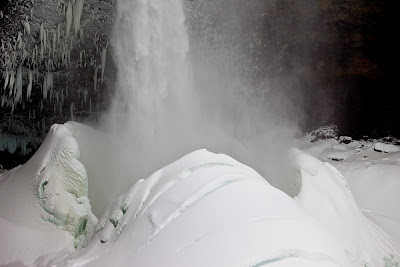
The last two weeks have been higher speed than usual. Travel, prep, closed roads, full chaos, but Tim Emmett and I have now been at the Helmcken Falls Lodge for five days, and climbing every day. So far the climbing has consisted of super technical radically overhanging ice action to just get a line of gear out the cave. Yeah, CAVE!
We’re bolting ground-up ’cause it’s too steep to rap, and there would just be no way to find the line from above. It’s just nuts, insert expletives here. And we haven’t even climbed anything new, just worked and worked. Each time one of us comes down after a bolting session we’re just done mentally and physically, battered and bruised and stomped upon by falling icicles
The icicles in
Christian Pondella’s photo above are anywhere from ten to 50 feet in length. The snow cone is at least 100 feet high. We had to rope up to cross the crevasses, that’s how big it all is in there, the scale is just mind-bending. If it gets too warm we’re done without climbing anything, but the temperatures are holding, we found last year’s bolts under the ice, and it’s all ON! We start really climbing tomorrow, but realistically have another two days of prep to get to the top of the ice. Yesterday we sent down tons and tons of icicles, and yet you can’t even see where we’ve climbed unless you’re looking at just the right angle.
Seldom have I ever been involved with a route that feels so far out there. Icicles, rock, angles, crevasses? But one thing is for sure: We’re exactly where we want to be, have received far more than we dreamed of, and are totally stoked to be doing our best. You don’t get too many times like that in life really, yeah! Upward.
Posted in: Blog
Date: January 1st, 2011
Ice Tips:
-Carry more “short” ice screws. The standard rack here in the Rockies used to be a batch of 21cm or longer screws. Now the vast majority of my screws are 13cm, with a few stubbies if needed and one 21cm screw for V or A threads (I don’t think it matters much which one you use really). Clear the surface ice to get to good ice and a
13cm BD is as strong as a longer screw or close enough it doesn’t matter. Longer screws tend to hit rock and are then ever the same again; it’s far better to use a “too short” screw than one that’s too long. If I could only have one screw size it would be the 13cm.
-Dig hard to get to good ice for screws. A few days ago I set up a belay in a spot where a lot of other people had done the same; in my opinion almost every screw at that belay station was junk, I broke an “onion” skin off that was 15 cm thick and riddled with holes. In my view many if not most ice climbers don’t do enough clearing to get good screws, especially at belays. This is likely what led to a recent situation w
here three of the four ice screws in the system blew. Clear yer ice, get something undeniably solid or don’t bother with the screw.
-Push on the ice with both your hand on your lower tool and by taking your hand off the tool and pushing on the ice to balance, just like rock. I do this a lot, it’s intuitive now, but as I teach and coach I remember it’s not obvious until it’s learned. The long head of my triceps always gets sore from pushing when climbing ice, along with the lats… If you think about rock climbing you’ll probably remember all the pushing you do to move up, not just the pulling. Ice is the same, if one hand is pulling the other is pushing on the lower tool or ice…
-Good rock climbers can learn to climb ice a lot faster than good ice climbers can learn to climb rock. I attribute this to the fact that rock climbers already have the fitness, and just require motion training, while most ice climbers are relatively weak. But, while a rock climber can learn to get up about any ice climb in a season or two, just getting up a climb does not mean doing it well. I have seen reasonably competent rock climbers move with glacial speed on what for a good ice climber is 5.5 terrain. I think the real artistry and style of ice climbing is not in just getting up a pitch, but doing so quickly and securely. It’s like running–anyone can run a mile, but it’s another thing to do it in under five minutes… I would rather see someone climbing well below their max but in total control than someone pushing it on ice, not worth it.
-I’m seeing more and more people top-roping and working on their skills in Haffner and other places. This is great!
-If you don’t have a good placement don’t pull up on it. The situation will not improve. Make good placements, which are pretty much always possible. I see so many climbers get shallow placement and then pull up on it anyhow, which leads them to place the second tool at the same level as the poor placement.
-Don’t yell “ICE!” unless things are getting really western and someone is clearly in danger. This isn’t sport climbing, ice is going to fall off all the time, and the shout of “ice” loses its effectiveness rapidly if everyone is yelling ice for every little bit of falling water.
Performance Gains:
I’ve been out whacking icicles, dirt and rocks a lot the last few weeks, finally seeing some decent performance gains. My real fitness level likely hasn’t changed more than a few percent in the last couple of weeks after the training base I laid down (I managed to train on the broken finger, but that delayed its healing some) over the last few months, but I’m climbing a ton better. Why?
Because most of the initial rapid gains that occur in the gym or in the real world aren’t due to strength development but to better movement patterns, better muscle recruitment and more confidence. If you’re an athlete who has taken a break for whatever reason and come back to the sport, even years later, you can get back to your top ability relatively quickly if you haven’t gained 50 pounds and/or turned into a complete slob. This is more true for technique sports (climbing, kayaking, mountain biking, skiing, anything fun) than more pure endurance sports (road biking and road running, anything involving Lycra and toxic levels of repetitive suffering), but for all these sports the road back to performing well is a lot faster than pure physiological improvement would indicate.
Even on a “pure strength” movement like the bench press the athlete who has bench pressed at least his or her own bodyweight will get back to that level a lot quicker from the same relative fitness level than the novice who has never benched. Old-time coaches used to call this “muscle memory,” and while muscles don’t remember anything it’s still a decent term compared to the fancy sounding “neurological recruitment.” So my gains are less due to an improving fitness level than to having done a lot of work in the past, and now reactivating that mothballed programming.
This relates to New Year’s in the following manner: If you were once any good at something and make a resolution to get better at it again then you can, and faster than you thought possible. Those years of training and conditioning are still in there; gains will be speedy! Of course you’ll plateau eventually, but the barrier to getting truly good again at something you once loved is lower than many think. The pain level, on the other hand, is just as high as ever.
And Happy New Year!
Posted in: Blog