Date: July 27th, 2006
It’s been a great summer in the Canadian Rockies for sport climbing. I’ve been having these “give ‘er” weeks followed by rest weeks due to paragliding or sickness, it’s been a lot of fun and my general level is slowly coming up despite the erratic training schedule. About a month ago Utah Scott and I went up to Cougar Creek to the legendary Planet X crag, which took some finding but was well worth it. I think it’s the best “hard” crag I’ve climbed at in Canada, both for the climbing and position. It’s also the most “Rifle-like” crag I’ve climbed on, lots of funk body position and long, continuous routes. I’ve now done four trips to Planet X, it’s my favorite crag for sure. Right now there are only four routes on the overhanging 30M wall, all 12d or harder, with lots of ropes dangling on projects. One project went down yesterday, when Derek sent the rig he had been working on with BC Scott. Likely 14a or so, damn hard looking, congrats to Derek and good luck to Scott, watching these guys climb is inspirational. I’m working Packer, 5.hard for me, yesterday was good ’cause I was finally able to do all the moves and clips thanks to beta from Derek and Scott, who opened the route. I’ve only climbed one other route of that grade, it’s beat me up. It’s going to take some time to develop the stamina–generally I get two burns in on Packer and a few others on the mega-classic Shooting Star and Sticky Buns. All the routes are a full 30M, generally 5.11 or easy 5.12 to start and then about 15M of “business.” Today my tips and back are blown apart, feels good. Yesterday was almost crowded–there were seven people up there! I haven’t sport climbed seriously in about five years, it’s fun to get back into it with a motivated crew. Thanks to everybody I’ve been going up there with, I’m fired up. Paragliding will inevitably get in the way to some extent, it’s always a bit of a conflict but this time of year air will always win over rock until about September, but I’m staying after it enough to develop fitness again.
Bow Valley Grade Commentary:
Most of the grades around here are pretty solid, but I’ve noticed a general grade creep going on in the Bow Valley over the last few years. The new guidebook up-rated some routes a letter grade or two. Some of the classic 12+ routes such as Tintin are now 13a despite being classic 12+ for many years. There’s always some grading confusion at every area, but it seems like there’s a trend to call many 5.12 routes 5.13. Stygian Ayre is a classic example of this, it’s 12c or maybe D max, yet it’s become a popular “13a” despite being a short boulder problem. Grades don’t matter in the sense of world peace, but they should be reflective of a climb’s redpoint difficulty and bear some relation to grades around the world. The flip side of over-grading is under-grading; if you get a route wired enough it may feel easy. Some of the Grassi routes are starting to suffer this syndrome; get some of the 5.12a or b routes hideously wired and they do feel 5.11, but that’s not how to rate a route either. To get a valid grade on a route takes a fair number of redpoint ascents by people who climb that grade reguarly. I think what’s happening in the Bow Valley is that some people are rating routes based on quick comparisons to one or two other routes roughly in the same grade, not a broad spectrum of routes. Using the softest possible example of a 13a to justify upgrading multiple 12d routes to 13a also doesn’t make sense; better to more realistically down-rate the soft 13a to 12d. Grade bitch mode off, give ‘er.
Posted in: Blog
Date: July 24th, 2006
The following list is from an Australian Aviation mag, my mom sent them to me, good advice:
RULES OF THE AIR
1. Every takeoff is optional. Every landing is mandatory.
2. If you push the stick forward, the houses get bigger. If you pull the stick back, they get smaller. That is, unless you keep pulling the stick all the way back, then they get bigger again.
3. Flying isn’t dangerous. Crashing is what’s dangerous.
4. It’s always better to be down here wishing you were up there than up there wishing you were down here.
5. The ONLY time you have too much fuel is when you’re on fire.
6. The propeller is just a big fan in front of the plane used to keep the pilot cool. When it stops, you can actually watch the pilot start sweating.
7. When in doubt, hold on to your altitude. No-one has ever collided with the sky.
8. A ‘good’ landing is one from which you can walk away. A ‘great’ landing is one after which they can use the plane again.
9. Learn from the mistakes of others. You won’t live long enough to make all of them yourself.
10. You know you’ve landed with the wheels up if it takes full power to taxi to the ramp.
11. The probability of survival is inversely proportional to the angle of arrival. Large angle of arrival, small probability of survival and vice versa.
12. Never let an aircraft take you somewhere your brain didn’t get to five minutes earlier.
13. Stay out of clouds. The silver lining everyone keeps talking about might be another airplane going in the opposite direction. Reliable sources also report that mountains have been known to hide out in clouds.
14. Always try to keep the number of landings you make equal to the number of take offs you’ve made.
15. There are three simple rules for making a smooth landing. Unfortunately no one knows what they are.
16. You start with a bag full of luck and an empty bag of experience. The trick is to fill the bag of experience before you empty the bag of luck.
17. Helicopters can’t fly; they’re just so ugly the earth repels them.
18. If all you can see out of the window is ground that’s going round and round and all you can hear is commotion coming from the passenger compartment, things are not at all as they should be.
19. In the ongoing battle between objects made of aluminum going hundreds of miles per hour and the ground going zero miles per hour, the ground has yet to lose.
20. Good judgment comes from experience. Unfortunately, the experience usually comes from bad judgment.
21. It’s always a good idea to keep the pointy end going forward.
22. Keep looking around. There’s always something you’ve missed.
23. Remember, gravity is not just a good idea. It’s the law. And it’s not subject to repeal.
24. The three most useless things to a pilot are the altitude above you, runway behind you, and a tenth of a second ago.
25. There are old pilots and there are bold pilots. There are, however, no old, bold pilots.
Posted in: Blog
Date: July 22nd, 2006

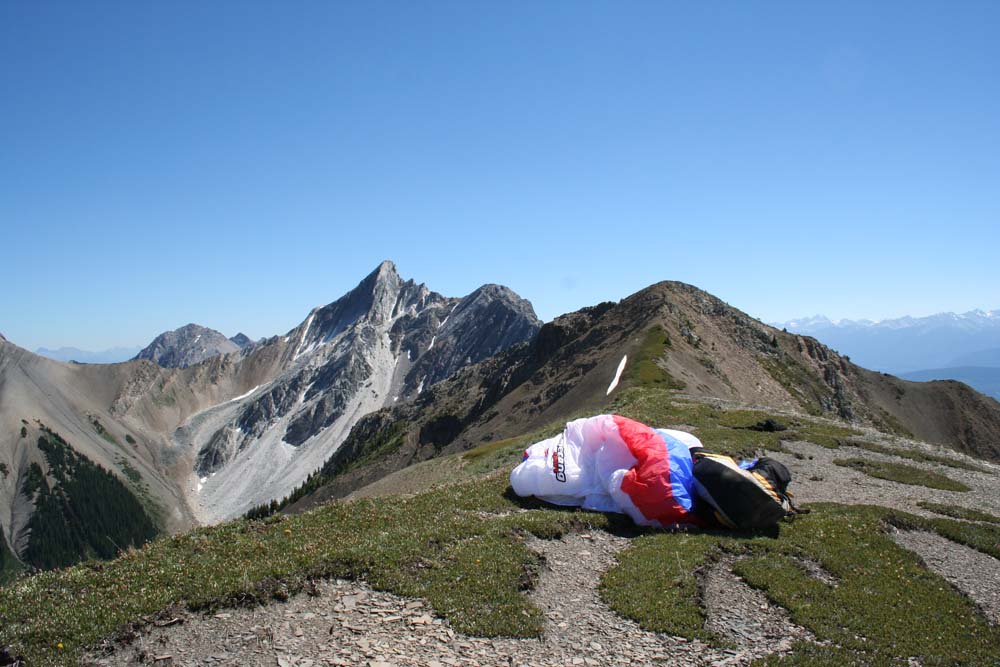
Kim and I have been flying in Golden the last two days, it’s been good value. Kim has about doubled her cumulative thermal time from the last three years over the last two days, and managed to get up above Mt. 7 last night, which fired her up. It was one of those perfect Mt. 7 evenings–abundant lift until around 9:00 p.m., nice light on the range, just a great evening, and the morning was good for thermal aspirants also.
I’m still feeling congested and was pondering not flying yesterday as the air looked a bit stable, but I’m a sucker for thermals, and the cycles on launch looked good enough. Amazingly, there was almost no wind yesterday, it was like flying in France or something. The early afternoon thermals were a bit small, but going up well if you could lock into them. The lack of wind meant there were only localized winds, it really felt like France where you can stuff it into the “lee,” play close to the rocks and just enjoy the range. Base was even lower than yesterday, and there wasn’t a cloud to be seen anyhow, so once again the wilderness flying ideas didn’t happen. But after about 20K, just above Castle Peak, I spied this perfect alpine ridge with a little meadow. I’ve always wanted to land up high in the Candian Rockies, but mid-day conditions normally preclude this idea… Today things were perfect, so I did a few fly-bys just to make sure the wind wasn’t stronger than I thought it was, then tried to top land a few times. The ridge was above treeline and directly south-facing, so the thermic breeze would just lift me up the side of it too fast to land each time I came in. Finally I gave up with the standand top-landing techniques and went for the “surge and swoop” trick, which I’ve really been getting into lately. Hang gliders have been downing “fly on the wall” landings for years, but only recently have paraglider pilots been trying the trick. Basically you just point the glider at the hill from well below the top, slow it down with brake, then release and let the glider surge up the hillside. With the lift on the hillside you end getting a surprisingly long flare window, and for extra points you can hammer one brake and neatly spin the glider just as you touch down. I didn’t get an extra points due to coming in through a bit of a sink cycle and thinking I was going to pound in a bit hot, but it ended up working perfectly, I was just so surprised that it worked well that I forgot to spin the wing and managed to fill the leading edge up with quarter-sized rocks when I “whacked” it. I balled the wing up on top of the alpine ridge, took off my shirt, ate lunch, and marvelled at being in such a cool place. Paragliding is so good sometimes!
I kept careful watch on the winds; there have been at least two people who have top-landed along the range and then had to walk down when conditions got too strong to relaunch. My day was perfect, so after a while I got back into the air and flew down the range a bit more with a Swede before turning around and going hard back to Mt. 7, maybe 60K out and back with a lunch stop. I’ve been flying the Boomerang Sport a lot lately, it just gives an extra margin of confidence and relaxation to flying; I don’t think I would have top-landed on my Boom IV, but I have a lot of faith in the Sport, it’s definitely more forgiving. I was able to keep half bar on while flying through some pretty turbulent air, something I’m normally not up for.
After another downwind uphill landing on 7 I realized conditions were still good and Kim wasn’t yet ready to fly, so I set myself a mini-task to fly onto the range north of launch across the Kicking Horse Canyon (the rocks behind the photo of Keith on his Boom IV) and back; with the top of the lift at 8500 feet that wouldn’t leave a lot of room for the long transition, but it just looked like fun to fly over the canyon and explore the rocky cliffs and then try to make it back to launch to drive the truck down while Kim flew. The 5K glide over was pretty sinky and a bit upwind (a light north set up later in the day), so it was near full-bar all the way there. I came into the west-facing hillside low but immediately climbed back out to 8300 feet, sweet! Unfortunately I sunk like a rock as I flew a bit morehttp://www.blogger.com/img/gl.link.gif north and ended up down to below 6000 feet. From that altitude it wasn’t clear if I had the glide over the bump between me and Golden, and certainly not enough altitude to make it back to launch. I started thinking I had pushed the day too long, but finally got back out to 8,200 and went for the glide back “home.” Somehow the whole canyon was lifting off this time and with the tailwind I got back to launch plenty high to land again, and to drive the truck down for Kim, who was already thermalling out. Keith was in the air over launch as well, we did some long glide tests between the Boom IV and the Sport I was flying. The Boom IV had a slight speed edge at 1/2 bar, but the Sport was gliding very, very close at 1/2 bar. The air was calm, which favours the Sport a bit, but I was very surprised at how well the Sport glides. It’s becoming my favorite glider for its handling, nice to get a confirmation that it also glides very well. In an upwind glide in more turbulent air the IV would likely have a bigger performance edge, but still…
So this is a long story about doing nothing but having a really good time flying in Golden. Nothing beats just messing about in the air for hours.
Posted in: Blog
Date: July 21st, 2006
The paragliding scene is growing quickly in Canmore–when I first moved to Canmore there were only two or three active pilots, now there’s around 20 of us at various skill levels. It’s gotten to the point where I’ll see gliders in the sky and not know who it is, almost strange, grin.
To help both the newer pilots and visiting pilots I wrote a short Canmore Paragliding Guide. It has useful weather links, hike descriptions, etc.
Kim and I are over in Golden getting an air fix. Kim had her longest thermal flight yesterday morning, and another good one in the evening. One of the great things about Golden is the morning and evening thermal action, nice and relaxed but still above big terrain. I had big plans to fly off into the wilderness after flying about 60K down to Parson, but it was a bit high pressure, the thermal were topping out at about 10,000 feet which is low for Golden (but still 7K over the valley). I ended up cruising down to Radium, 90K, in around three hours, then spent a half hour soaring a small road cut in town just above my chosen landing field. The hawks and ravens were also playing there, I really enjoyed messing about low with the birds. I’m often pretty goal-driven when flying, yesterday the goal wasn’t smart to chase but the flying sure was fun–saw some goats on an alpine ridge, got a good view of the Bugaboos and Assinaboine, nice to just turn some circles and groove on the mountains.
Today also looks good, so Kim and I have stayed in Golden. Maybe today will be good for back country flying. I’ve got a strong desire to try a new back country flight, we’ll see.
Workouts:
I managed to stay reasonably fit during the Paragliding Nationals in Quebec through going to the Allez-up gym in Montreal, but came down with yet another case of Crud on the way home. This is the third time in six months I’ve been sick, it’s getting old. Anyhow, didn’t train for a week but then got after it with Kevin at Grassi, a couple of good but short gym sessions and then a trip up to Planet X in Cougar Creek with Scott. I think Planet X is the best crag I’ve climbed at in the Rockies, it’s a lot like Rifle. Not very many routes yet, but the potential is amazing. Scott redpointed Sticky Buns, a super-classic, congrats to him. I had a go at on-sighting it but pitched off, I’m not at that level yet. I managed to redpoint second go with Scott’s helpful beta, then decided to get on Fudge Packer, which is named after Derek, a super-talented local who actually makes fudge as his primary job. Anyhow, it destroyed me, feels very hard. I’ve only ever climbed one other route of that grade, Fudge Packer is savage. I’m going to try that again. Managed to do a victory lap on Sticky Buns, I’m looking forward to going back up there with Scott, who plans to bump it up a letter grade and do Shooting Star, one of the best 13a routes anywhere.
Posted in: Blog
Date: July 19th, 2006
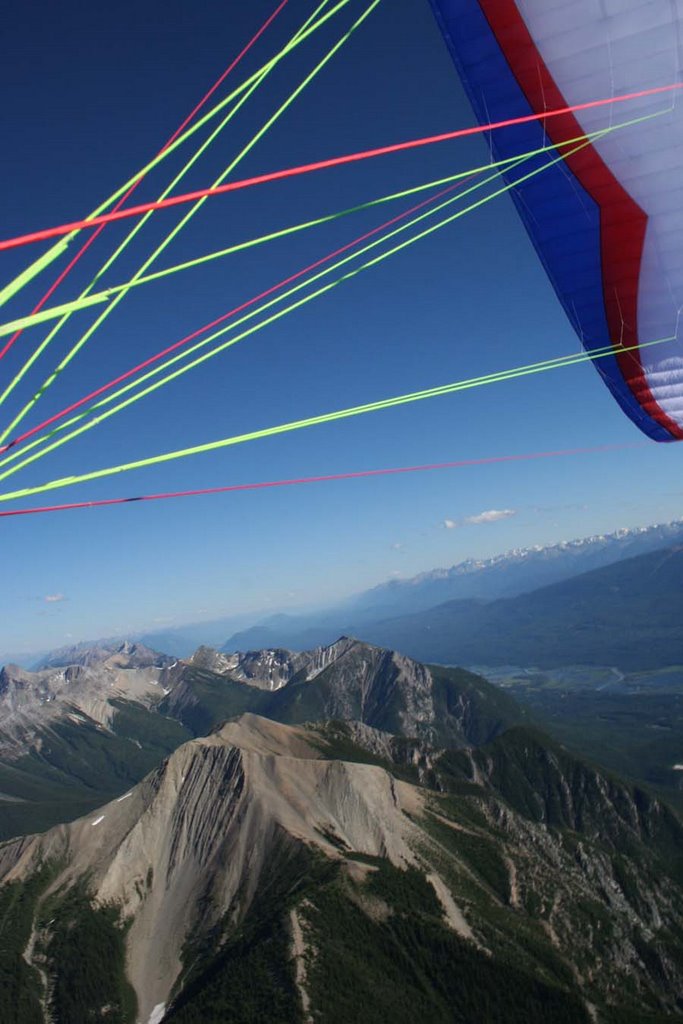
Gin “Glider Family” Notes
I’ve flown Gin gliders exclusively for the last four years. The following are some comments on my experiences with the current Gin “family” of gliders; other pilots may have different impressions, glider preferences and even results seem very pilot-related. I am a Gin Team pilot.
I have 100+ hours on the SM Boom III and a similar amount on the IV, and around 40 on the new M Boomerang Sport. I’ve flown both in all sorts of conditions ranging from light to very strong, mountains and flats. I also have a fair number of hours on the Zoom Race (50+) and Gangster. I’ve also been flying the Beetle tandem some this spring. The gliders are all related, so these notes are written that way.
The Boom IV is the obvious performance benchmark for the family. The IV excels at gliding well at speed–it’s a competition-focused tool. It also climbs well–I can normally get to the top or near the top of the stack on the IV. Brake pressure is stiff and precise, and the whole glider feels very hard in the air. Every single air movement is translated to the pilot, which is great for locating thermals and really feeling the air. This “air feel” is primarily why I prefer to fly comp gliders most of the time. The IV out-glides the old Boom III, especially at higher speeds. The IV prefers to be flown relatively fast in thermals, and is always “in front” of the pilot. It almost never pitches back behind the pilot when encountering thermals or headwind gusts, which makes it go into the wind very well. It requires regular strong input to keep the glider from pitching forward aggressively in strong air, but this is also why it tends to go upwind so well. The IV tends to frontal when it collapses on bar, which is generally a faster recovery than an asym deflation. It also tends to frontal in big collapses in extreme turbulence, again preferable to a big asym. Most frontals are relatively casual even with some bar on, but big asymetrics at speed generally result in excitement and some loss of altitude. At comparable speeds the IV is about as stable as the III, but because it’s faster at 1/2 bar collapses can be more dynamic at similar bar settings—for the first year of flying the IV I’d often look down at my GPS and think, “Am I really going that fast?” The only issue I have with the IV is that the tips get stuck in the lines somewhat easily compared to the II and III. The IV is an “orbit” glider, meaning that it’s best to just set the bank angle and then ride it around instead of constantly adjusting it. A friend called the IV a “sail plane,” that’s a good metaphor.
I had given up flying 2/3 gliders a few years back as all of this class of glider that I’d flown seemed to only offer the performance of a 2 with all the instability of a 3. The 2/3 gliders also didn’t offer very good “feel” for the air, and without the air “feel” I would think the glider was fine and then it would all go to hell, especially on bar. Recovering 2/3s was every bit as entertaining as a 3. For this reason I started flying DHV 2 gliders like the Gangster and the Zoom when I needed something solid for deep wilderness flights (Andes, over the Grand Canyon) or to film and take pictures in the air, and various Boomerangs when I was free flying or competing. I take more collapses flying the 2s because I pay less attention to the air and the wing, but the collapses are benign–on both the Zoom and Gangster I felt confident flying in even very strong conditions with the brakes in one hand and a camera in the other, or both hands off the brakes. I’ve folded the Zoom Race up a few times without the brakes in my hands, no big deal. The Zoom Race offers very respectable performance with a large margin of inherent stability, plus it’s more fun to mess with (wing-overs, acro) than a comp glider, at least for me. The Zoom Race does take proper weight shift control and input to stay open in rough air.
I first flew the new Boomerang Sport while shooting photos with a French friend. I was honestly prepared for another DHV 2/3 that didn’t go all that well compared to a proper comp glider, and yet blew up a lot. My first few flights were into windy strong spring conditions here in the Canadian Rockies–the valleys are already hot, yet the temps aloft are usually below freezing, meaning the lapse rate and thermal strength tend to be high. Right off launch it was clear that the Sport is a new glider–I could feel the air very well despite the “buttery” smooth feeling of the wing. As I thermalled out in rowdy air I thought, “Hey, this feels nice!” On the first glide I pushed half bar and the glide was good; I kept the bar on as I flew into a mild lee, surprisingly the glider stayed open and cut through the chop smoothly. I actually forgot to completely release the speed bar when I connected with the first lee thermal, the glider just felt good on bar and the step-down speed system means the bar pressure is quite low. My 5020 confirms that glide and speed are both better than the Zoom Race and very close to the Boomerang III on most glides.
After many more flights I’ve decided the Sport does three things very well. First, It’s incredibly pitch stable, meaning that it seldom gets “out front” of the pilot, yet it doesn’t lag behind the pilot in thermals or when hitting headwind gusts. I don’t know how Gin and the other designers made these two contradictory factors work, but they did, a first for DHV 2 or 2/3 glider for me. Second, the Sport is also the best coordinated glider I’ve ever flown–set the angle, relax, go up. It’s almost like cheating. Finally, it glides on bar very well–it feels very close to the III in glide up to about half bar, and it’s stable even with a lot of bar on. I can keep the bar at half or more in air that I would have to reduce the bar on the IV in. I’ve done some filming and photography while flying the Sport; at first I was concerned that it would be too hectic to fly one-handed, but it’s solid enough that I’ve sold my Zoom Race, my old “one handed” glider. My French friend, a professional photographer, also uses the Sport as his photo platform while flying one-handed even in strong conditions. That says a lot about both the glider and my friend’s skill flying one-handed…
In short, the Sport has changed my basic opinion of DHV 2/3 gliders from “No” (all the instability of a 3 with the performance of a 2) to a “Yes!” It seems like the first 2/3 with very close to “3” performance and “2” recovery characteristics. I’m considering flying my Sport in my next two competitions—both are at big mountain sites with strong conditions where the glides between thermals can be very turbulent; if I can keep a decent glide with more bar on then I can with my IV then perhaps I can actually fly faster overall? The climb rate seems as good as the IV, so if I can fly faster between thermals then it could be a good solution. I’ve done enough competitions with people on Boom Sports to see that the Sport glides well compared to anything in the sky; it’s annoying to be on a Boom IV and have a Boom Sport keeping pace. I can drop the Sports with more bar, but sometimes I have to get off the bar in choppy air that the Sports can glide through on bar. Maybe this is lack of skill or faith on my part, but either way it makes me wonder if a Boom IV is the best tool for me to go fast at rough sites.
For competitions in relatively humid air (Eastern North America, Europe in general) I’ll continue to fly the IV, same for flatland comps where the climbs are strong but the inter-thermal glides generally OK (Chelan, Texas). Nothing goes like a Boom IV on 3/4 bar!
My only complaint with the Sport is relatively minor; the brakes attach to the riser with magnets, which seemed like a great idea at first. However, the bakes tend to detach from the risers when laying out the glider, and then also re-attach when launching, which is annoying. I like to feel my glider as it comes up, the feeling of the brakes being locked to the risers as I lift the glider feels like a possible brake line knot until the magnets release. I prefer snaps.
The final glider I’ve been flying some is the Gin tandem, the Beetle. I’ve flown a lot of tandems over the years, but my favorite was always the old Merak from about 1997. I’ve wanted a glider that flew like that tandem ever since. The closest tandem I’ve flown to the Merak was the Advance tandem, but the Beetle now takes the place of the Merak in my “best tandem” category. It launches easily (always the first consideration when flying passengers with very inconsistent responses to the command, “RUN!”), has good brake pressure and just flies well. I set my first tandem landing on the Beetle up like I did for my old tandem and found myself much too high; it’s more like a Zoom in terms of glide.
I wrote all this down to help me think about the differences between gliders, if you’ve read all of it you’re persistent, good luck with whatever you fly!
Posted in: Blog
Date: July 9th, 2006
In the last two months I’ve climbed in somewhere around six different gyms due to the travel schedule. I actually really like climbing on plastic and always have. I generally get my ass kicked, but that’s what’s so good about it–on rock I can often trick my way through difficult moves, but plastic strips climbing movement down to its most basic form. Back in the sixties my parents used to joke that one day you would be able to buy hand holds in the climbing stores, their joke is now a fun reality.
I’ve honestly enjoyed every gym I’ve climbed in over the last few months, and have some decent fitness going at the moment thanks to the plastic abuse. Paragliding season normaly leaves me a bit, as my my friend John Winsor says, “Fat and sassy!” but this year the comps have been near good climbing gyms so I’ve at least avoided the fat part. Good gyms share a few features. First is a motivated local scene. We’ve all seen the forlorn climbing walls inside health clubs, abandoned by the clientele and largely ignored. Some gyms inside health clubs, such as Chelsea Piers in NYC, thrive thanks to the local scene. Chelsea has a monster over-hanging wall and a good manager (Les), plus a crew of motivated locals, so it’s going well. The bouldering needs work at Chelsea, but it’ the most entertaining roped climbing I’ve done in a gym of late.
Height isn’t everything–the Vsion, in Canmore, is short like a pygmie but has the best bouldering of any of the gyms I’ve climbed in lately. There is no excuse to walk out of that gym without blasted fingers and arms.
Good gyms also use a comprehensible system to mark holds. My biggest complaint in any gym is a poor hold marking system. This is going to be a controversial statement, but after climbing in dozens of gyms all over the world I’m going to make it: Plain old colored tape is WAY better for marking holds than using holds of the same color, putting colored doo-dads on the bolt heads or any of the other schemes I’ve seen (putting colored pieces of plastic behind the holds so that they stick out is second best in the marking scheme rankings). The colored hold idea sounds great when presented with a box of new bright red holds, but the reality is that using colored holds to set routes limits the creativity of the route setter (there are only so many types of hold per colored set), the number of routes that can go on the wall, and confuses the hell out of climbers. Those bright red holds start to look a lot like the bright orange ones after a few years of thousands of chalky hands grabbing ’em. I spent the last week climbing at a great gym in Montreal (Allez Up!), which has all the requirements of a good gym (great local scene, good staff, good routes, good bouldering) but suffers from using colored holds. I often heard even local climbers arguing about whether or not a hold was “on” the route, that’s just frustrating for the climbers in the gym.
The floor system of a gym is also important, especially for bouldering. My favorite is the huge thick track and field crash pads found in gyms such as Allez-Up and the Calgary Climbing Centre. You can pitch off from even 15 feet up and relax. Second best is thick padded carpet with mobile crash pads, such as is found in the Wall Crawler gym in Atlanta, the Rogue Rock Gym and the Vsion. The problem with mobile crash pads is that you have to move them around, and landing on the edge of a pad can result in a twisted ankle. Pea-sized gravel is actually excellent for crashing into while bouldering and for protecting lead plummets, but turns the air into an Asthma-inducing miasma of chalk dust, gravel dust and who knows what else. Cut-up tires are a nice bit of a recylcing, but the chalk dust tends to settle into the tires and get disturbed each time someone falls on the tires. I also shudder to think what those tire bits are releasing into the gym air.
Health-club style fitness equipment is generally a waste in a gym. Nothing makes you climb better than climbing, and most of the time the bench press in a climbing gym is relegated to holding climbing bags or as a good place to sit between sessions on a boulder problem. Get rid of it. A good pull-up bar and a campus board is about all it takes, but many gyms don’t have a decent pull up bar for working on front levers or just doing pullups.
The staff also counts in a gym; I’d rather have a relatively average climber who checks my belaying skills out and is friendly than a local rock star who can’t be bothered to be friendly to everyone. I’ve seldom had a bad experience with staff in a climbing gym; occasionally someone will recognize me, but often I go through the check-out procedure just like everyone else, and that’s cool with me. I heard through the grapevine that John Bachar once failed the belay test at a gym in San Francisco, I’m always a bit nervous about whether or not I’ve using my ATC in the locally approved manner. Standards vary. Good gyms tend to recognize that lead belaying requires a dynamic response from the belayer, but some gyms still insist on tying the belayer down. That’s OK for top-roping with a fat dude and a small women, but not on a lead wall.
I’ve got some more opinions on climbing gyms, but time to get on a flight back home to Calgary, and the “I fly way too much so I get to sit in a nice chair and drink while I wait for my next flight” lounge is threatening to cut me off the good scotch.
WG
Posted in: Blog
Date: July 9th, 2006
It’s over! It’s been an entertaining week here in Quebec, with lots of good people and adventures. The flying wasn’t very good, but the local scene is great. The hub of the local activities is the school, Distance Vol Libre, or DVL. DVL has a huge LZ with a perfect training hill in the middle of it. Distance Vol Libre has the best infrastructure I’ve ever seen at a paragliding/hang gliding school anywhere in the world, and a great staff of instructors for both HG and PG. I would definitely recommend the school to anyone wanting to learn to fly, I was surprised by the how well-organized the flying scene here is–we don’t hear much about Quebec flying out West, but this place is cool. There’s also a local aerotow operation (thanks for the party the last night!) for HGs, so it’s a one-stop place for all forms of free flight. You can tell a lot about a school by how their ex-students fly–the skill level was very solid here. If you’re ever in Montreal it’s definitely worth checking out.
The non-flying locals are also friendly–yesterday I landed about 4K from goal and ended up drinking beer with a local farmer, which turned into a birthday party. Hanging out in the shade mangling French and drinking beer was a lot of fun, definitely one of the highlights of the competition for me. I was a little bit concerned about my very bad French and the local response, but without exception the people were amused rather than offended by my Franglais. Many people in rural Quebec speak a little English, and if you just try to speak French a bit it all works out. It’s nice to be in a place where the locals don’t all speak better English than I do the local language, I learned a lot (relatively speaking) of French this trip.
Mt. Yamaska is a relatively small (300M) bump surrounded by farm fields, with launches that face all directions. Despite the low height it’s fairly difficult to sink out, the hill is the perfect shape for ridge soaring while waiting for a thermal. The low altitude and high humidity tend to make the air relatively smooth also. We managed to score five tasks, but the average validity of those tasks was under 400 points for the winner. Even that number is high given that validity was artificially inflated on one task because of some scoring technicalities involving turnpoint radi. Anyhow, the local pilots said flying five tasks in a week was good, but I don’t think I’ve ever competed in such random conditions. The scattered scores from each day reflected this–it was frustrating to head out on glide and deck task after task, but that was the norm. The ground and air are very moist, which severly limits the lift. The locals said “normal” conditions are better, but anyplace this green must get a lot of rain normally. We used a relatively low “nominal distance,” 35K, which is meant to be the distance of an average flight. This was obviously set too high as the average flight was about 10K, but you can’t have a competition with a nominal distance of 10K, that’s one thermal… Most of the tasks were decided in two or less thermals–good tasks should involve the pilots making multiple decisions, but the flights here were simply too short to do that.
Bruno Berti won the two tasks that had decent validity and won the meet, congratulations to him. I beleive he is the first Quebecois Canadian Paragliding Champion or at the least the first in the last ten years that I remember, nice one. Although I don’t think much of the conditions for this competition I do respect Bruno’s ability to stay patient and circle in light lift, it’s a skill I find very difficult to apply in a competition.
I ended up second after racing a bit too hard on two days–this is something I’ve done lots of, I’m always over-optimistic about the possibilities for better thermals just down the course line. The reality is that the maximum sustained climb rates here in Quebec were under 2m/s, so you had to be extremely patient–1m/s sustained was about as good as it was likely to get, and because cloud base was so low it only took a short glide to be on the ground. At no point during this competition did we get to race, it was simply a battle of survival to stay in the air. I can do that when it’s not a comp situation, but I need to learn better patience for competition situations in bad conditions. I always think, “There MUST be something better than this just down the course line!” Usually there’s not.
I will come back to Yamaska and fly for sure–I imagine there are amazing days here with good lift and clouds, and the friends I’ve made here would be fun to visit without ever turning a circle in the air. Thanks to Eric Olivier, Mark Dowsett and the many volunteers who gave this competition a great flavour. A special thanks to Sylvie, our heroic driver, who often found us before we found ourselves. Also thanks for the great lunches each day, the hikes to launch (cool path with ropes on the steep parts, we hiked to launch every day, great way to start the day), and the $2 beers in the LZ–it’s all a good memory! I hope to see many of the Quebec pilots out west this summer.
wg
PS–my bud Josh and I have been traveling together as usual, and we’ve had a good time speaking Francais as we see it, which occasionally but not often is how the locals actually hear it. Anyhow, we also had a bet on the last day’s results that inspired me to turn a few more circles in the .5m/s lift–If Josh flew farther than me I had to spend the morning installing software on his new Macbook, if I flew farther he had to apply his bulk to moving large rocks out of my yard. Without that bet I would have landed earlier for sure, so thanks to Josh for the good week, and I look forward to getting those rocks out of my yard, grin…
Posted in: Blog